
 Developer Tools
Templ
Type-safe HTML templating language for Go with compile-time safety
Better Auth is a free, open-source authentication framework for TypeScript that ships with 50+ plugins, 40+ social providers, multi-tenancy, passkeys, 2FA, and SSO — all without a third-party service. Built by Bereket Engida and backed by Y Combinator, it's the most comprehensive self-hosted auth solution for modern web apps.
Better Auth is an open-source, framework-agnostic authentication library for TypeScript that gives you enterprise-grade auth — SSO, passkeys, multi-tenancy, magic links, 2FA — in a single npm package. We rate it 85/100: the strongest free authentication option for TypeScript developers who want full data ownership without the $25/month-per-seat sticker shock of Auth0 or Clerk.
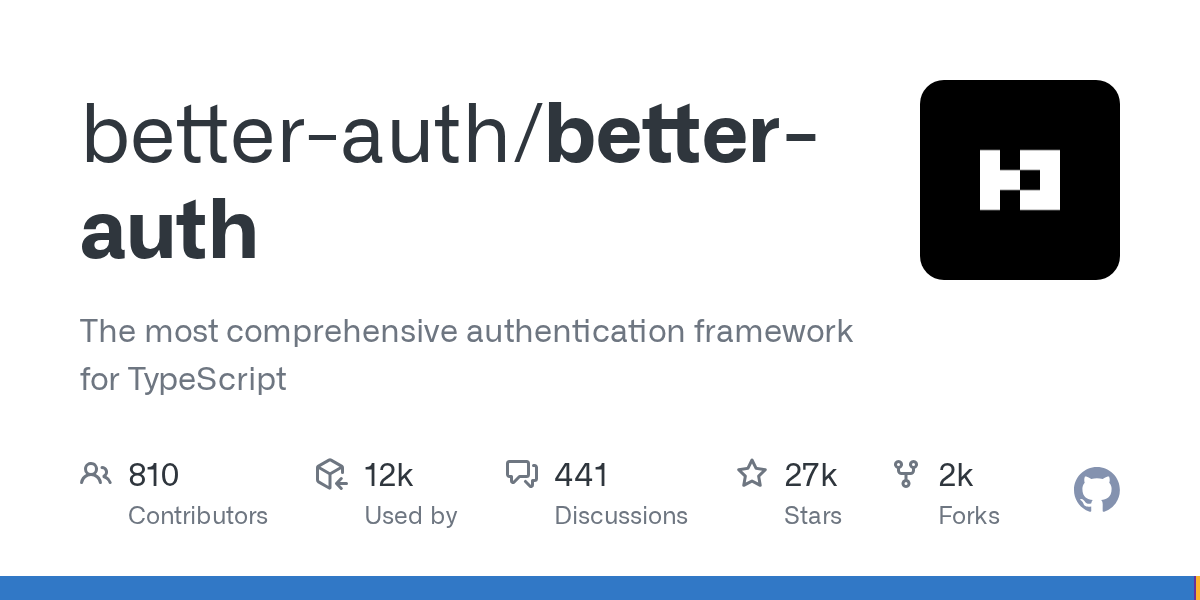
Better Auth was created by Bereket Engida, a self-taught developer from Ethiopia who started programming at 18. He open-sourced the library in and within a year had amassed 27,500+ GitHub stars, 2,400+ forks, and a place in Y Combinator's X25 batch. In June 2025 the company raised a $5 million seed round from Peak XV Partners, Y Combinator, P1 Ventures, and Chapter One — an extraordinary milestone for a developer tooling project that remains MIT-licensed and free.
The core insight behind Better Auth is blunt: existing TypeScript auth solutions force you to either hand your user data to a third-party SaaS (Clerk, Auth0, Stytch) or assemble a patchwork of libraries yourself (NextAuth, Lucia). Better Auth solves both problems — it runs in your own database, ships with an opinionated plugin architecture, and has first-class support for over 20 frameworks including Next.js, Nuxt, SvelteKit, Astro, Hono, and Express.

On Hacker News, Better Auth's Launch HN post attracted hundreds of comments. The most praised quality was developer experience: multiple users reported getting a fully functional auth system with email, social login, and sessions running in under 3 hours — versus days with Passport.js or NextAuth. One commenter wrote: "Been using it for the past 2 weeks, love it. Within 24 hours of reporting a vulnerability it was patched" — a response time that impressed the security-conscious developer community.
The recurring complaints are specific and worth knowing: early adopters flagged missing SCIM support as a deal-breaker for enterprise sales (now being addressed), concerns about venture funding creating future lock-in despite the MIT license (the team has committed to remaining free), and no Firebase/Firestore adapter currently available. On Reddit's r/webdev, the most common praise is the plugin system — developers love that adding passkeys or 2FA is a single line of config rather than a weekend of integration work.
Better Auth the library is completely free and open source under the MIT License with no usage limits, user caps, or features locked behind paid tiers. There is an optional managed cloud dashboard in development (for user management UI and analytics) that will have a paid tier, but the core auth engine will remain free.
| Plan | Price | Notes |
|---|---|---|
| Open Source | $0 forever | All auth features, unlimited users, self-hosted |
| Cloud Dashboard (beta) | TBD | Hosted user management UI — optional add-on |
| Enterprise | Contact | SLA, dedicated support, SCIM provisioning |
Best for: TypeScript-first teams building full-stack web apps with Next.js, SvelteKit, Nuxt, or Astro who want complete data ownership, a generous feature set out of the box, and zero per-seat auth fees. Particularly compelling for B2B SaaS products that need organizations and roles without paying Clerk's $100+/month team pricing.
Not ideal for: Teams on non-TypeScript backends (Ruby on Rails, Django, Laravel), or enterprise buyers who need a fully managed solution with guaranteed uptime SLAs and a vendor support contract. For React Native mobile-first apps, the ecosystem is still maturing. If you rely on Firebase/Firestore as your database, there is no official adapter yet.
Pros:
Cons:
Clerk is the closest managed competitor — polished hosted UI, great DX, but starts at $25/month and your user data lives on their servers. Auth.js (NextAuth) is the incumbent open-source option but requires more assembly, lacks built-in organizations and password auth, and has a less ergonomic plugin model. Supabase Auth is excellent if you're already using Supabase — but ties you to their platform. Better Auth wins on data ownership plus feature completeness for pure TypeScript stacks.
For TypeScript developers, yes — unequivocally. Better Auth is the rare open-source project that covers 90% of what paid auth services offer, ships first-class TypeScript types, and has the momentum (27k+ stars, YC-backed, v1.5.6 in March 2026) to keep improving. The free-forever pricing removes the risk entirely. We rate it 85/100. The 15-point gap is for maturing SCIM/enterprise features and the absence of Firebase support — gaps that will likely close in 2026.
Developer ToolsType-safe HTML templating language for Go with compile-time safety
 Developer Tools
Open-source API key management and rate limiting platform for modern developers
 Developer Tools
Open-source low-code platform for building internal business applications
 Developer Tools
Git-friendly open-source API client for REST, GraphQL, and gRPC
ServiceNow and Accenture Launch Forward Deployed Engineering Program to Scale Agentic AI in the Enterprise (May 6, 2026)
At Knowledge 2026, ServiceNow and Accenture announced a joint forward deployed engineering program that drops co-located engineer pods into customer environments to ship agentic AI workflows natively on the ServiceNow AI Platform — with access to 300+ pre-built agent skills and the AI Control Tower as the governance backbone.
May 7, 2026
ReFiBuy Raises $13.6M Seed to Help Brands Get Recommended by AI Shopping Agents (May 5, 2026)
ReFiBuy, the Raleigh-based agentic commerce platform from ChannelAdvisor founder Scot Wingo, closed an oversubscribed $13.6M seed led by NewRoad Capital Partners on May 5, 2026 — betting that the next billion-dollar e-commerce moat is being chosen by ChatGPT, Claude and Perplexity.
May 7, 2026
OpenAI Replaces ChatGPT's Default Model With GPT-5.5 Instant — 52.5% Fewer Hallucinations, 30% Shorter Answers (May 5, 2026)
OpenAI on May 5 swapped GPT-5.3 Instant for the new GPT-5.5 Instant as ChatGPT's default model, claiming 52.5% fewer hallucinated claims on high-stakes prompts and 30% more concise answers. The model also rolls into the API as chat-latest and adds personalization from Gmail and past chats for Plus and Pro web users.
May 7, 2026
Is this product worth it?
Built With
Compare with other tools
Open Comparison Tool →