 Developer Tools
Templ
Type-safe HTML templating language for Go with compile-time safety
Bun is a drop-in Node.js replacement with a built-in bundler, package manager, and test runner — 4× faster startup, 30× faster installs. Now owned by Anthropic.
Bun is an all-in-one JavaScript and TypeScript toolkit — a single binary that is a runtime, bundler, test runner, and package manager — built in Zig on top of Apple's JavaScriptCore engine, aiming to be a drop-in replacement for Node.js. We rate it 86/100 — for greenfield TypeScript servers, CLIs, and serverless functions it is the fastest and most cohesive choice on the market in 2026; for mission-critical enterprise workloads, Node.js is still the safer default.
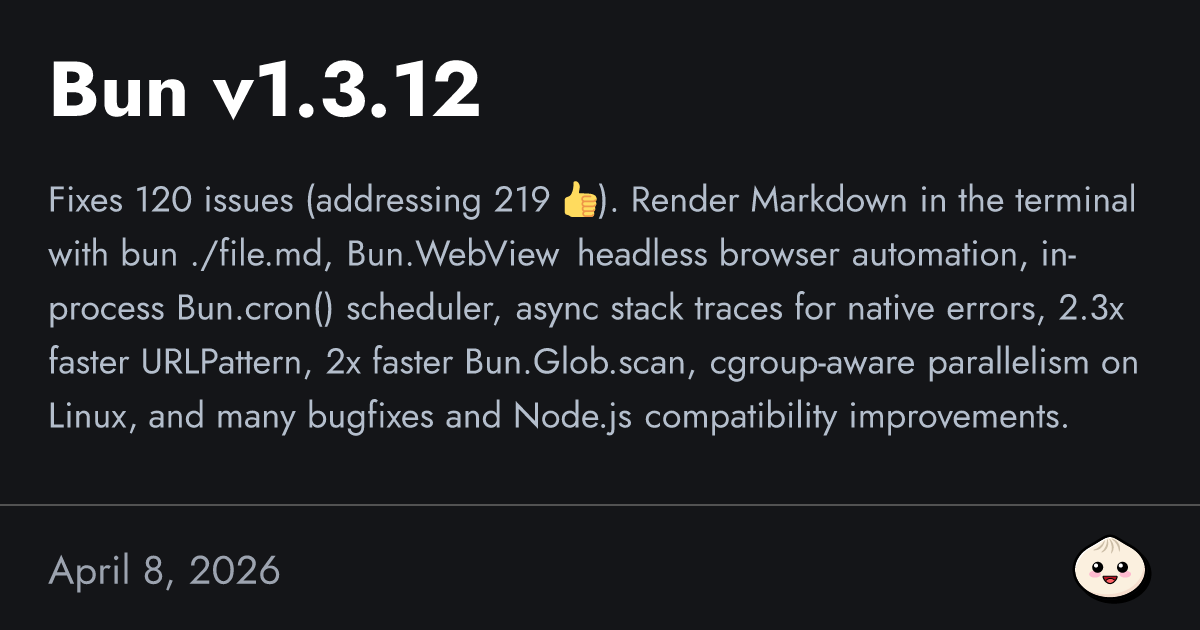
Bun was created by Jarred Sumner and first shown publicly in , with the 1.0 stable release landing on . The current version is Bun v1.3.12, released on , and the GitHub repository has crossed 89,000 stars. On , Anthropic announced it had acquired Oven, the company behind Bun, the same day it disclosed Claude Code had reached a $1B annual run-rate — Bun will remain MIT-licensed and the team has committed publicly to Node.js compatibility as the core product focus.
The specific problem Bun solves is that a typical modern TypeScript project stacks four separate tools (Node, npm/pnpm, Jest/Vitest, esbuild/Vite), each with its own config file and its own performance ceiling. Bun collapses all four into one binary: bun run, bun install, bun test, and bun build share the same process, the same module resolver, and the same TypeScript/JSX transpiler. The practical effect is that a cold bun install in a mid-size repo finishes in under 2 seconds where npm install takes 30–60, and a Bun HTTP server serves 3× the requests per second of the Node equivalent on the same hardware.
fs, http, net, child_process, worker_threads, and the vast majority of npm packages work unchanged. Cold start is ~5ms versus ~60ms for Node, which is the single biggest reason teams switch for serverless functions.bun install on a clean repo with 800 dependencies routinely finishes in 1.5–3 seconds.bun test supports describe/it/expect, snapshots, mocking, and the vi/jest globals unchanged. Tests typically run 5–10× faster than Vitest on the same suite.Bun.build bundles a 10,000-component React app in ~270ms versus ~570ms for esbuild, with native CSS, HTML, and single-file executable output.Bun.serve) that does 2.5M WebSocket messages/second; Bun.password with native bcrypt/argon2; shell scripting via Bun.$; and new in v1.3.12, Bun.WebView for headless browser automation plus an in-process Bun.cron() scheduler.tsc, no ts-node, no babel.config.js — Bun transpiles .ts and .tsx on import with zero configuration. It also imports JSON, TOML, YAML, WebAssembly, and SQL files natively.bun build --compile produces a standalone binary for Linux, macOS (Intel and ARM), and Windows — useful for CLIs you want to ship without requiring users to install Node.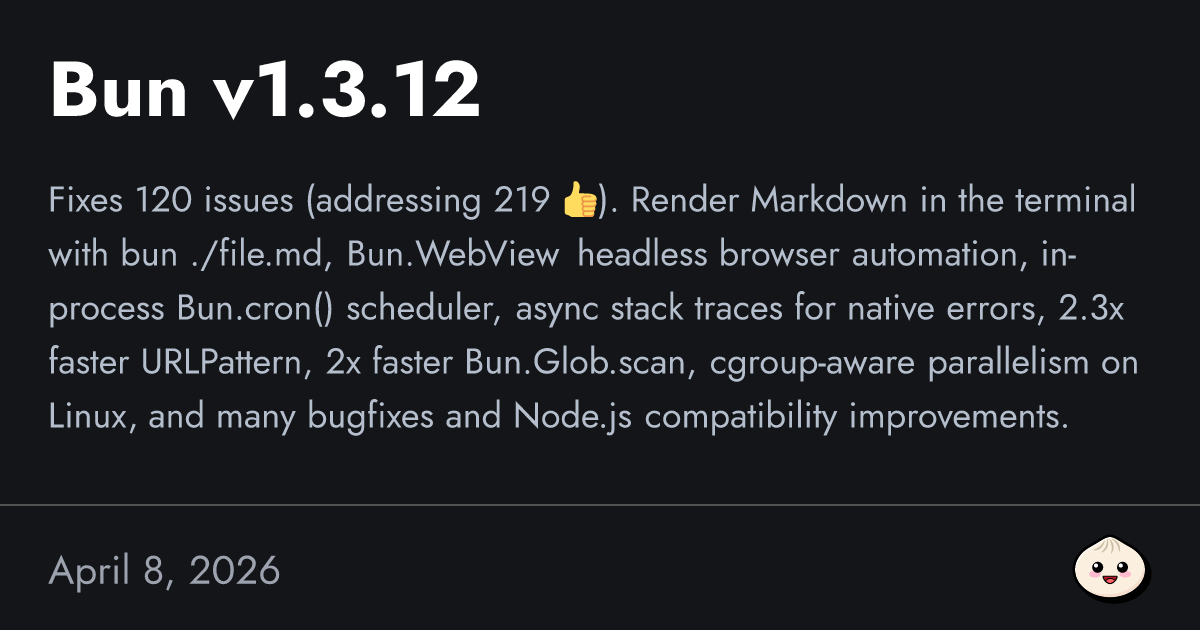
Bun.WebView, in-process Bun.cron(), and cgroup-aware parallelism on Linux.Across Reddit (r/node, r/webdev, r/javascript), Hacker News, and the Bun GitHub issue tracker, the sentiment is split almost exactly along workload lines. The loudest praise comes from people running Bun on serverless platforms (Railway, Vercel, Cloudflare) where the sub-5ms cold start is transformative, and from teams building internal CLIs where the single-file executable replaces a messy pkg/nexe pipeline. Typical comment: "Our install+test CI step went from 3 minutes to 40 seconds — we didn't change anything else."
The honest complaints are equally consistent. First, debugging: multiple production users on r/node and HN report that the --inspect debugger still crashes on breakpoints in complex apps, making serious debugging painful. Second, stability at scale: a widely-upvoted GitHub issue from March 2026 points out that Bun has ~4,900 open issues against ~89k stars — high even adjusting for a bot that auto-closes duplicates — and the author argues Bun isn't yet ready to carry enterprise-grade production weight. Third, ecosystem gaps: some popular packages that rely on undocumented V8 internals still break on JavaScriptCore, though the list shrinks with every release. Fourth, some developers remain wary of the Anthropic acquisition — the team has publicly committed to MIT licensing and Node compatibility, but governance concentration is a real concern.
Bun is 100% free and MIT-licensed. There is no paid tier, no telemetry paywall, no enterprise SKU, and no feature-gated cloud service. You pay only for wherever you host your Bun apps — any Node-compatible host works.
| What | Price | Notes |
|---|---|---|
| Bun runtime + CLI | $0 / MIT | Unlimited projects, unlimited teammates, no feature gates |
| Hosting (serverless) | Provider pricing | Railway, Fly.io, Render, AWS Lambda (with Lambda layer), Vercel — all officially supported |
| Anthropic-related products | Separate | Claude Code is a separate commercial product that happens to be built on Bun — it is not a Bun pricing tier |
Best for: solo developers and small-to-mid-size teams building new TypeScript backends, serverless functions, CLIs, and internal tools where startup latency and build speed directly affect DX or user experience. Teams shipping to Cloudflare Workers-style environments, Railway, or Fly.io see the biggest wins. CI pipelines with heavy install-and-test steps are another clean win.
Not ideal for: large enterprise applications that depend on V8-specific native modules (some observability and APM vendors still ship V8-only agents), teams with strict compliance/audit requirements that need a decade of production hardening, and any application where a single debugger crash on a breakpoint is unacceptable. Node.js LTS remains the right answer there.
Pros:
Cons:
--inspect) is still unreliable on complex apps — confirmed by multiple production users as of April 2026Node.js: still the industry default — slower and more verbose, but has 15 years of production hardening and every library works. Pick Node for risk-averse enterprise workloads.
Deno: the other JavaScriptCore-era runtime-from-scratch. Better security model (permissions), native TypeScript, and Deno Deploy is a first-party edge platform. Bun is faster; Deno has a cleaner standards story.
pnpm + Node + Vite + Vitest: the "best-of-breed Node stack" assembled by hand. Fast and battle-tested, but it's four tools with four configs — which is precisely the pain Bun removes.
For any new TypeScript project in 2026 — especially a serverless function, a CLI, or a mid-size backend — Bun is the pragmatic default. The performance numbers are real, the developer ergonomics are a clear upgrade over Node + npm + Jest + esbuild, and the Anthropic acquisition means the project now has enterprise-scale commercial incentive behind it. The 86/100 rating reflects the remaining debugger and stability rough edges: it's not yet at Node's decade-plus reliability bar, but it is production-ready for most teams and it is clearly the fastest-moving runtime in the space.
ServiceNow and Accenture Launch Forward Deployed Engineering Program to Scale Agentic AI in the Enterprise (May 6, 2026)
At Knowledge 2026, ServiceNow and Accenture announced a joint forward deployed engineering program that drops co-located engineer pods into customer environments to ship agentic AI workflows natively on the ServiceNow AI Platform — with access to 300+ pre-built agent skills and the AI Control Tower as the governance backbone.
May 7, 2026
ReFiBuy Raises $13.6M Seed to Help Brands Get Recommended by AI Shopping Agents (May 5, 2026)
ReFiBuy, the Raleigh-based agentic commerce platform from ChannelAdvisor founder Scot Wingo, closed an oversubscribed $13.6M seed led by NewRoad Capital Partners on May 5, 2026 — betting that the next billion-dollar e-commerce moat is being chosen by ChatGPT, Claude and Perplexity.
May 7, 2026
OpenAI Replaces ChatGPT's Default Model With GPT-5.5 Instant — 52.5% Fewer Hallucinations, 30% Shorter Answers (May 5, 2026)
OpenAI on May 5 swapped GPT-5.3 Instant for the new GPT-5.5 Instant as ChatGPT's default model, claiming 52.5% fewer hallucinated claims on high-stakes prompts and 30% more concise answers. The model also rolls into the API as chat-latest and adds personalization from Gmail and past chats for Plus and Pro web users.
May 7, 2026
Is this product worth it?
Built With
Compare with other tools