
 Developer Tools
Templ
Type-safe HTML templating language for Go with compile-time safety
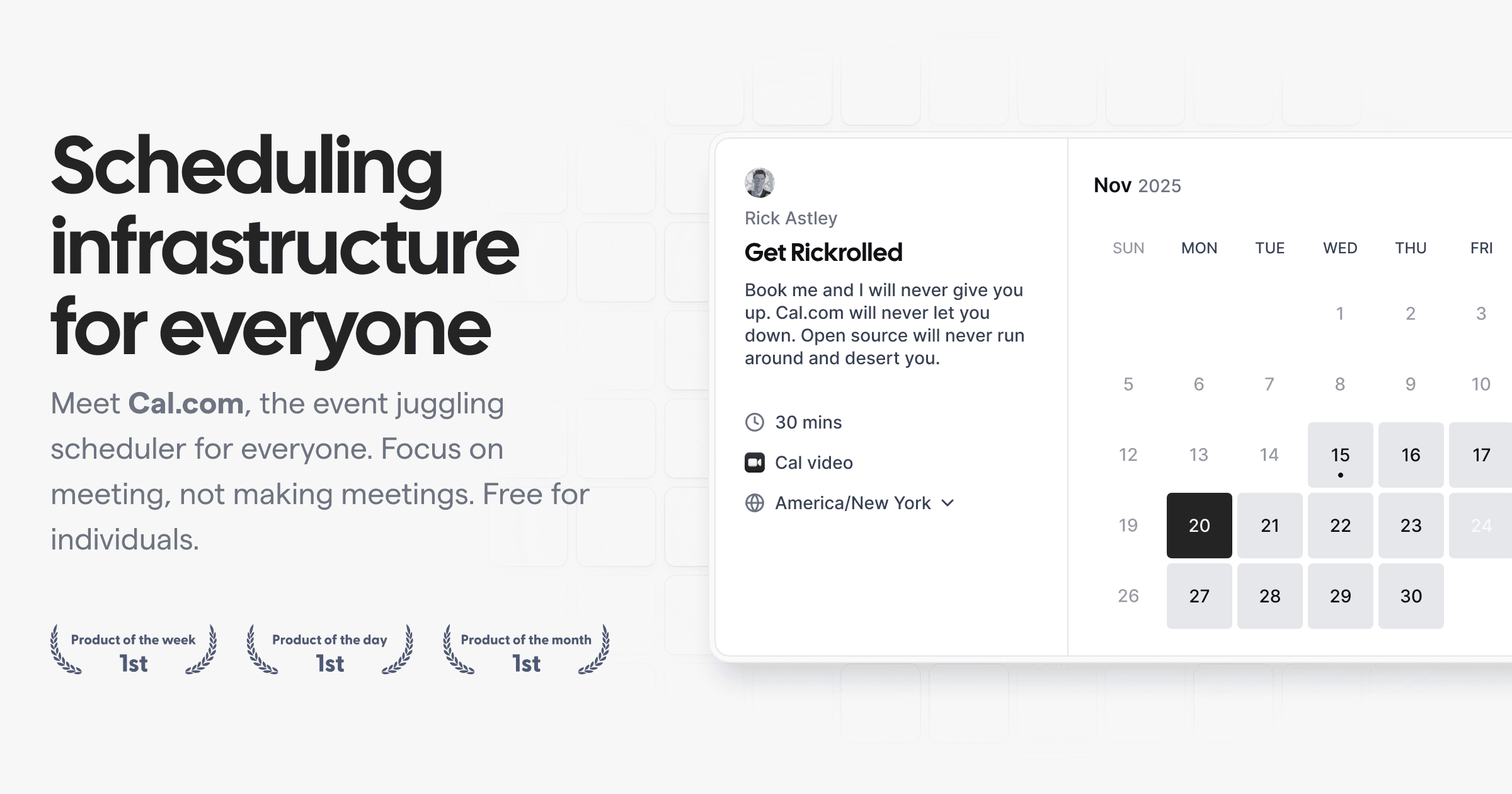
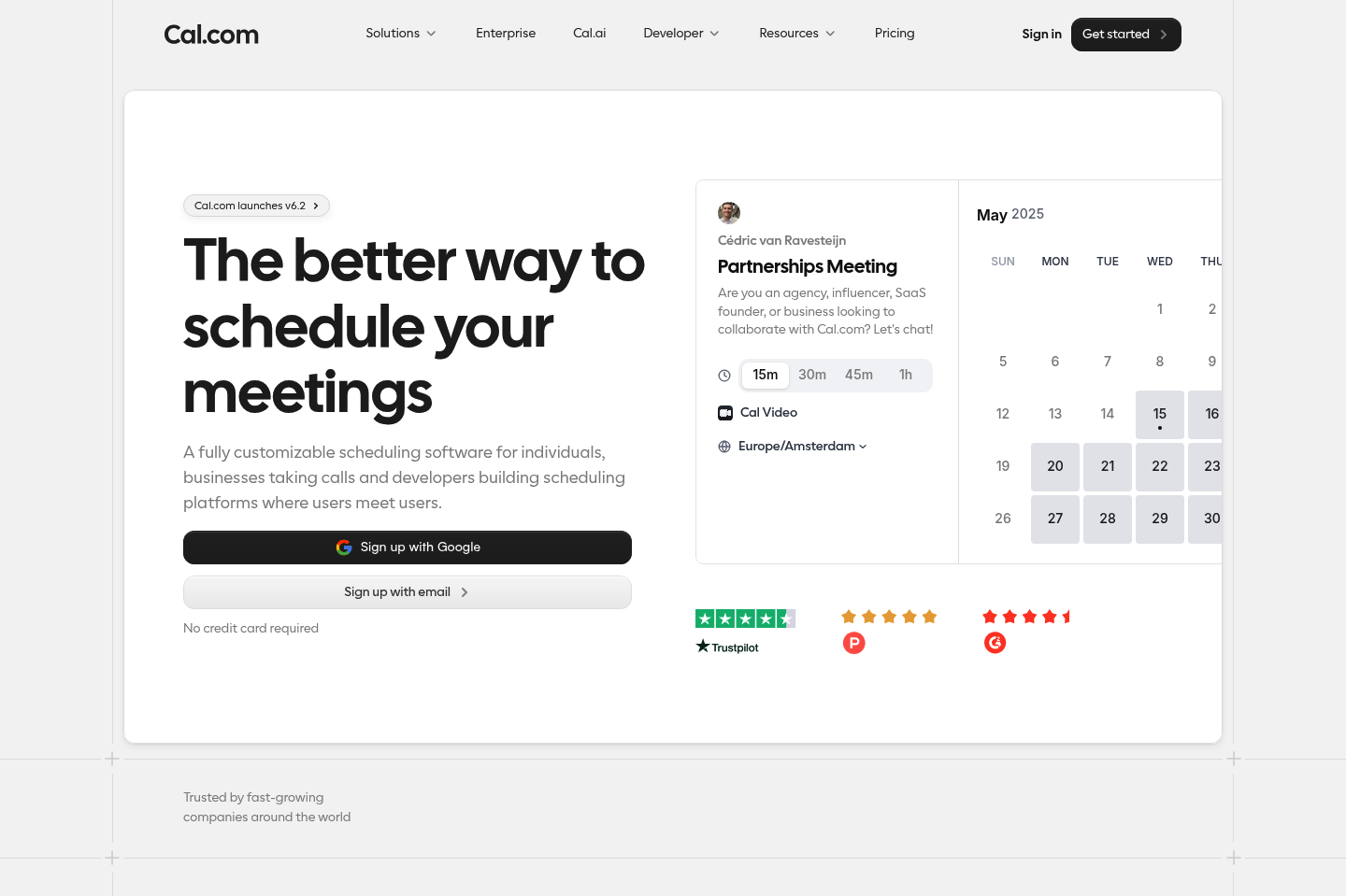
Cal.com is the open-source Calendly alternative with 40,900+ GitHub stars, giving individuals and teams full scheduling control with self-hosting support, a genuinely free plan, and 65+ integrations. From solo freelancers to Fortune 500 companies, it scales with enterprise-grade compliance at developer-friendly prices.
Cal.com is an open-source scheduling platform that lets individuals, teams, and enterprises manage bookings and meeting availability without surrendering data to a closed SaaS vendor. We rate it 80/100 — an excellent Calendly alternative for developers and teams who value ownership, flexibility, and a genuinely generous free tier.
Cal.com (formerly Calendso) was founded by Peer Richelsen and Bailey Pumfleet and launched on as the open-source answer to Calendly's closed ecosystem. The GitHub repository has accumulated over 40,900 stars, making it one of the most-starred scheduling projects in existence. At its core, Cal.com provides a scheduling link you share with anyone — but unlike Calendly, you can self-host it on your own infrastructure, customize every aspect of the interface, and connect it via a fully documented REST API.
Cal.com operates a hosted cloud version while maintaining the AGPLv3-licensed open-source codebase. It is scheduling infrastructure — a platform on which developers can build their own booking products.

On Reddit's r/selfhosted and r/webdev, Cal.com receives consistent praise for flexibility and its generous free tier. The most recurring complaint is self-hosting complexity — multiple threads describe the Docker setup as requiring significant DevOps knowledge. On Product Hunt, where Cal.com earned #1 Product of the Month, early adopters praised Calendly-level features at zero cost. G2 reviewers highlight customization depth and smooth Google Calendar integration as top strengths. The recurring critique on G2 and Trustpilot is that Microsoft Exchange and Outlook Calendar sync can be unreliable. The original Hacker News launch thread hit #1, with technical users validating that the AGPLv3 license genuinely protects the open-source model.
| Plan | Price | Key Limits |
|---|---|---|
| Free | $0/month | 1 user, unlimited event types & bookings, all 65+ integrations |
| Teams | $12/user/month (annually) | Round-robin routing, booking analytics, Cal Video recording |
| Organizations | $28/user/month (annually) | Unlimited sub-teams, SAML SSO, SOC 2, HIPAA, ISO 27001 |
| Enterprise | Custom | Dedicated support, SLA guarantees, HRIS integrations, dedicated database |
Annual billing saves 25%. Self-hosting is free under AGPLv3, though server costs typically run $5–$50/month on a VPS like DigitalOcean or Hetzner.
Best for: Solo developers and freelancers wanting Calendly-grade scheduling at $0; small and mid-size teams needing round-robin booking and analytics; privacy-conscious organizations requiring HIPAA or SOC 2 compliance; companies embedding scheduling into their own product via the Cal.com API.
Not ideal for: Non-technical users who need plug-and-play scheduling with minimal setup — Calendly's onboarding is more approachable. Organizations deeply embedded in Microsoft 365 may face more sync friction than with Microsoft Bookings.
Pros:
Cons:
Calendly is the market leader with more polished onboarding and deeper enterprise integrations, but no self-hosting, no open-source code, and higher pricing for equivalent team features. Tidycal (AppSumo) offers lifetime deal pricing but significantly fewer integrations and no API depth. Microsoft Bookings integrates natively with Microsoft 365 and is often included in existing subscriptions — the better choice for Microsoft-heavy organizations.
For individual users, Cal.com is a clear win at $0 — delivering more customization, more integrations, and more control than any other free scheduling tool on the market. For teams, the $12/user/month Teams plan is competitive with Calendly while providing open-source peace of mind. For compliance-sensitive organizations, $28/user/month delivers HIPAA and SOC 2 at pricing that undercuts many competitors. The only real hesitation points are self-hosting complexity and occasional Microsoft sync issues. We rate Cal.com 80/100.
ServiceNow and Accenture Launch Forward Deployed Engineering Program to Scale Agentic AI in the Enterprise (May 6, 2026)
At Knowledge 2026, ServiceNow and Accenture announced a joint forward deployed engineering program that drops co-located engineer pods into customer environments to ship agentic AI workflows natively on the ServiceNow AI Platform — with access to 300+ pre-built agent skills and the AI Control Tower as the governance backbone.
May 7, 2026
ReFiBuy Raises $13.6M Seed to Help Brands Get Recommended by AI Shopping Agents (May 5, 2026)
ReFiBuy, the Raleigh-based agentic commerce platform from ChannelAdvisor founder Scot Wingo, closed an oversubscribed $13.6M seed led by NewRoad Capital Partners on May 5, 2026 — betting that the next billion-dollar e-commerce moat is being chosen by ChatGPT, Claude and Perplexity.
May 7, 2026
OpenAI Replaces ChatGPT's Default Model With GPT-5.5 Instant — 52.5% Fewer Hallucinations, 30% Shorter Answers (May 5, 2026)
OpenAI on May 5 swapped GPT-5.3 Instant for the new GPT-5.5 Instant as ChatGPT's default model, claiming 52.5% fewer hallucinated claims on high-stakes prompts and 30% more concise answers. The model also rolls into the API as chat-latest and adds personalization from Gmail and past chats for Plus and Pro web users.
May 7, 2026
Is this product worth it?
Built With
Compare with other tools
Open Comparison Tool →