 Developer Tools
Templ
Type-safe HTML templating language for Go with compile-time safety
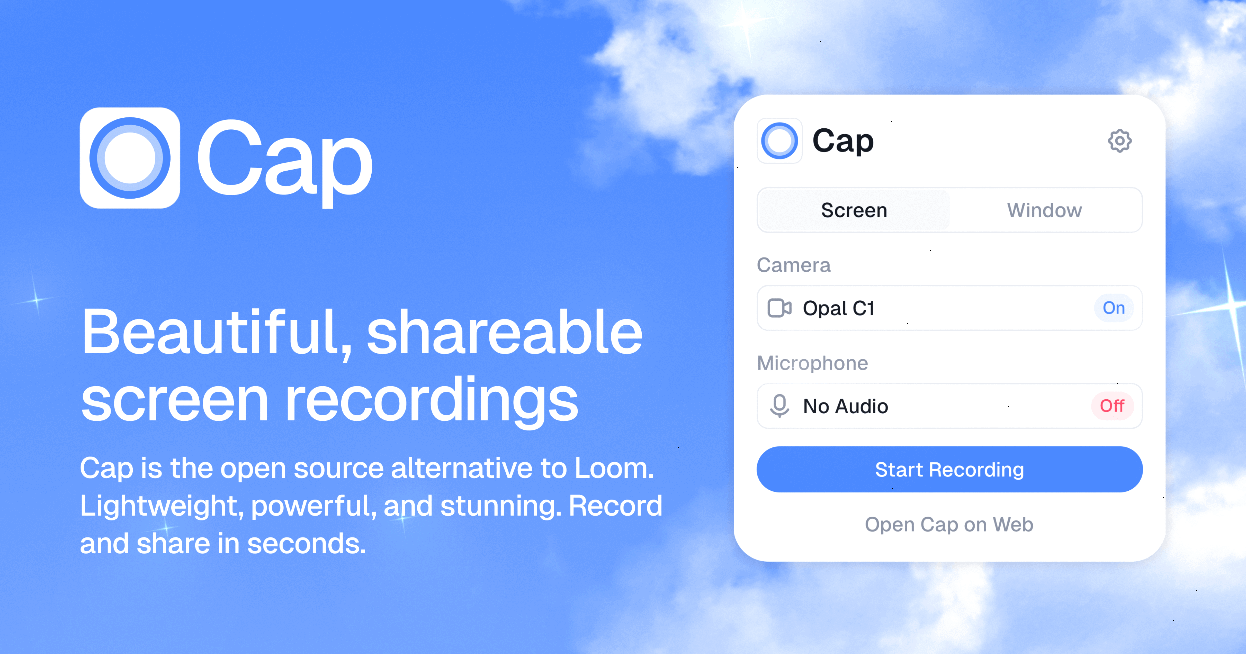
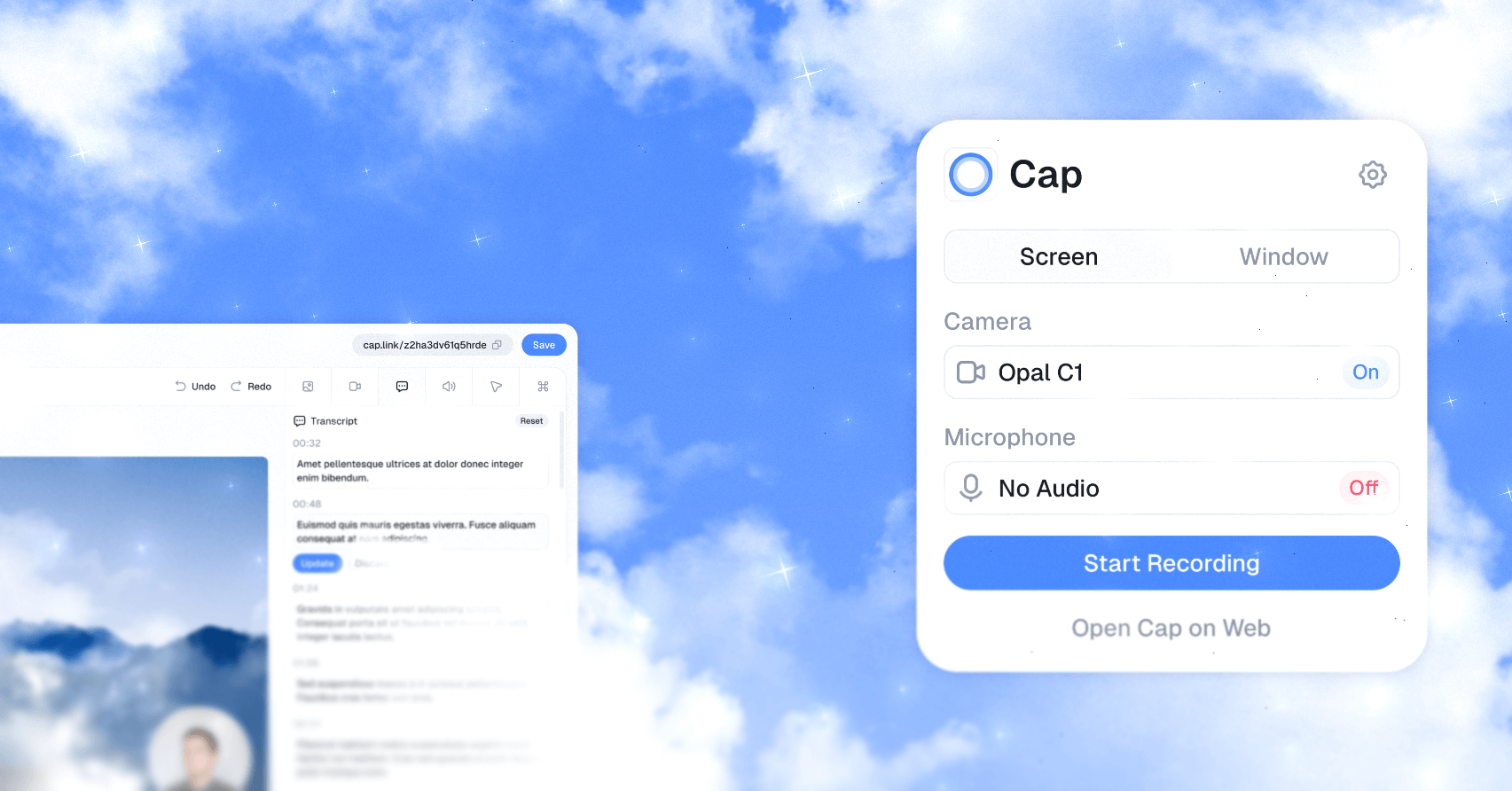
Cap is an open-source, local-first Loom alternative for Mac and Windows with a Studio editor, AI transcripts, and self-hosting support. Pro starts at $8.16/month — roughly half the price of Loom.
Cap is an open-source, local-first screen recorder for macOS and Windows that aims to replace Loom for product demos, async updates, and quick bug reports. We rate it 84/100 — the most polished open-source Loom alternative on the market in 2026, provided you can live with a young-but-fast-moving cloud backend and a Pro plan that still feels early compared to Loom's mature sharing features.
Cap is a screen-recording and video-messaging tool built by Cap Software, Inc., founded by Richie McIlroy — a serial micro-SaaS builder out of Liverpool, UK who raised a pre-seed round to turn Cap from a side project into a company. The project lives at github.com/CapSoftware/Cap with 18,300+ GitHub stars, a Rust + Tauri desktop app, a Next.js web app, and a dual MIT/AGPLv3 license. The latest public release at time of writing is v0.4.84, shipped on .
The pitch is simple: record your screen at up to 4K/60fps, get an instant shareable link or a full Studio editor, and choose whether your video lives on Cap's cloud, your own S3 bucket, or your own self-hosted Cap server. Nothing is forced through somebody else's SaaS — that is the entire point.
docker compose up -d on any VPS gives you a full Cap server. Railway and Coolify one-click templates are official.scap) and uses native OS APIs, so even long recordings stay small and CPU-light compared to Electron-based competitors.cap.yourdomain.com, which matters if you send recordings to customers.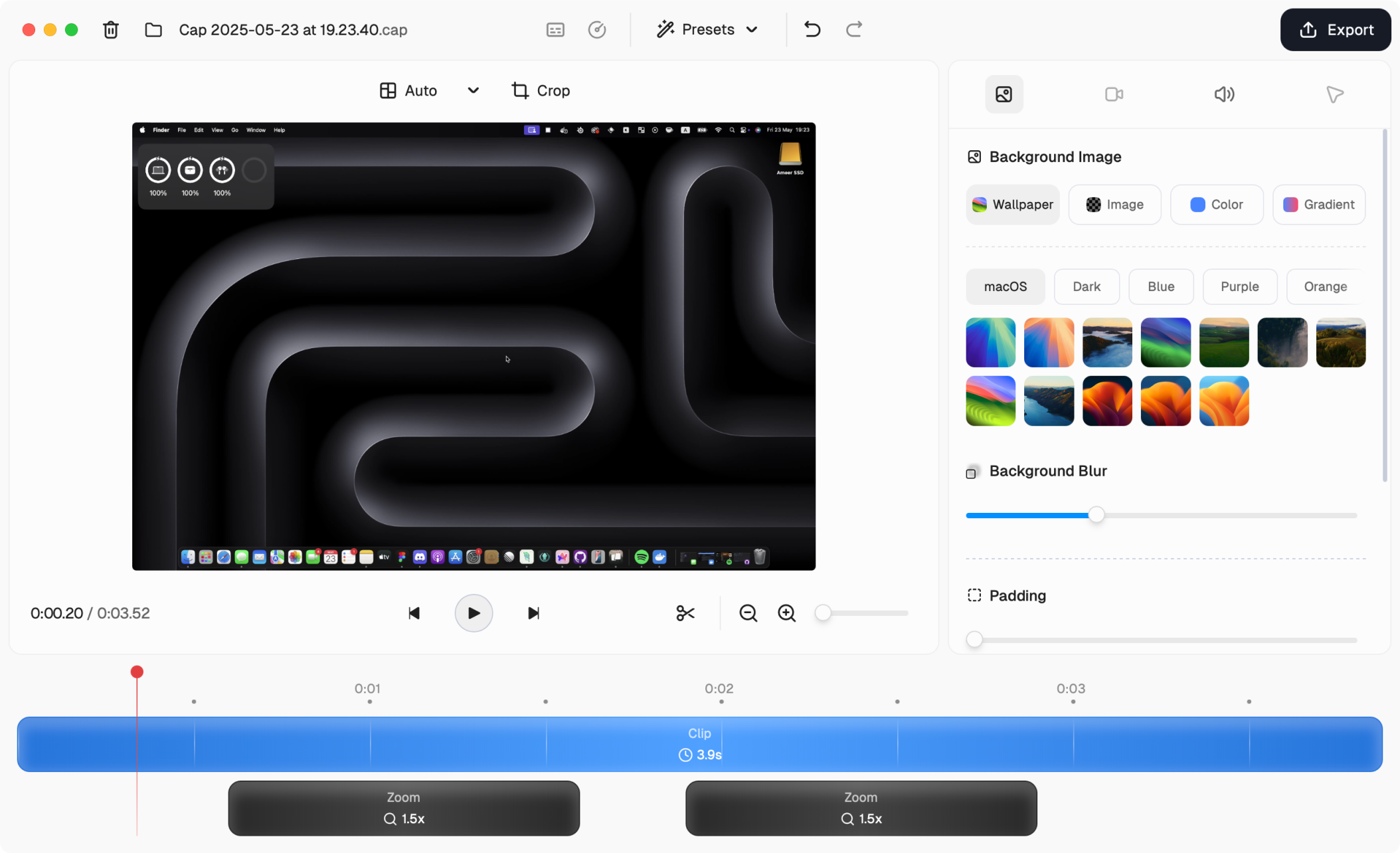
Public sentiment is unusually warm for a v0.x open-source app. On the Cap GitHub repo, bug reports get triaged in hours — multiple users on r/opensource and r/macapps describe reporting a bug and receiving a signed build within the same day. Testimonials pulled from the public landing page include “hands down one of the best OSS I’ve used, so much so I’ve uninstalled Loom and Screen Studio” and “that UI is so polished — between the open source code, self-hosted vids, editing features and price point, gonna give Loom some competition.”
The recurring critical notes are honest ones: the cloud dashboard is still catching up to Loom on commenting, viewer analytics, and folder management, and the Windows build trails the Mac build by a release or two on new features. None of these are blockers if you mainly care about capture quality and ownership.
| Plan | Price | Key Limits |
|---|---|---|
| Free | $0 | Unlimited local recordings, shareable links up to 5 minutes, community support |
| Desktop License | $58 lifetime or $29/year | Commercial rights, full Studio editor, MP4/GIF export, 5-minute share links |
| Cap Pro | $8.16/user/month (annual) or $12/user/month (monthly) | Unlimited cloud storage and link length, AI titles/transcripts/chapters/summaries, custom domain, shared team spaces, Loom importer |
| Enterprise | Custom | SAML SSO, managed self-hosting, bulk discounts, SLAs, priority support |
Against Loom's $18/month Business plan, Pro is roughly 55% cheaper per seat annually — and that is before you factor in the one-time Desktop License, which has no Loom equivalent.
Best for: solo developers, indie founders, small engineering and design teams who already pay for Loom and resent the Atlassian-era price hikes; privacy-conscious consultants who need to keep client recordings on their own S3; and anyone building inside a regulated company that bans third-party video SaaS.
Not ideal for: large sales or CS teams that depend on Loom's viewer analytics, engagement reports, and deep Slack/Salesforce integrations — Cap's cloud is catching up but is not there yet. Also not ideal for pure Linux-only shops: there is no first-party Linux desktop build at the time of writing.
Pros:
Cons:
Loom remains the incumbent and still has the best collaboration layer, but it is now an Atlassian product and costs $18/user/month. Screen Studio is a beautiful Mac-only editor with no cloud layer and a $229 lifetime price. tl;dv focuses on meeting recording with AI, not ad-hoc loom-style videos. If you want open source and can live without a polished desktop app, Windmill-style self-hosters sometimes pair OBS with a homegrown web player — it works, but it is not this pleasant.
If you already pay for Loom and you don't depend on its enterprise analytics, Cap is the easiest switch we have recommended in 2026: same core workflow, better capture quality on Mac, half the price, and the option to self-host when compliance asks. If you are a greenfield team that just needs to send product demos to customers or async updates to your team, start with the free Desktop License, upgrade to Pro when you need AI features, and keep the self-host escape hatch in your back pocket. Rating: 84/100.
cap-camera* and scap-*) are MIT-licensed and the rest of the project is AGPLv3. The full source is at github.com/CapSoftware/Cap, and self-hosting is a single docker compose up -d command.ServiceNow and Accenture Launch Forward Deployed Engineering Program to Scale Agentic AI in the Enterprise (May 6, 2026)
At Knowledge 2026, ServiceNow and Accenture announced a joint forward deployed engineering program that drops co-located engineer pods into customer environments to ship agentic AI workflows natively on the ServiceNow AI Platform — with access to 300+ pre-built agent skills and the AI Control Tower as the governance backbone.
May 7, 2026
ReFiBuy Raises $13.6M Seed to Help Brands Get Recommended by AI Shopping Agents (May 5, 2026)
ReFiBuy, the Raleigh-based agentic commerce platform from ChannelAdvisor founder Scot Wingo, closed an oversubscribed $13.6M seed led by NewRoad Capital Partners on May 5, 2026 — betting that the next billion-dollar e-commerce moat is being chosen by ChatGPT, Claude and Perplexity.
May 7, 2026
OpenAI Replaces ChatGPT's Default Model With GPT-5.5 Instant — 52.5% Fewer Hallucinations, 30% Shorter Answers (May 5, 2026)
OpenAI on May 5 swapped GPT-5.3 Instant for the new GPT-5.5 Instant as ChatGPT's default model, claiming 52.5% fewer hallucinated claims on high-stakes prompts and 30% more concise answers. The model also rolls into the API as chat-latest and adds personalization from Gmail and past chats for Plus and Pro web users.
May 7, 2026
Is this product worth it?
Built With
Compare with other tools
Open Comparison Tool →