 Developer Tools
Templ
Type-safe HTML templating language for Go with compile-time safety
Convex is a reactive backend platform with a built-in database, TypeScript functions, and real-time sync out of the box. We rate it 85/100 — the most polished developer experience in backend-as-a-service today.
Convex is a reactive backend platform that combines a serverless database, TypeScript server functions, and live-updating client libraries into one integrated stack. We rate it 85/100 — the most cohesive developer experience in backend-as-a-service today, with one big asterisk: you're buying into their TypeScript-first abstractions, not standard SQL.
Convex was founded in 2021 by Jamie Turner (ex-Dropbox Engineering Director), James Cowling, and Sujay Jayakar, with a team of engineers who previously built sync and storage systems at Dropbox. The company raised a , publicly launched in , and open-sourced the core backend in 2024.
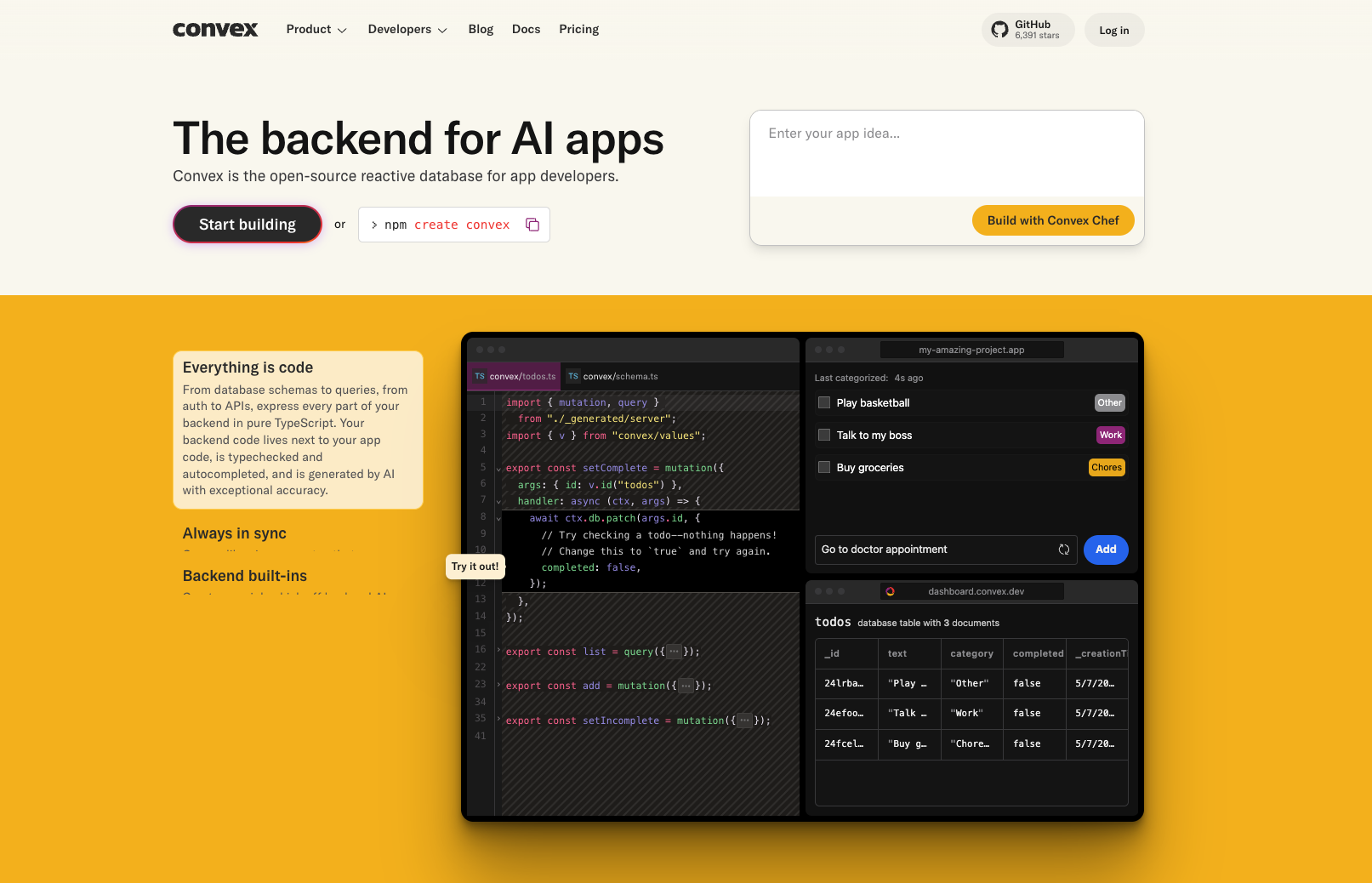
The core pitch is that most apps spend 80% of their backend effort on boilerplate: caching, WebSocket glue, REST endpoints, cache invalidation, and optimistic updates. Convex collapses all of that into one model — you write a TypeScript query function, and any client that reads from it automatically re-renders when the data changes. No React Query, no Redux, no WebSocket provider, no serverless endpoint boilerplate.


Developer sentiment is consistently strong, especially from indie and small-team builders. On Product Hunt Convex holds a 5.0/5.0 rating across 40+ reviews, with praise concentrated on onboarding speed, clear docs, and responsive founders. On Reddit (r/nextjs, r/reactjs) and Hacker News, the dominant sentiment is that Convex "makes backend work feel simpler" and "just works" for reactive apps replacing Firebase or handwritten WebSocket setups.
The most common complaints are real, though: you learn Convex's abstractions instead of SQL, heavy analytic or map-reduce queries still need a separate warehouse, and the compute-time pricing on long-running functions can surprise teams that spawn a lot of background work. A vocal minority site at convex.sucks catalogs edge cases — worth reading before committing on an enterprise project. The fair summary: excellent for greenfield TypeScript apps; a tougher fit if you need portable SQL or self-serve dashboards for non-engineers.
Convex offers a permanent free tier with no credit card required, then scales via a per-developer Professional plan and a custom-quoted Business/Enterprise plan. Overage on all paid plans is pay-as-you-go.
| Plan | Price | Key Limits |
|---|---|---|
| Free & Starter | $0/month | 1–6 devs, 1M function calls/mo, 0.5 GB DB, 1 GB files, 20 GB-h compute, 30-day log retention |
| Professional | $25/developer/month | Up to 20 devs, 25M calls/mo, 50 GB DB, 100 GB files, 250 GB-h compute, daily backups, SOC 2 / HIPAA reports, custom domains |
| Business & Enterprise | From $2,500/month | 50+ devs, unlimited deployments, SSO/SAML, fine-grained permissions, dedicated infra, SLAs, enterprise support |
Overage pricing: additional function calls are billed at roughly $2 per 1M calls, DB storage at $0.20/GB/month, and action compute in GB-hours. Startup discounts and an open-source program offer the Professional tier free for qualifying teams.
Best for: TypeScript-native teams building real-time, multiplayer, or AI-agent apps (chat, collaborative editors, dashboards, live multiplayer games, LLM chat UIs). Solo developers and 2–5 person startups get the most leverage — Convex replaces Supabase + a realtime layer + a jobs system with one SDK, and the free tier comfortably covers early-stage projects.
Not ideal for: Teams with heavy SQL reporting or BI requirements (you'll still need a warehouse), Python/Go/Ruby shops (the first-class SDK story is TypeScript-only), regulated enterprises that require full on-premise deployment without any SaaS coupling, and anyone who wants to stay close to Postgres for portability.
Pros:
Cons:
The closest alternatives are Supabase (open-source Postgres with realtime — more portable, less integrated), Firebase (Google's original reactive backend — larger ecosystem, weaker TypeScript story), and Neon (serverless Postgres — only a database, not a full backend). For pure AI-backend needs, PocketBase is a lightweight self-hosted alternative worth comparing, and Trigger.dev handles the durable-workflow piece without the full backend.
Yes, for the right team. If you're building a reactive TypeScript app and you value developer experience more than having a SQL escape hatch, Convex is the best-in-class option in 2026. The 85/100 rating reflects outstanding DX, a genuinely differentiated sync model, and a real open-source backstop, docked for the non-trivial lock-in, the TypeScript-only client story, and the compute-heavy pricing that catches some teams off guard. Start on the free tier — you'll know within a weekend whether Convex's abstractions click for your workflow.
ServiceNow and Accenture Launch Forward Deployed Engineering Program to Scale Agentic AI in the Enterprise (May 6, 2026)
At Knowledge 2026, ServiceNow and Accenture announced a joint forward deployed engineering program that drops co-located engineer pods into customer environments to ship agentic AI workflows natively on the ServiceNow AI Platform — with access to 300+ pre-built agent skills and the AI Control Tower as the governance backbone.
May 7, 2026
ReFiBuy Raises $13.6M Seed to Help Brands Get Recommended by AI Shopping Agents (May 5, 2026)
ReFiBuy, the Raleigh-based agentic commerce platform from ChannelAdvisor founder Scot Wingo, closed an oversubscribed $13.6M seed led by NewRoad Capital Partners on May 5, 2026 — betting that the next billion-dollar e-commerce moat is being chosen by ChatGPT, Claude and Perplexity.
May 7, 2026
OpenAI Replaces ChatGPT's Default Model With GPT-5.5 Instant — 52.5% Fewer Hallucinations, 30% Shorter Answers (May 5, 2026)
OpenAI on May 5 swapped GPT-5.3 Instant for the new GPT-5.5 Instant as ChatGPT's default model, claiming 52.5% fewer hallucinated claims on high-stakes prompts and 30% more concise answers. The model also rolls into the API as chat-latest and adds personalization from Gmail and past chats for Plus and Pro web users.
May 7, 2026
Is this product worth it?
Built With
Compare with other tools
Open Comparison Tool →