 Developer Tools
Templ
Type-safe HTML templating language for Go with compile-time safety
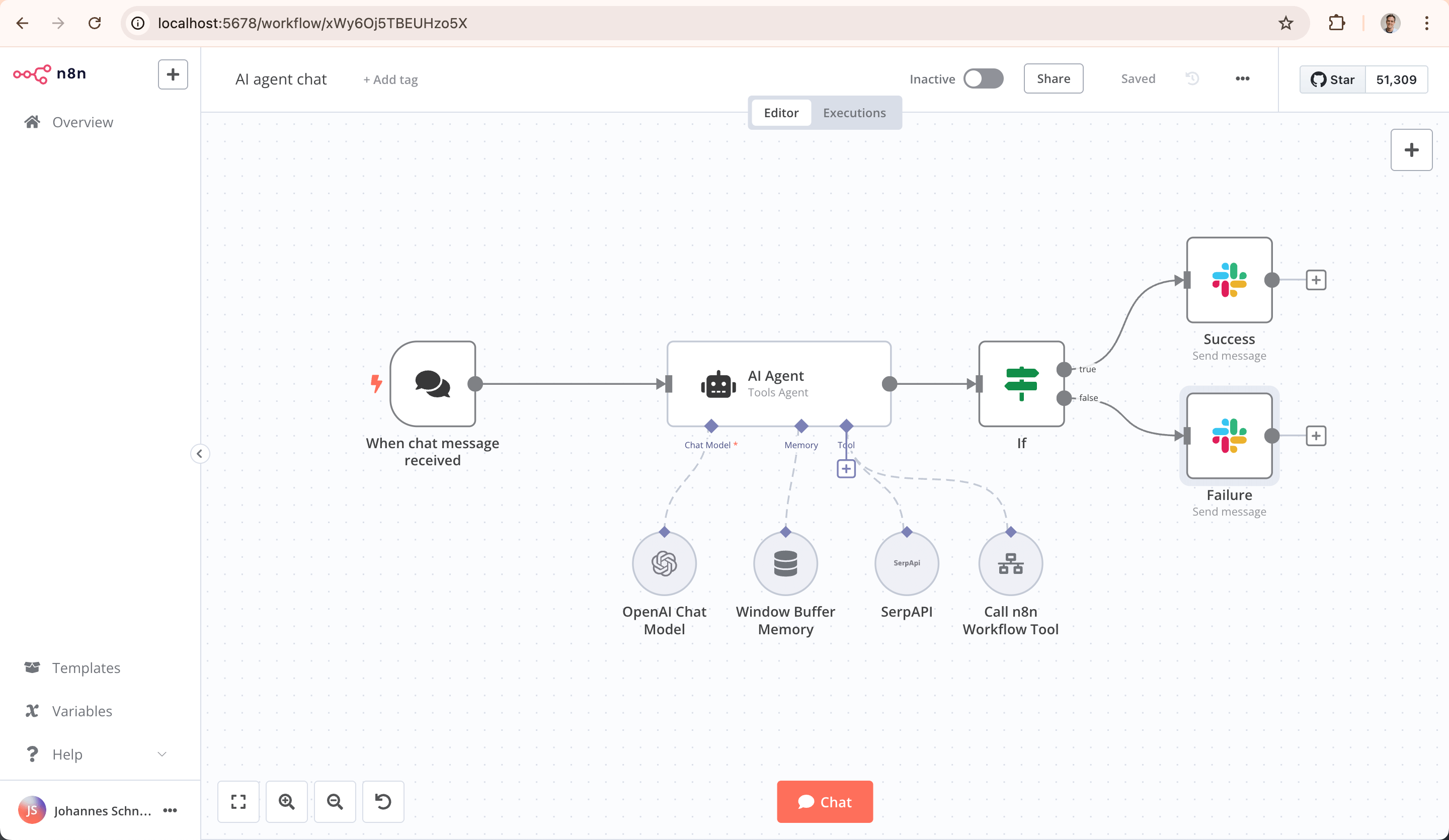
n8n is a fair-code workflow automation platform combining visual no-code building with full custom code support and native AI. Self-host free with unlimited executions, or use managed cloud from €24/mo.
n8n is a fair-code workflow automation platform that uniquely blends visual no-code building with the full power of custom JavaScript and Python — all deployable on your own servers at zero cost. We rate it 81/100 — an outstanding choice for technical teams, developers, and power users who want Zapier's convenience without Zapier's pricing ceiling or data lock-in.
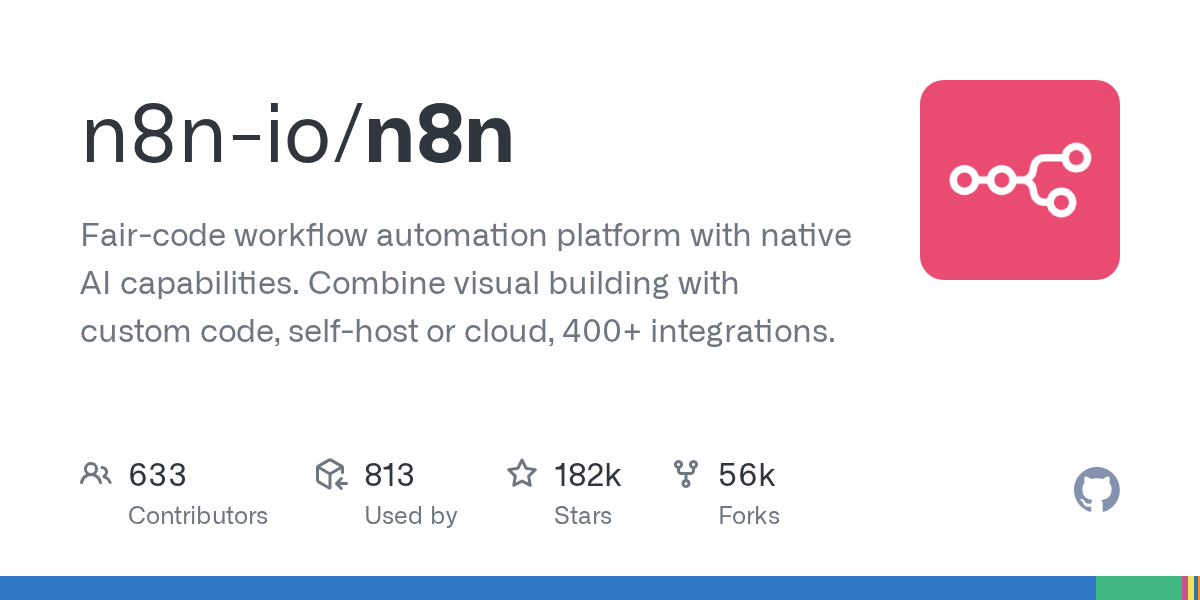
n8n (pronounced "n-eight-n") was created by Jan Oberhauser and first open-sourced on GitHub on . Originally a personal side project, it has grown into one of the most popular workflow automation platforms in the world, accumulating over 181,000 GitHub stars and 56,000+ forks — one of the largest community followings for any automation tool. The company behind it, n8n GmbH, is headquartered in Berlin and has raised venture funding to support its commercial cloud offering while keeping the core self-hosted engine free.
The core insight that makes n8n different: most automation tools charge per workflow execution, which creates unpredictable costs that punish success. n8n's self-hosted Community Edition has zero execution limits, zero seat limits, and zero workflow limits. For teams running thousands of automations daily, this alone can reduce costs by 70–90% compared to SaaS alternatives like Zapier or Make.com.
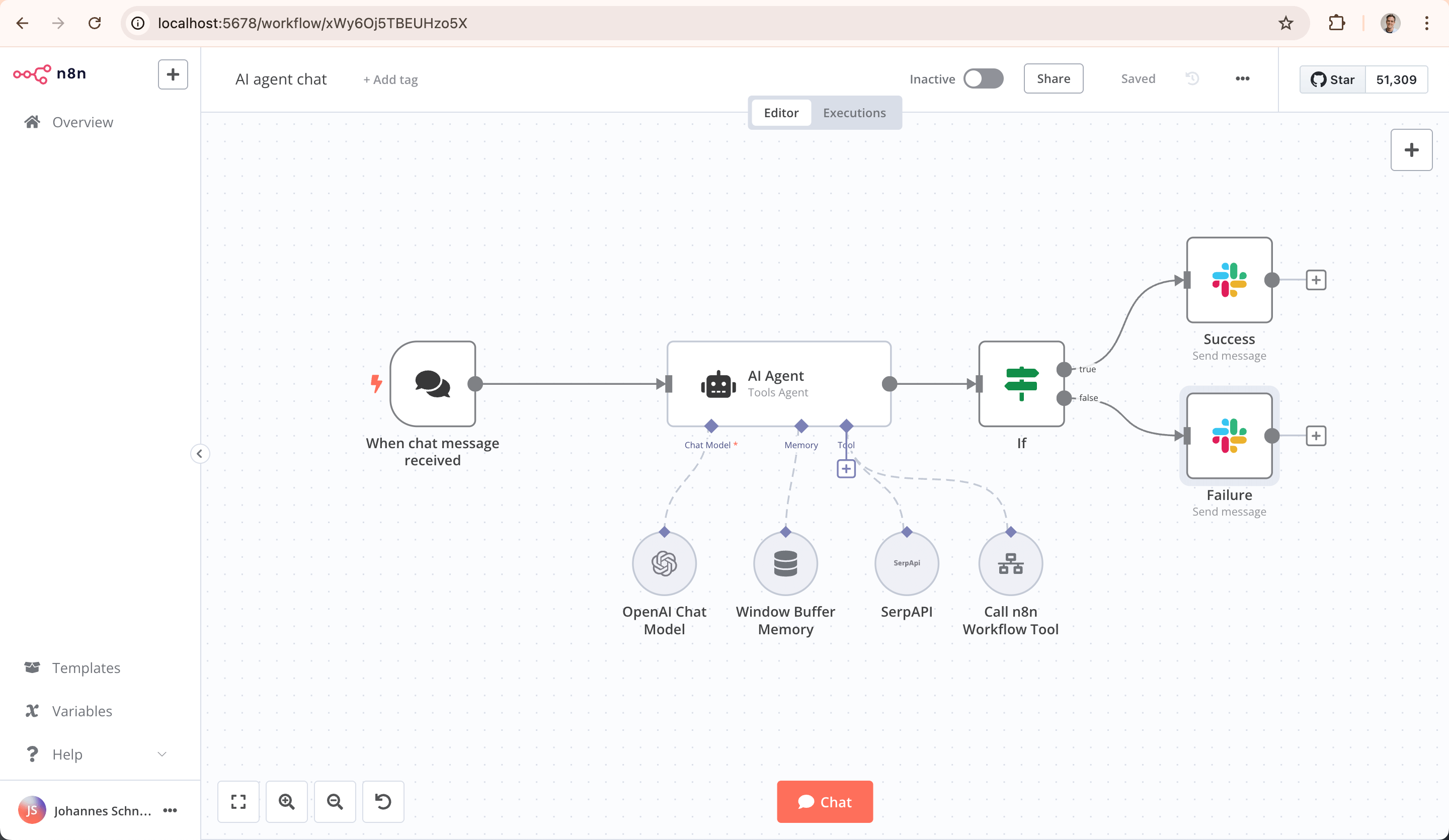
docker-compose up command deploys the full stack. Runs on any VPS, Kubernetes cluster, or bare-metal server. Data never leaves your infrastructure.On G2, n8n holds a strong 4.5/5 rating across hundreds of reviews. The most upvoted positives are its self-hosting capabilities, the power of combining code with no-code, and its pricing compared to Zapier. On Reddit's r/selfhosted and r/n8n, the community is highly active — users regularly share complex workflow templates, and sentiment skews positive with most threads focused on "what can I build?" rather than complaints.
The most consistent criticism across G2, Capterra, and Reddit: the learning curve for non-developers is steep. Creating advanced flows with branching logic, error handling, and sub-workflows requires patience. Unlike Zapier, n8n expects you to understand data structures. Several G2 reviewers note that the documentation — while improved — still has gaps for advanced use cases, and some enterprise features like SSO require the Business or Enterprise plan.
On Hacker News, the launch thread generated substantial technical discussion, with senior developers praising the fair-code licensing model as a sustainable business approach while others debated whether the Sustainable Use License (SUL) qualifies as truly "open source" under OSI definitions (it doesn't — a distinction worth noting).
n8n's pricing is based on cloud execution count, while the self-hosted Community Edition is completely free with no limits.
| Plan | Price | Executions / Month | Key Features |
|---|---|---|---|
| Community (self-hosted) | Free | Unlimited | All integrations, unlimited workflows, unlimited users |
| Cloud Starter | €24/month | 2,500 | Managed hosting, community support |
| Cloud Pro | €60/month | 10,000 | Shared projects, priority support, 3 shared projects |
| Cloud Business | €800/month | 40,000 | SSO, admin roles, audit logs, compliance tools |
| Startup Plan | €333/month | 50,000 | Business features at 50% off for startups under 20 employees |
| Enterprise | Custom | Custom | SLA, dedicated support, custom infrastructure |
Note: Overage executions on Business cost €4,000 per additional 300,000 executions. All cloud plans include unlimited users, unlimited workflows, and all 400+ integrations.
Best for: Developers, DevOps engineers, technical founders, and power users who want maximum flexibility in workflow automation. Teams self-hosting for cost savings or data sovereignty. Anyone building AI-native automation pipelines or RAG systems. Companies processing high execution volumes who can't afford per-execution pricing at scale.
Not ideal for: Non-technical users who want Zapier-level simplicity and don't want to write any code. Teams that need plug-and-play with no infrastructure management. Organizations that need a truly OSI-approved open-source license (n8n uses the Sustainable Use License, which has commercial restrictions).
Pros:
Cons:
Zapier: The market leader with the best user experience and the largest integration library (~7,000 apps). Per-task pricing makes it expensive at scale. No self-hosting. Best for non-technical users wanting simplicity.
Make.com (formerly Integromat): More visual and beginner-friendly than n8n, with competitive cloud pricing. No self-hosting. Weaker code support. Good middle ground between Zapier and n8n.
Windmill: A newer, truly open-source (Apache 2.0) workflow platform that's more developer-focused with full script support in multiple languages. Less mature ecosystem than n8n but zero licensing restrictions.
At 81/100, n8n earns a strong recommendation — particularly for technically-inclined teams and individual developers. The self-hosted Community Edition is one of the best free automation platforms available anywhere: unlimited workflows, unlimited executions, unlimited users, and 400+ integrations. The cloud plans are competitive at Starter and Pro tiers but become expensive at Business scale. The Sustainable Use License is a reasonable trade-off for a sustainable business model, though teams needing true OSI-approved open source should consider Windmill instead. If you're building AI agents, processing large data pipelines, or just tired of Zapier's per-task pricing, n8n is likely the right tool for you.
ServiceNow and Accenture Launch Forward Deployed Engineering Program to Scale Agentic AI in the Enterprise (May 6, 2026)
At Knowledge 2026, ServiceNow and Accenture announced a joint forward deployed engineering program that drops co-located engineer pods into customer environments to ship agentic AI workflows natively on the ServiceNow AI Platform — with access to 300+ pre-built agent skills and the AI Control Tower as the governance backbone.
May 7, 2026
ReFiBuy Raises $13.6M Seed to Help Brands Get Recommended by AI Shopping Agents (May 5, 2026)
ReFiBuy, the Raleigh-based agentic commerce platform from ChannelAdvisor founder Scot Wingo, closed an oversubscribed $13.6M seed led by NewRoad Capital Partners on May 5, 2026 — betting that the next billion-dollar e-commerce moat is being chosen by ChatGPT, Claude and Perplexity.
May 7, 2026
OpenAI Replaces ChatGPT's Default Model With GPT-5.5 Instant — 52.5% Fewer Hallucinations, 30% Shorter Answers (May 5, 2026)
OpenAI on May 5 swapped GPT-5.3 Instant for the new GPT-5.5 Instant as ChatGPT's default model, claiming 52.5% fewer hallucinated claims on high-stakes prompts and 30% more concise answers. The model also rolls into the API as chat-latest and adds personalization from Gmail and past chats for Plus and Pro web users.
May 7, 2026
Is this product worth it?
Built With
Compare with other tools