
 AI Tools
Aider
AI pair programming in your terminal—free, open-source, any LLM
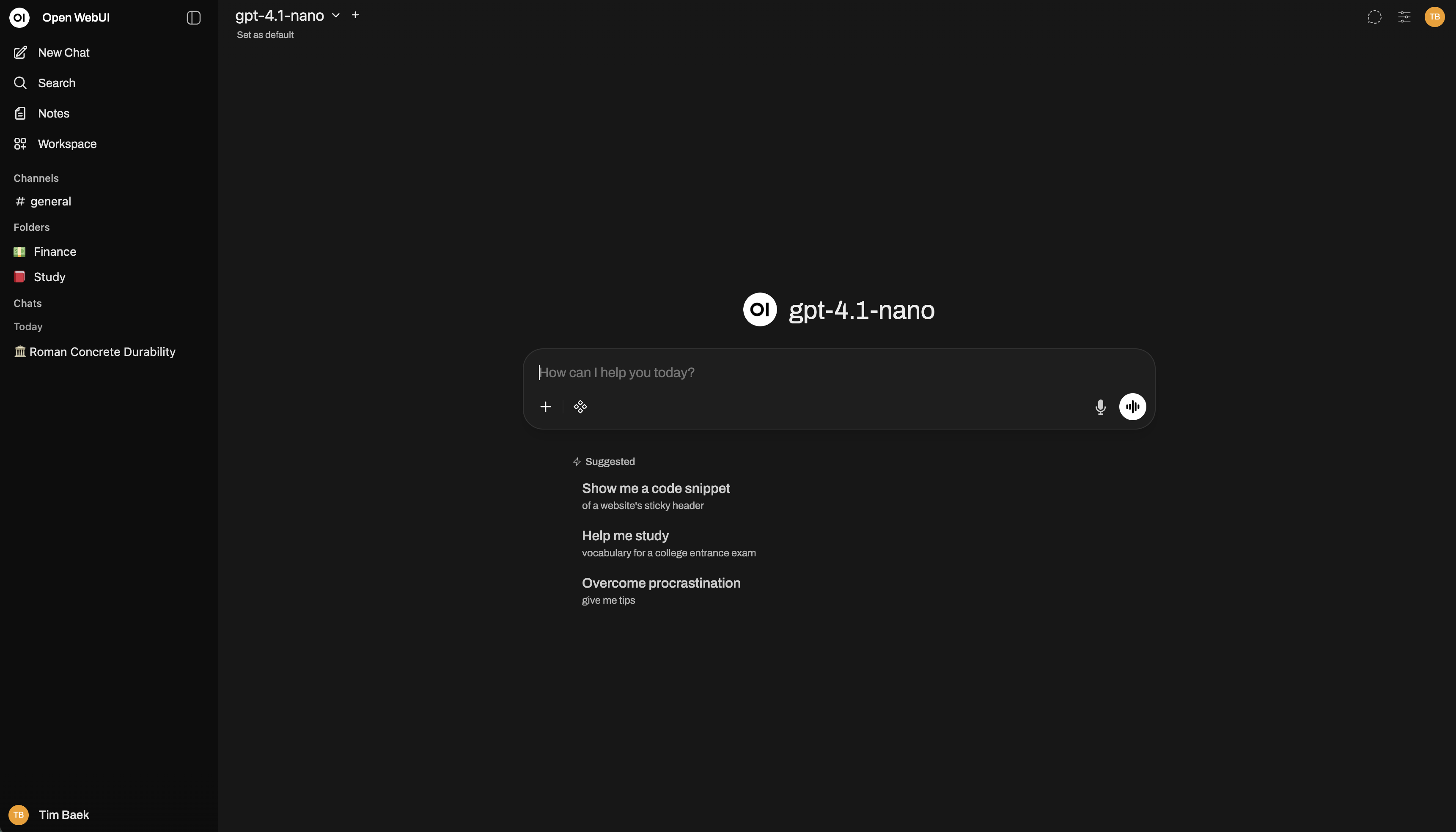
Open WebUI is a self-hosted, extensible AI chat platform that runs fully offline with Ollama or any OpenAI-compatible API. With 133k GitHub stars and enterprise-grade RBAC, SSO and RAG built in, it's the default frontend for the local LLM era.
Open WebUI is an open-source, self-hosted AI chat platform that runs a private ChatGPT-style interface against Ollama, Claude, OpenAI and any OpenAI-compatible API — entirely on your own hardware, entirely offline if you want it. We rate it 86/100 — it is the closest thing the open-source world has to a default frontend for the local LLM era, provided you are comfortable running a Docker container and can live with a support model that mostly means opening GitHub issues.
Open WebUI was created by Timothy Jaeryang Baek in early 2024 as "Ollama WebUI" — a side project to give the then-new Ollama runner a usable browser interface. It was renamed to Open WebUI later that year once the team added OpenAI-compatible API support, and has since grown into a full application with a team behind it, an enterprise tier and one of the most active communities in open-source AI.
As of the project sits at 133,000+ GitHub stars, ships releases roughly every two weeks, and the latest stable is v0.9.1, published on . The pitch is simple: if you have a GPU at home or a private server, you should not have to choose between ChatGPT Pro and a bare terminal — Open WebUI is the missing UI layer that turns whatever model you want to run into something your non-technical teammates will actually use.

ghcr.io/open-webui/open-webui:latest), with :ollama and :cuda variants that bundle the runtime. No telemetry, no outbound calls required — all data stays on your box.
On r/LocalLLaMA, Open WebUI is effectively the default recommendation for anyone asking "what should I put in front of Ollama?" — and a recent thread praising v0.9's RAG overhaul cleared 2,000 upvotes. Praise clusters around polish ("looks and feels like ChatGPT"), the breadth of providers, and the fact that SSO/RBAC are free. On Hacker News, a v0.6 launch thread drew comments like "Open WebUI is one of those projects where every release makes me slightly less excited about my ChatGPT subscription."
Complaints are real and recurring. The v0.6.6 license change in — requiring branding to stay visible for deployments over 50 users unless you buy an enterprise license — triggered sharp debate on GitHub, with some forks spinning up (notably LibreChat's continued growth). Users also note that observability is thin compared to commercial platforms (basic logging, no usage attribution per user), and that the upgrade path between major versions has shipped migration bugs more than once.
The core platform is free under the Open WebUI License (a permissive license with a branding-protection clause for large deployments). You pay only for the infrastructure you run it on, and — if you use cloud models — whatever the upstream API charges. Optional managed and enterprise tiers are available for teams that want white-labeling or SLA support.
| Plan | Price | Key Limits |
|---|---|---|
| Self-hosted (OSS) | $0 | Unlimited users and models. Must keep Open WebUI branding visible for deployments over 50 users. |
| Community hosted | from $9.99/month | Managed instance for solo users and small teams who don't want to run the container themselves. |
| Enterprise | Custom (contact sales) | White-labeling, LTS releases, SLA support, priority security patches, SCIM/OIDC hardening. Custom-quoted by seat count. |
Best for: Developers, homelabbers and small engineering teams who want a polished ChatGPT-style UI over local models or private API keys, and mid-sized enterprises that need SSO/RBAC over LLMs without paying per-seat commercial pricing. It is especially strong for regulated industries (healthcare, legal, government) that cannot send data to OpenAI but still want a modern chat experience over their own inference cluster.
Not ideal for: Companies that need granular per-user token attribution, chargeback billing, or complex audit logs out of the box — the enterprise story there is still catching up to commercial alternatives. Also not the best fit for users who refuse to touch Docker; while the installer is simple, it still assumes you can run a container.
Pros:
Cons:
LibreChat is the most popular true-OSS fork-adjacent alternative — fully MIT-licensed with no branding clause, though the UI is a step behind and RAG is less polished. AnythingLLM (Mintplex Labs) focuses more on document-centric RAG workflows and less on the general chat experience. Onyx (formerly Danswer) is the enterprise-search-first choice with better ACLs but a heavier footprint. For raw chat against Ollama, the upstream Ollama app itself is fine but lacks RAG, multi-user and tool calling.
Yes — with one caveat. If you are running LLMs on your own hardware or through API keys and you don't need per-user billing or advanced audit features, Open WebUI is the highest-leverage piece of software you can install in 2026. A single docker run gets you a chat UI better than most commercial products, RAG over your documents, voice calls, SSO, and the ability to swap models by the sentence. The enterprise pricing opacity and the branding clause are real frictions for organisations above 50 users, which is the only reason we land at 86/100 rather than 90+. For everyone else, it is simply the default.
ServiceNow and Accenture Launch Forward Deployed Engineering Program to Scale Agentic AI in the Enterprise (May 6, 2026)
At Knowledge 2026, ServiceNow and Accenture announced a joint forward deployed engineering program that drops co-located engineer pods into customer environments to ship agentic AI workflows natively on the ServiceNow AI Platform — with access to 300+ pre-built agent skills and the AI Control Tower as the governance backbone.
May 7, 2026
ReFiBuy Raises $13.6M Seed to Help Brands Get Recommended by AI Shopping Agents (May 5, 2026)
ReFiBuy, the Raleigh-based agentic commerce platform from ChannelAdvisor founder Scot Wingo, closed an oversubscribed $13.6M seed led by NewRoad Capital Partners on May 5, 2026 — betting that the next billion-dollar e-commerce moat is being chosen by ChatGPT, Claude and Perplexity.
May 7, 2026
OpenAI Replaces ChatGPT's Default Model With GPT-5.5 Instant — 52.5% Fewer Hallucinations, 30% Shorter Answers (May 5, 2026)
OpenAI on May 5 swapped GPT-5.3 Instant for the new GPT-5.5 Instant as ChatGPT's default model, claiming 52.5% fewer hallucinated claims on high-stakes prompts and 30% more concise answers. The model also rolls into the API as chat-latest and adds personalization from Gmail and past chats for Plus and Pro web users.
May 7, 2026
Is this product worth it?
Built With
Compare with other tools
Open Comparison Tool →