

 Developer Tools
Templ
Type-safe HTML templating language for Go with compile-time safety
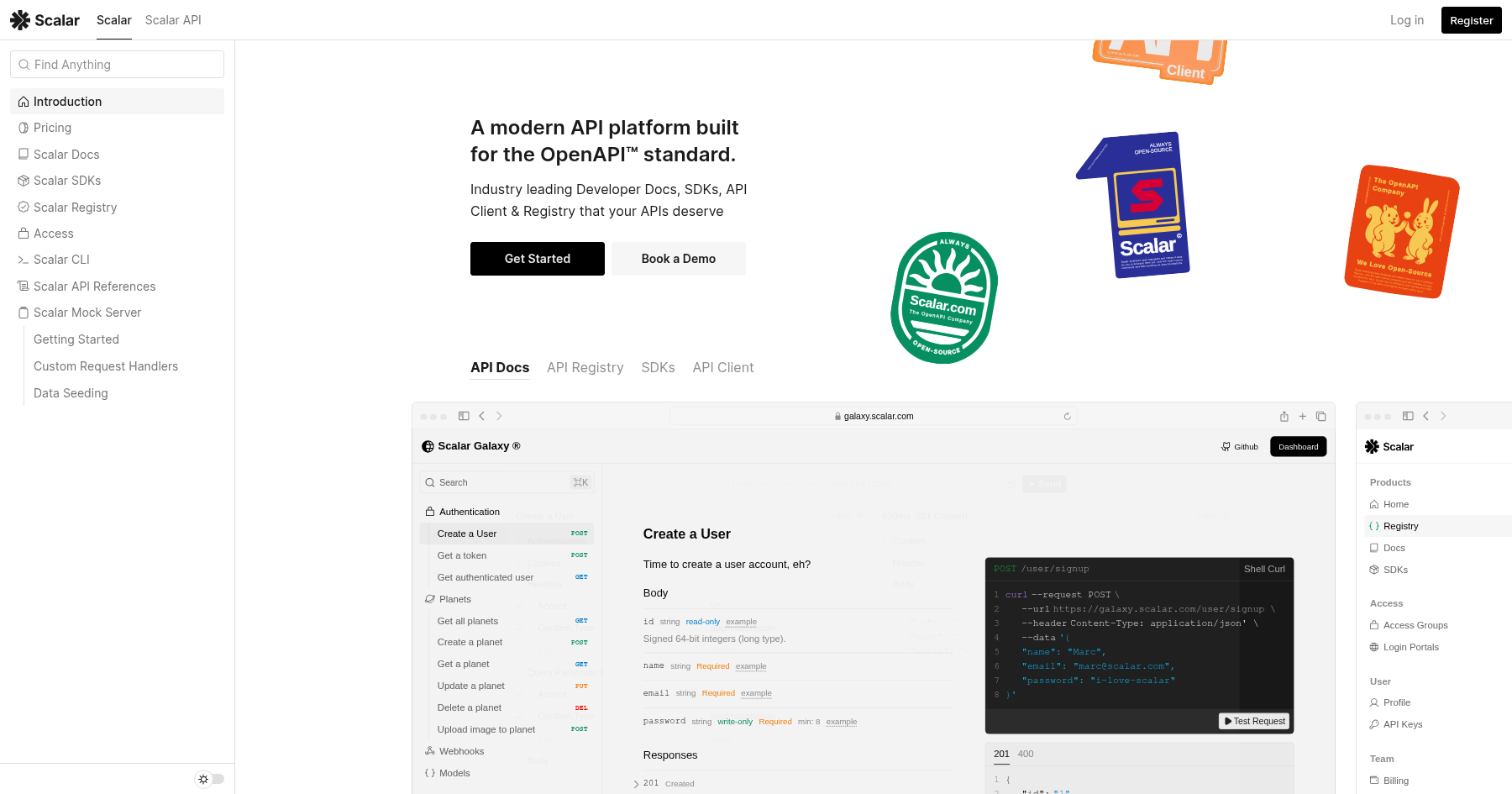
Scalar is an open-source API platform that transforms OpenAPI specs into beautiful interactive documentation, a fully-featured REST API client, and type-safe SDKs — all from a single source of truth. With 14.8k GitHub stars and integrations across 30+ frameworks, it's become the modern replacement for Swagger UI.
Scalar is an open-source API platform built around the OpenAPI standard, offering beautiful API reference documentation, a modern REST API client, and automatic SDK generation from a single specification. We rate it 83/100 — an excellent choice for developer teams who want polished, interactive API docs without the Swagger UI baggage, particularly if you're on .NET, FastAPI, or any of the 30+ supported frameworks.
Scalar was founded in by Marc Laventure and Cameron Rohani, headquartered in San Francisco. The company set out with a clear mission: replace the aging Swagger UI ecosystem with something developers actually enjoy using. By , the main GitHub repository has accumulated over 14,800 stars, and frameworks including Hono, FastAPI, Django, Laravel, NestJS, and Effect have adopted Scalar as their default API documentation renderer.
The core of Scalar is its OpenAPI-first approach: you maintain a single OpenAPI (formerly Swagger) specification, and Scalar transforms it into a three-pronged output — beautiful interactive documentation, an offline-first API client, and type-safe client libraries for TypeScript, Python, Go, PHP, Java, and Ruby. This means no more maintaining separate documentation and code — your spec is the source of truth.


Developer reception has been strongly positive, particularly among .NET and Python ecosystems. On Product Hunt, Scalar earned a 4.7/5 from early reviewers who praised its clarity and ease of setup. Across GitHub issues and Reddit's r/webdev and r/node communities, the most upvoted threads highlight two consistent strengths: the speed of the documentation rendering (notably faster than Swagger UI on large specs) and the near-zero configuration required to embed it into existing frameworks. The .NET community was particularly enthusiastic after Microsoft endorsed it — several popular blog posts from .NET developers report switching from Swagger UI in under 15 minutes.
The recurring criticism centers on a few areas: the Pro plan's $72/month minimum (three seats required) feels steep for two-person teams; SDK generation is priced separately at $100/language/month on top of the Pro plan, which adds up quickly for polyglot teams; and some users report that the managed hosting can occasionally lag on cache invalidation when specs are updated. For self-hosters, these concerns largely disappear, but then you're managing your own infrastructure.
Scalar uses a freemium model with a generous open-source free tier.
| Plan | Price | Key Features |
|---|---|---|
| Free | $0/month | 1 editor seat, API References, API Client (full features), custom HTML/CSS/JS, subdomain hosting, email domain access control |
| Pro | $24/seat/month (min 3 seats) | Custom domains, Git sync, MDX + Guides, Landing Pages, SSO/SAML, RBAC, priority support, optional SDK add-ons (+$100/language/month) |
| Enterprise | Custom pricing | All Pro features plus Cloud Sync, upcoming gRPC/GraphQL/WebSocket clients, dedicated SLA |
Best for: Developer teams building public-facing or partner APIs who want polished, interactive documentation without custom dev work; .NET, FastAPI, and NestJS teams who want the framework's built-in Scalar integration; open-source projects needing free, beautiful, self-hostable docs; teams looking to replace Postman with an OpenAPI-native alternative.
Not ideal for: Teams needing robust collaboration features inside the API client (Scalar's client is newer and more limited than Postman's in this regard); small two-person startups who find the $72/month Pro minimum restrictive; anyone needing gRPC, GraphQL, or WebSocket support today (those are on the roadmap for Enterprise).
Pros:
Cons:
The most direct competitors are Mintlify (polished documentation platform, but more expensive and closed-source), Redocly (enterprise-grade, similar OpenAPI focus, higher pricing), and ReadMe (full developer hub with analytics, but no free self-hosting). For the API client specifically, Bruno and Hoppscotch are the main open-source alternatives — both strong choices, but neither integrates as tightly with OpenAPI specs as Scalar does.
For the vast majority of teams, Scalar's free tier alone makes it worth trying immediately — you get a full API client, hosted documentation, and framework integrations at zero cost. The Pro plan is compelling for teams shipping public APIs who need custom domains, Git sync, and SSO; just be aware of the three-seat minimum. We rate Scalar 83/100: it's the best free option for OpenAPI-driven API docs today, and its active development trajectory suggests the gaps (SDK pricing, client maturity, gRPC) will close in 2026.
ServiceNow and Accenture Launch Forward Deployed Engineering Program to Scale Agentic AI in the Enterprise (May 6, 2026)
At Knowledge 2026, ServiceNow and Accenture announced a joint forward deployed engineering program that drops co-located engineer pods into customer environments to ship agentic AI workflows natively on the ServiceNow AI Platform — with access to 300+ pre-built agent skills and the AI Control Tower as the governance backbone.
May 7, 2026
ReFiBuy Raises $13.6M Seed to Help Brands Get Recommended by AI Shopping Agents (May 5, 2026)
ReFiBuy, the Raleigh-based agentic commerce platform from ChannelAdvisor founder Scot Wingo, closed an oversubscribed $13.6M seed led by NewRoad Capital Partners on May 5, 2026 — betting that the next billion-dollar e-commerce moat is being chosen by ChatGPT, Claude and Perplexity.
May 7, 2026
OpenAI Replaces ChatGPT's Default Model With GPT-5.5 Instant — 52.5% Fewer Hallucinations, 30% Shorter Answers (May 5, 2026)
OpenAI on May 5 swapped GPT-5.3 Instant for the new GPT-5.5 Instant as ChatGPT's default model, claiming 52.5% fewer hallucinated claims on high-stakes prompts and 30% more concise answers. The model also rolls into the API as chat-latest and adds personalization from Gmail and past chats for Plus and Pro web users.
May 7, 2026
Is this product worth it?
Built With
Compare with other tools