 Developer Tools
Templ
Type-safe HTML templating language for Go with compile-time safety
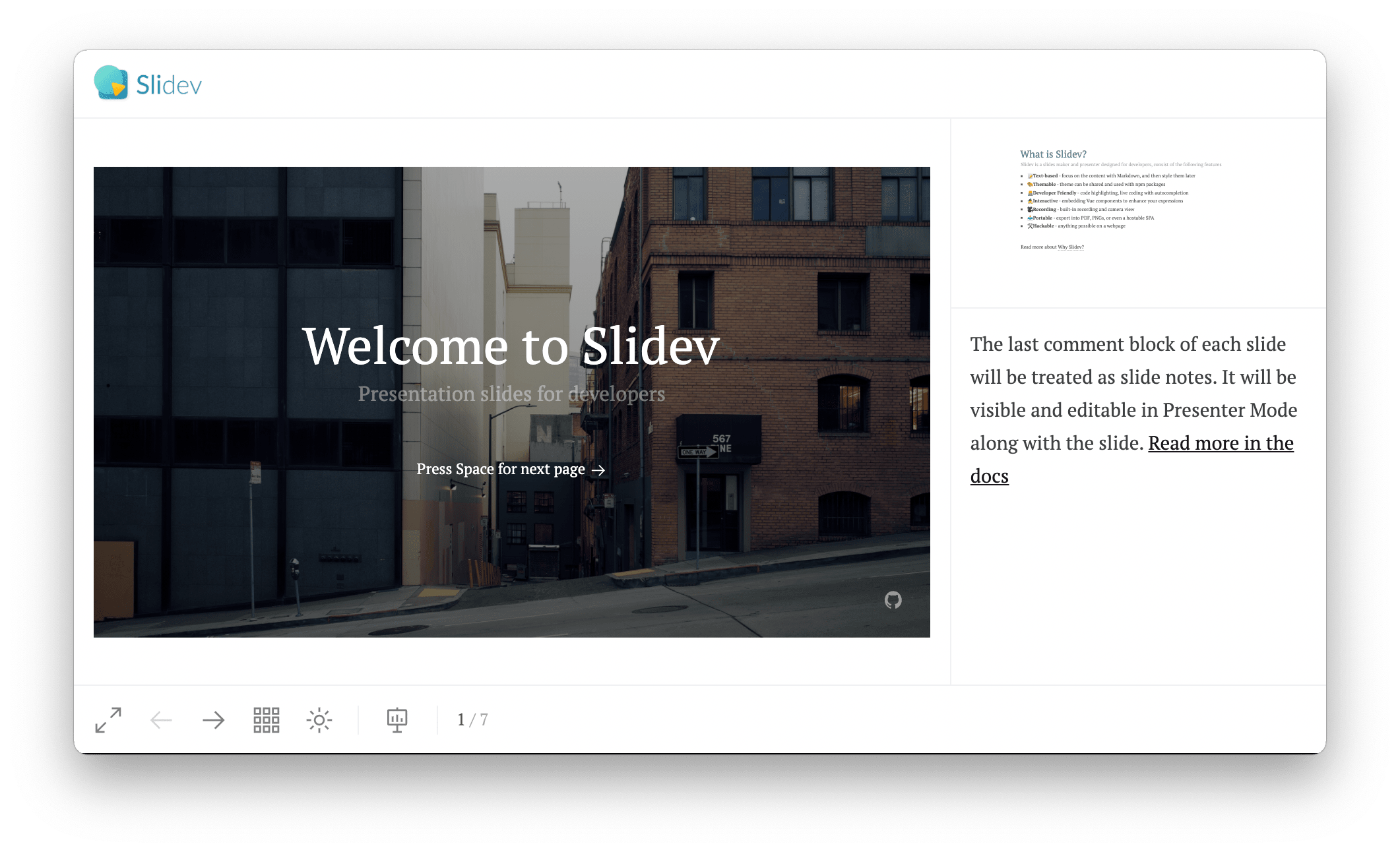
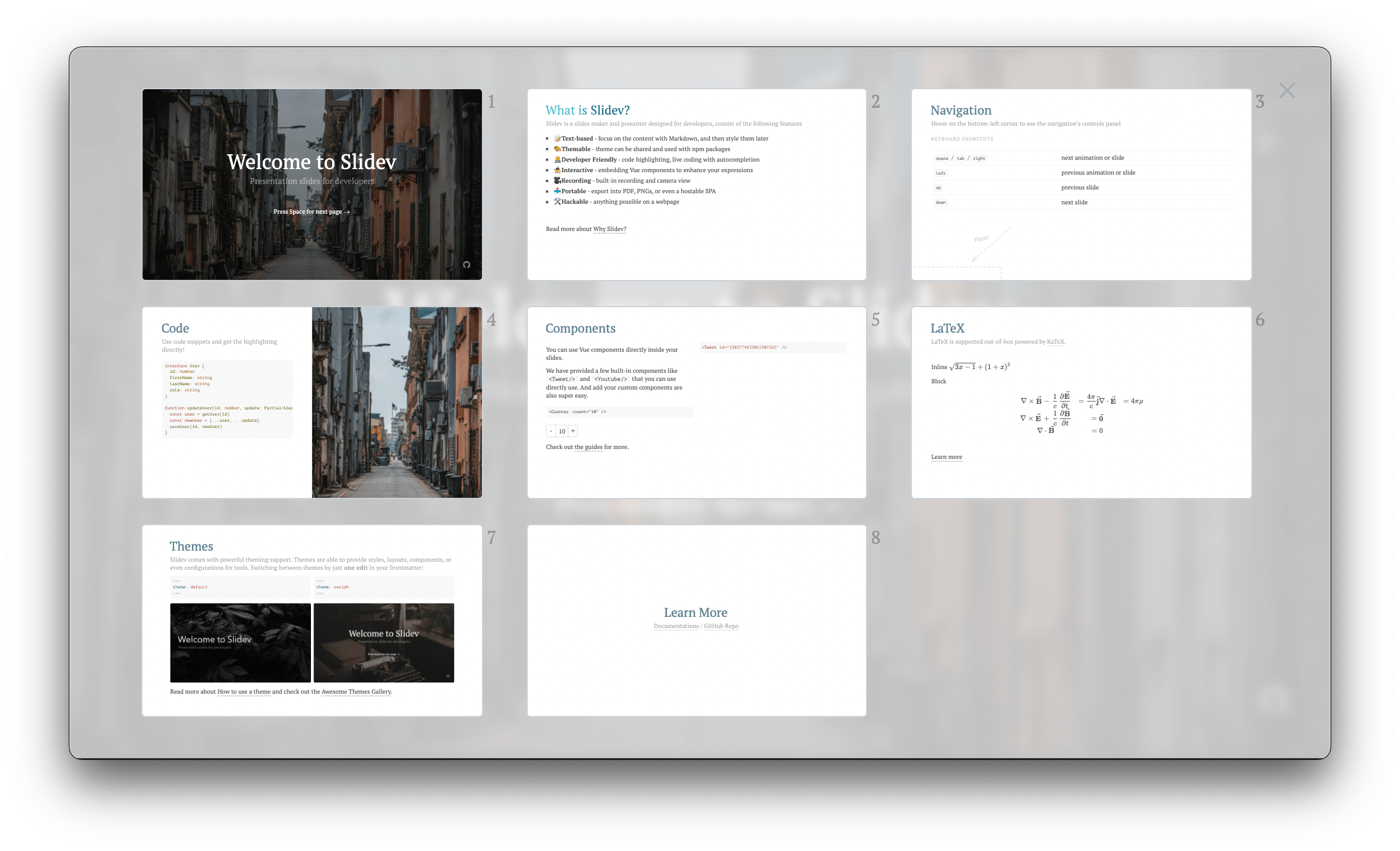
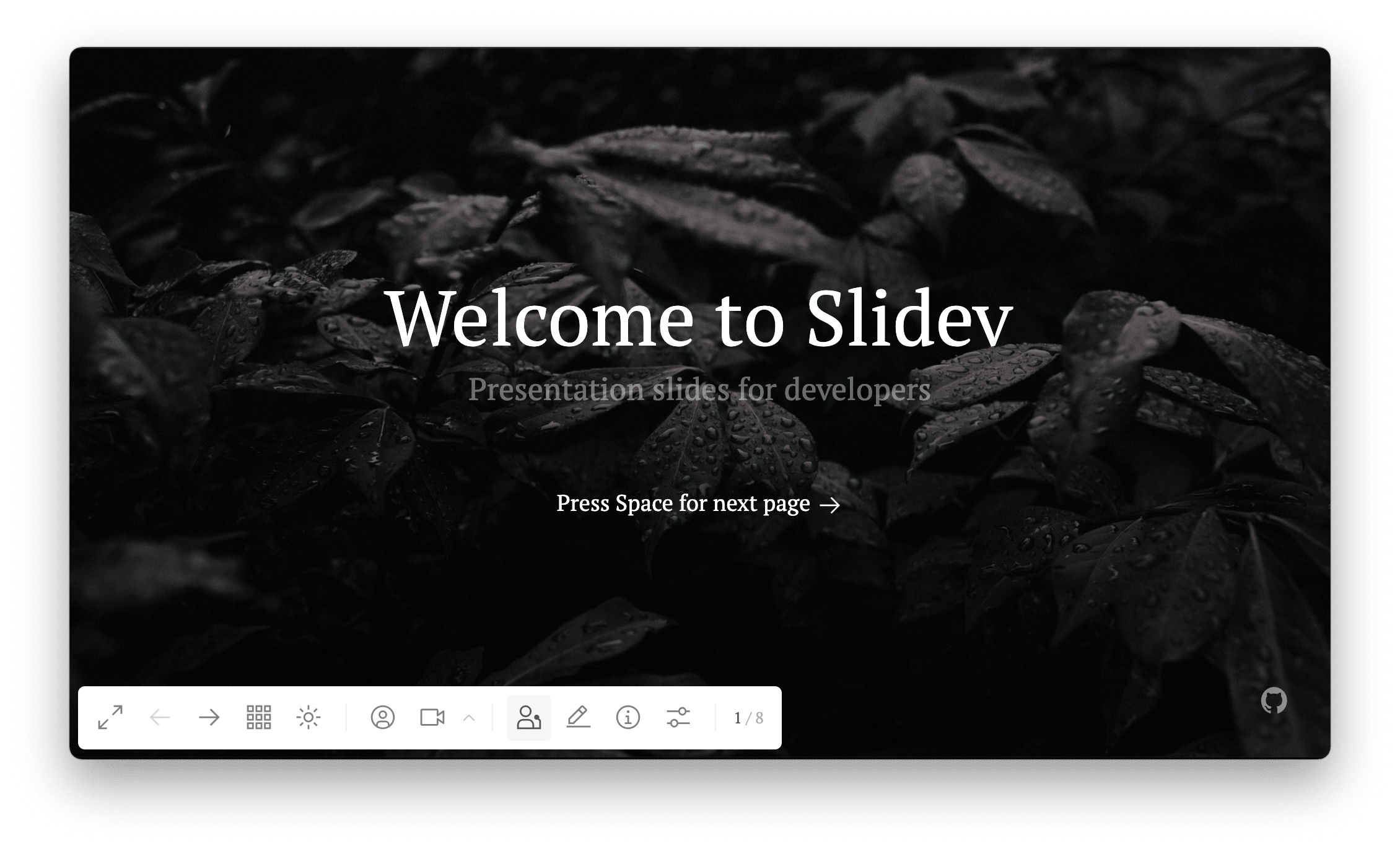
Slidev is an open-source slide deck framework that lets developers write talks in Markdown with embedded Vue components, syntax-highlighted code blocks, and live demos. It is free, MIT-licensed, and currently sits at over 46,000 GitHub stars.
Slidev is an open-source presentation framework built specifically for developers — you write slides in Markdown, embed Vue components, and ship interactive code demos. We rate it 89/100 — the right pick for any developer who can already write Markdown and wants Git-tracked decks with first-class code blocks instead of fighting drag handles in Keynote.
Slidev is a web-based slide maker created by Anthony Fu — the same engineer behind Vitest, VueUse, UnoCSS, and a core team member of Vue, Nuxt, and Vite. It launched publicly on and has grown into one of the most-starred presentation tools on GitHub, with over 46,000 stars and an active release cadence (the most recent tag, v52.15.0, shipped on ).
The pitch is simple: presentations are still mostly authored in WYSIWYG editors that feel slow and force you to copy-paste code as flat images. Slidev flips that around — your deck is a .md file, version-controlled like any other source, with HMR-powered live editing in your browser and Vue components for any custom layout you want.
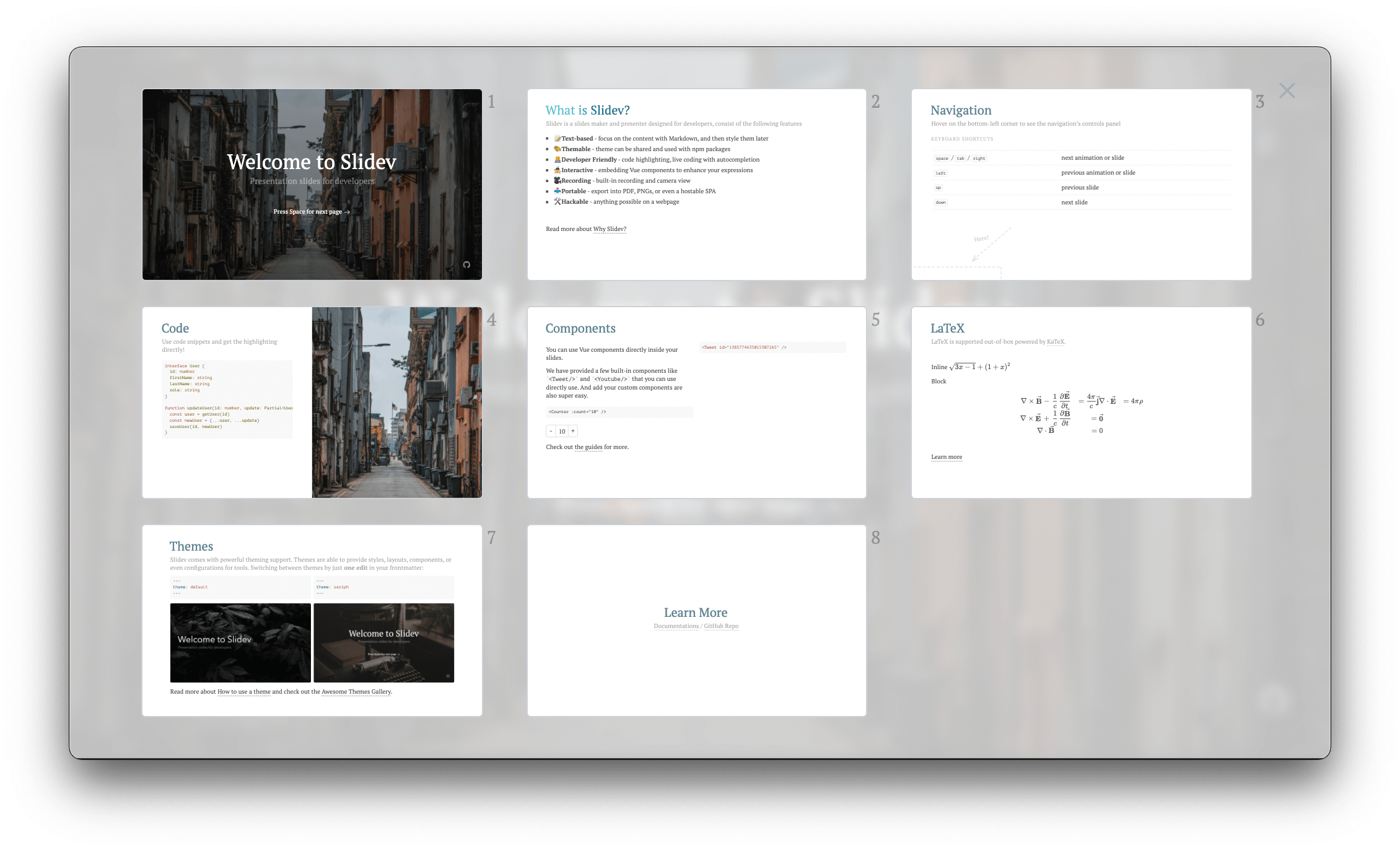
--- in a single Markdown file. Front-matter blocks per slide control the layout, transitions, and assigned components.<Tweet/>, <Youtube/>, custom chart, or any Vue 3 component directly into a slide. UnoCSS atomic classes work out of the box for inline styling.--with-clicks for animation-aware pagination), PPTX (with speaker notes attached per slide), or PNGs via --format png. Static SPA build deploys to Netlify, Vercel, or GitHub Pages with a single command.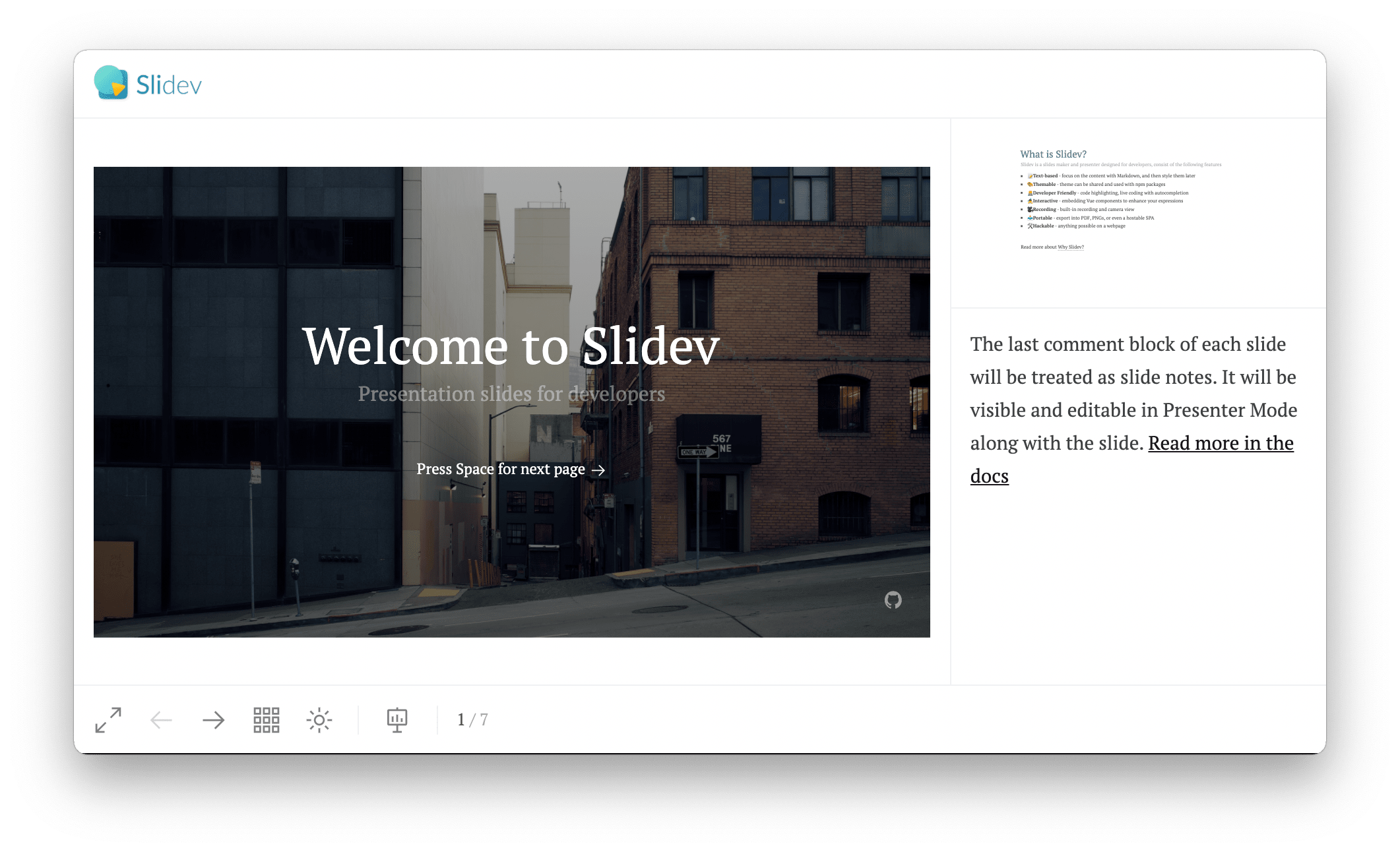
Sentiment around Slidev is unusually positive for a presentation tool. On the original Hacker News launch thread, the most-upvoted comments call out the developer workflow — Markdown plus Git diffing — as the killer feature compared to Keynote or Google Slides. A more recent HN discussion notes that "Reveal.js vs Sli.dev seems like a toss up" but credits Slidev for a smoother authoring experience.
The recurring complaints are real: the learning curve is steeper than Marp because Slidev directives are not standard Markdown, and getting the most out of custom layouts requires some Vue knowledge. Independent reviewers and the community-maintained comparison on tonai.github.io flag a missing native table-of-contents helper as a notable gap, although community plugins fill it. On Reddit's r/webdev and r/vuejs, the most-shared sentiment is that decks built once in Slidev are easier to update for the next conference than any WYSIWYG slide tool — a productivity argument that compounds over time.
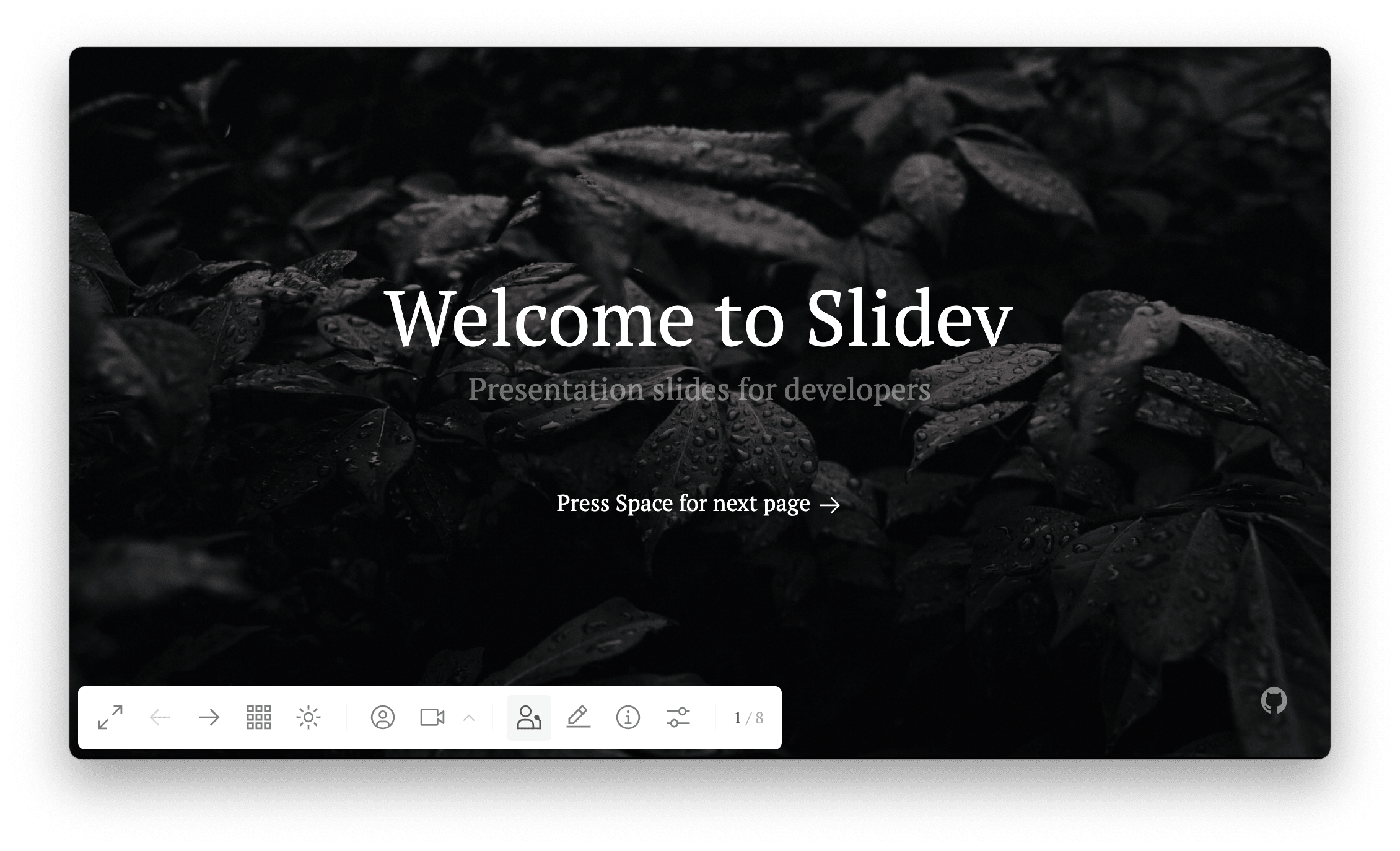
Slidev is free and open-source under the MIT license — there is no paid tier, no subscription, and no usage limit. You can self-host the static build on any CDN at no cost. The optional StackBlitz starter at sli.dev/new is also free.
| Plan | Price | What's Included |
|---|---|---|
| Open Source (only tier) | $0 | Full framework, all components, all export formats, presenter mode, recording, themes, MIT license — unlimited use commercial or personal. |
Best for: Developers, technical conference speakers, dev advocates, university lecturers in CS, and anyone who already lives in Markdown and Git. Teams that maintain a recurring talk track (onboarding, system design reviews, lunch-and-learns) get the most leverage because decks become reusable source files.
Not ideal for: Marketing, finance, or sales teams that need real-time co-editing the way Google Slides offers it — Slidev has no multiplayer mode. Skip it if your audience reviews decks via shared Google Drive comments, or if you need Microsoft 365 organizational templates.
Pros:
Cons:
Reveal.js is the older, HTML-first alternative with a larger plugin ecosystem but a clunkier authoring experience. Marp is closer to vanilla Markdown and easier to pick up but has fewer interactive features. Excalidraw is the right complement when you need hand-drawn diagrams inside any of these tools.
For developers who give technical talks, Slidev is a clear yes — the Markdown workflow plus Shiki-rendered code blocks is genuinely better than the alternatives, and the price tag is zero. The 89/100 score reflects a tool that's best-in-class for its target audience but loses points for the Vue learning curve and the lack of real-time collaboration that non-technical teammates often expect. If you've ever struggled to fit a code block into a Keynote slide without it looking awful, install Slidev today.
--format png. PPTX exports embed slides as images so text is not selectable in PowerPoint.ServiceNow and Accenture Launch Forward Deployed Engineering Program to Scale Agentic AI in the Enterprise (May 6, 2026)
At Knowledge 2026, ServiceNow and Accenture announced a joint forward deployed engineering program that drops co-located engineer pods into customer environments to ship agentic AI workflows natively on the ServiceNow AI Platform — with access to 300+ pre-built agent skills and the AI Control Tower as the governance backbone.
May 7, 2026
ReFiBuy Raises $13.6M Seed to Help Brands Get Recommended by AI Shopping Agents (May 5, 2026)
ReFiBuy, the Raleigh-based agentic commerce platform from ChannelAdvisor founder Scot Wingo, closed an oversubscribed $13.6M seed led by NewRoad Capital Partners on May 5, 2026 — betting that the next billion-dollar e-commerce moat is being chosen by ChatGPT, Claude and Perplexity.
May 7, 2026
OpenAI Replaces ChatGPT's Default Model With GPT-5.5 Instant — 52.5% Fewer Hallucinations, 30% Shorter Answers (May 5, 2026)
OpenAI on May 5 swapped GPT-5.3 Instant for the new GPT-5.5 Instant as ChatGPT's default model, claiming 52.5% fewer hallucinated claims on high-stakes prompts and 30% more concise answers. The model also rolls into the API as chat-latest and adds personalization from Gmail and past chats for Plus and Pro web users.
May 7, 2026
Is this product worth it?
Built With
Compare with other tools
Open Comparison Tool →