 Developer Tools
Templ
Type-safe HTML templating language for Go with compile-time safety
Tailscale is the WireGuard-based mesh VPN that replaces legacy corporate VPNs with an identity-first, zero-config network. It is now used by 20,000+ businesses and trades at a $1.5B valuation after its April 2025 Series C.
Tailscale is a zero-trust, identity-based mesh networking platform built on WireGuard that replaces legacy VPNs, SASE stacks, and privileged access tools with a flat overlay network you can stand up in minutes. We rate it 90/100 — if you have ever fought with OpenVPN, hand-rolled IPsec, or sat on a ticket queue waiting for a bastion host, Tailscale is the obvious upgrade and worth every cent of the $8/user business plan.
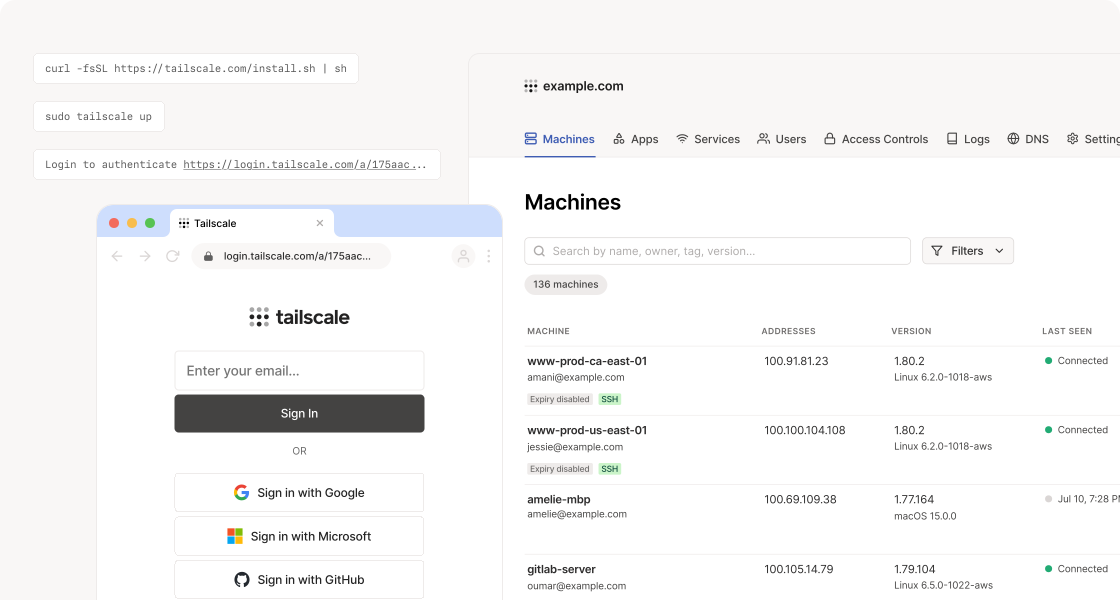
Tailscale is two things. First, it is an open-source client (github.com/tailscale/tailscale, Go, BSD-3-Clause) that runs on Linux, macOS, Windows, iOS, Android, FreeBSD, and even inside Docker — and in Kubernetes as an operator. Second, it is a hosted coordination service at tailscale.com that brokers WireGuard key exchange and authentication against your existing identity provider. Once you tailscale up, every device you add joins a single private network — a tailnet — with a stable 100.x.y.z IP and MagicDNS hostname, reachable end-to-end-encrypted even across NATs and firewalls.
The company was founded in 2019 in Toronto by CEO Avery Pennarun, CTO David Crawshaw, and Brad Fitzpatrick (the author of memcached and Go's HTTP stack). On Tailscale closed a $160M Series C led by Accel at a ~$1.5 billion post-money valuation, bringing total funding to $275M across 4 rounds. The company now serves 20,000+ businesses including Instacart, Mercury, Duolingo, Hugging Face, Mistral, Cohere, Nvidia and Microsoft, and reports more than 10,000 paying business tailnets. The latest client release is v1.96.4, shipped on , and the main repo sits at roughly 30.7k GitHub stars.
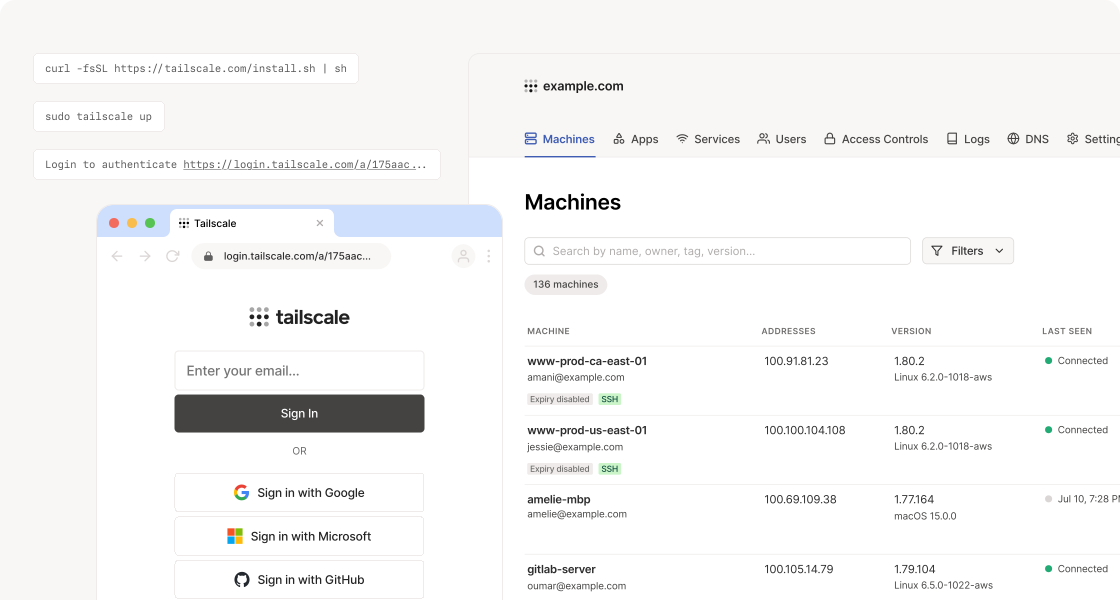
laptop.tail-scale.ts.net — no more remembering 100.64 IPs or keeping a /etc/hosts file in git.tag:prod-db), define groups, and write rules like {"action": "accept", "src": ["group:eng"], "dst": ["tag:prod-db:5432"]}.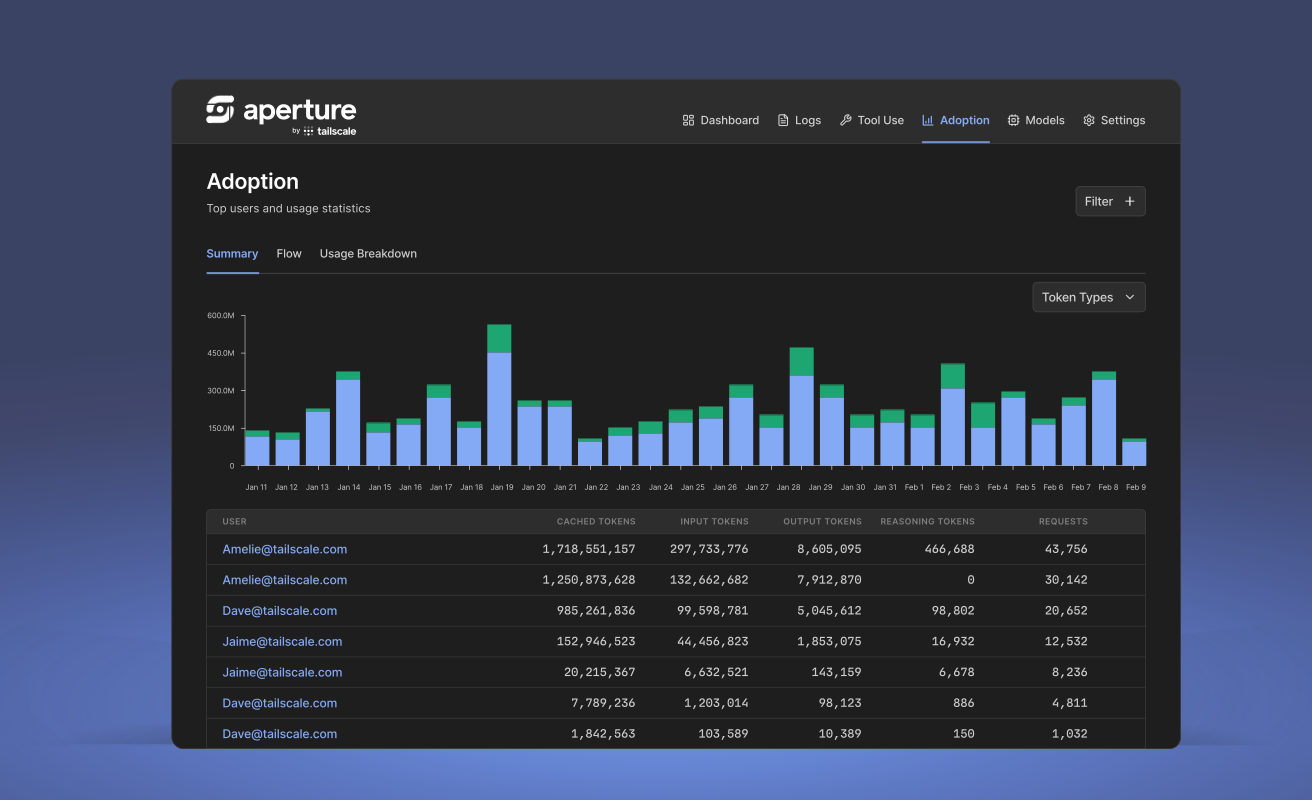
Sentiment across Hacker News, r/selfhosted, r/homelab, and r/sysadmin is among the most positive we see for any infrastructure product. The recurring refrain on HN is that Tailscale feels like "magic" — users regularly describe connecting 10–12 devices across home, office and cloud in under ten minutes. The Reddit homelab crowd loves MagicDNS and exit nodes enough that a common complaint is simply "I can't go back to regular VPNs."
The honest criticisms are specific. On G2 and Reddit, teams at scale complain that ACLs and DNS management get cumbersome past a few hundred devices, and that the Admin API still lacks bulk tag operations as of Q1 2026. Several HN commenters note that while the client is open source, the control plane is proprietary — a real concern that the community project Headscale addresses but with reduced feature parity. Pricing at $18/user/month for Premium is the other recurring gripe from growing teams, especially those that want just-in-time access and flow logs but cannot justify a $216/seat/year line item.
Tailscale rolled out a simplified "Pricing v4" on that expanded the free plan and retired the old usage-based Starter tier. The current tiers:
| Plan | Price | Key Limits |
|---|---|---|
| Personal | $0/month | Up to 6 users, unlimited user devices, 3 ACL groups, 50 tagged resources, 1,000 ephemeral minutes/month |
| Standard | $8/user/month | SCIM, 10 ACL groups, advanced roles, MDM, device posture integrations, webhooks |
| Premium | $18/user/month | 300 ACL groups, 10,000 ephemeral minutes/month, just-in-time access, advanced SSH, network flow logs, log streaming, priority support |
| Enterprise | Custom | Solutions Engineer support, custom MSA & SLAs, dedicated professional services, invoice billing |
A 14-day free trial covers business plans, nonprofits and accredited schools get a 50% discount, and eligible early-stage startups can apply to the Tailscale for Startups program for credits. Existing customers keep their prior pricing for at least 12 months.
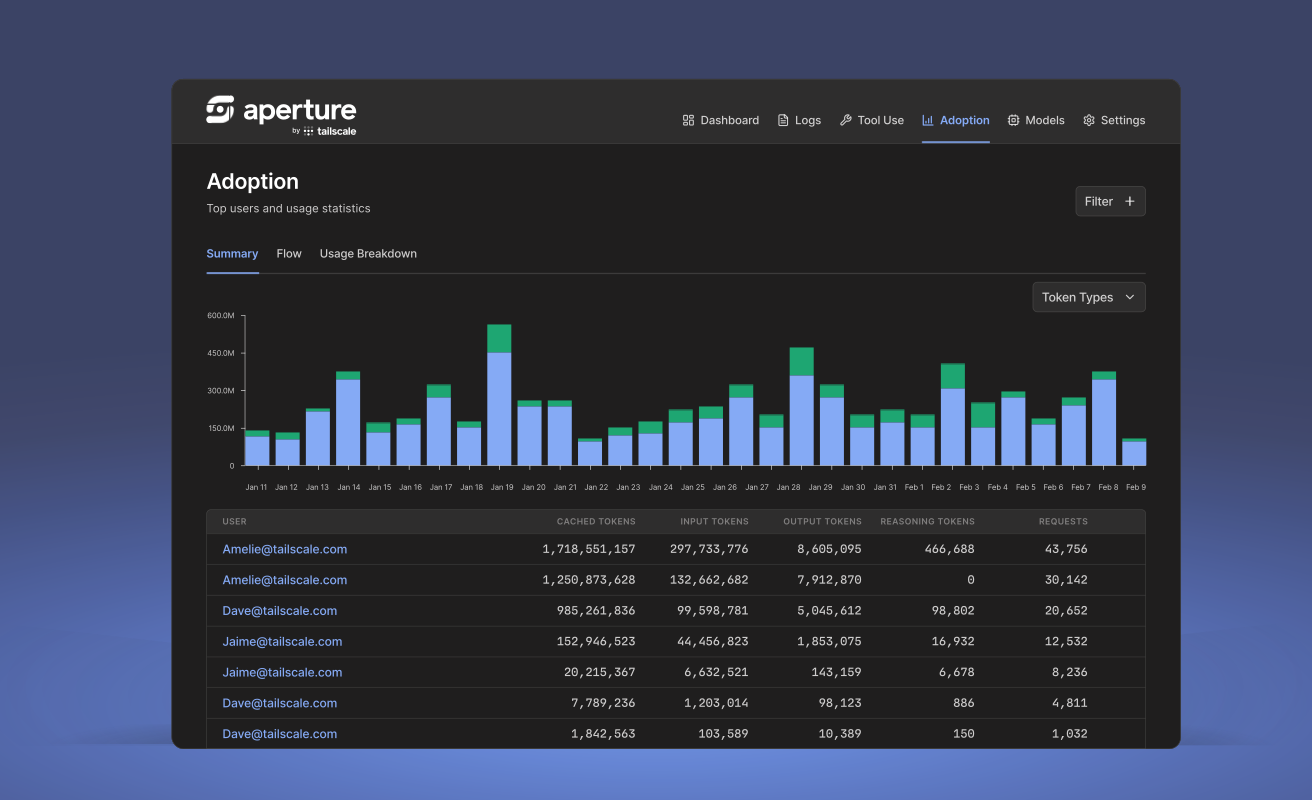
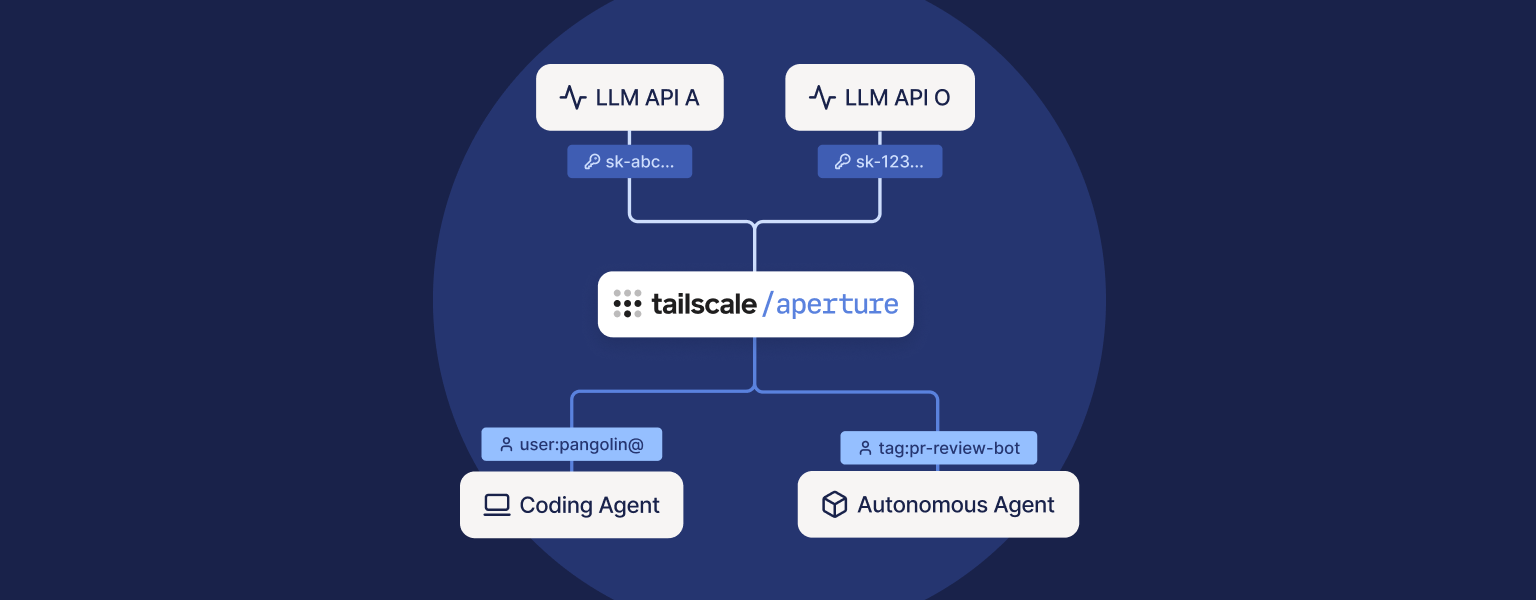
Best for: platform and DevOps teams replacing OpenVPN or hand-rolled IPsec; startups that need a zero-trust story without buying a SASE suite; developers who want laptop-to-homelab access; and AI teams that need to govern LLM API keys and coding agents through Aperture. If your access pattern involves "I need to SSH into a VM in another VPC from my laptop on hotel Wi-Fi," Tailscale solves it in one command.
Not ideal for: regulated environments that require an on-premises control plane Tailscale does not officially offer (Headscale is an unsupported community option); very large fleets (10,000+ devices) where bulk ACL tooling and API limits still feel rough; and users looking for a consumer privacy VPN in the Mullvad or ProtonVPN sense — that is not what Tailscale is.
Pros:
Cons:
Twingate — similar zero-trust remote access with a stronger PAM story but a more opaque closed architecture and less open-source tooling. ZeroTier — open-source mesh networking with a more networking-centric model (virtual L2), but weaker identity and SaaS polish. Cloudflare Access / WARP — excellent for HTTP apps and already bundled for Cloudflare customers, but less flexible for arbitrary TCP/UDP workloads. Headscale — fully self-hosted reimplementation of Tailscale's control plane; great for sovereignty, but you inherit all the ops.
Tailscale is the rare infrastructure product that is both easier and more powerful than what it replaces. If you are a team of fewer than ~500 people and your current VPN story is painful, a Standard plan at $8/user/month will pay for itself the first time nobody has to reset an OpenVPN config on a Saturday. We rate it 90/100 — the one-point-per-complaint deductions are for control-plane opacity, bulk ACL tooling at scale, and Premium pricing. For 95% of teams, this is the best VPN replacement shipping today.
ServiceNow and Accenture Launch Forward Deployed Engineering Program to Scale Agentic AI in the Enterprise (May 6, 2026)
At Knowledge 2026, ServiceNow and Accenture announced a joint forward deployed engineering program that drops co-located engineer pods into customer environments to ship agentic AI workflows natively on the ServiceNow AI Platform — with access to 300+ pre-built agent skills and the AI Control Tower as the governance backbone.
May 7, 2026
ReFiBuy Raises $13.6M Seed to Help Brands Get Recommended by AI Shopping Agents (May 5, 2026)
ReFiBuy, the Raleigh-based agentic commerce platform from ChannelAdvisor founder Scot Wingo, closed an oversubscribed $13.6M seed led by NewRoad Capital Partners on May 5, 2026 — betting that the next billion-dollar e-commerce moat is being chosen by ChatGPT, Claude and Perplexity.
May 7, 2026
OpenAI Replaces ChatGPT's Default Model With GPT-5.5 Instant — 52.5% Fewer Hallucinations, 30% Shorter Answers (May 5, 2026)
OpenAI on May 5 swapped GPT-5.3 Instant for the new GPT-5.5 Instant as ChatGPT's default model, claiming 52.5% fewer hallucinated claims on high-stakes prompts and 30% more concise answers. The model also rolls into the API as chat-latest and adds personalization from Gmail and past chats for Plus and Pro web users.
May 7, 2026
Is this product worth it?
Built With
Compare with other tools