 Design
Screen Studio
Professional macOS screen recorder with automatic zoom and cursor smoothing
tldraw is a free collaborative whiteboard and an infinite-canvas React SDK powering ClickUp, Padlet and Jam. The web app is free forever; commercial SDK use starts at $6,000 a year after a 100-day trial.
tldraw is both a free in-browser whiteboard at tldraw.com and a commercial infinite-canvas SDK at tldraw.dev that companies like ClickUp, Padlet and Jam embed to build their own canvas products. We rate it 78/100 — the most polished open-source canvas engine on the market and an obvious pick for the free browser whiteboard, but the new $6,000-a-year production license from SDK 4.0 makes it a harder sell for small teams that used to ship it for free.
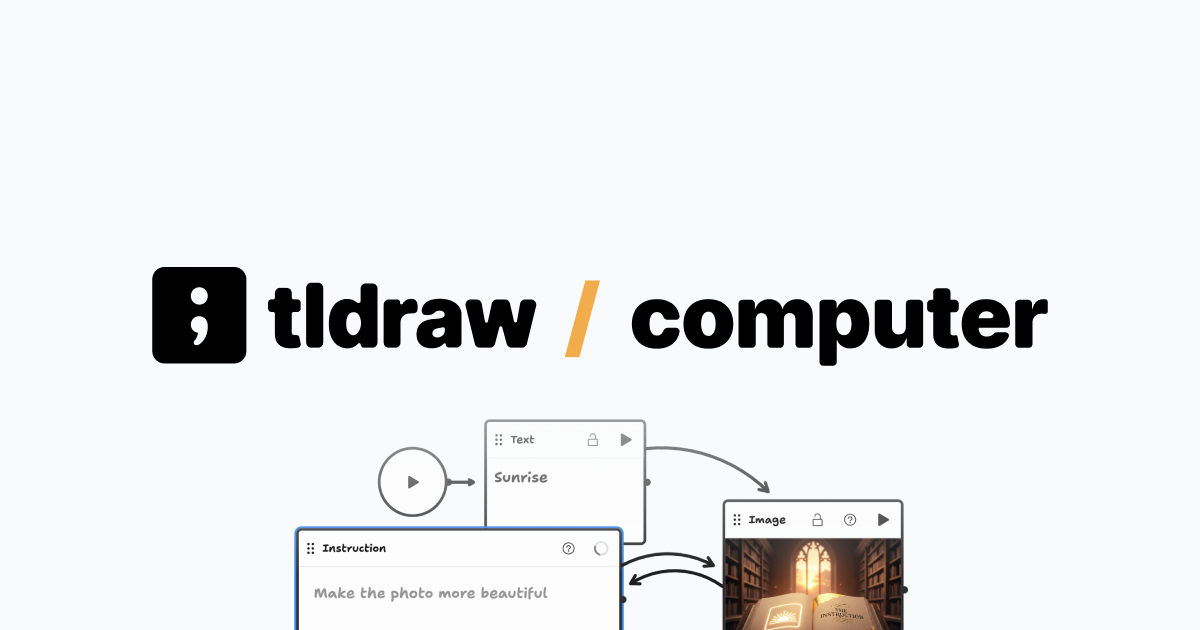
tldraw was created by Steve Ruiz and first launched in 2021 as a tiny open-source whiteboard toy. It has grown into a full product: the free whiteboard at tldraw.com, the SDK at tldraw.dev, an AI experiment called Make Real that turns sketches into working HTML, and a newer AI-native canvas at computer.tldraw.com. The GitHub repo at github.com/tldraw/tldraw has 46,400+ stars, 3,150 forks and shipped release v4.5.9 on . The company raised a $10M Series A from Lux Capital and Definition in April 2025, bringing total funding to $12M.
The pitch is specific: a feature-complete infinite canvas — multiplayer, selection geometry, snapping, image and video embeds, shape bindings, a record store, and an OpenGL mini-map — that you either use as a ready-made whiteboard in the browser or drop into your own React app in a few lines. Steve Ruiz claims the team has spent "three years and five million dollars building thousands of table-stakes features, from rotating cursors to handling pasted images," which is the part most teams underestimate when they try to build a canvas themselves.
The reaction on Hacker News to the SDK 4.0 launch is lopsided — almost everyone agrees the product is exceptional ("incredibly intuitive," "the best canvas engine on the web," "BigBlueButton moved to it and called it an excellent upgrade") and the complaints are almost entirely about the new licensing. The top-voted concern is that a $6,000 minimum with a manual sales process is "huge friction" that pushes indie developers to Excalidraw or roll-your-own, with one commenter summarising the feeling as "this is a great library and I will never be able to justify paying for it."
On Reddit's r/webdev and r/reactjs, reviewers praise the cleanliness of the API and the fact that the free whiteboard requires no signup, but a recurring complaint is that some previously-free features — multi-page canvases and link sharing — now require a tldraw account. On Product Hunt, earlier launches regularly cleared 500+ upvotes; the team has a reputation for shipping fast and answering support in public.
The free browser whiteboard at tldraw.com is free forever with no account needed. The SDK is free in development and localhost; production use requires a commercial license. Pricing (2026):
| Plan | Price | Who it's for |
|---|---|---|
| Free browser app | $0 forever | Anyone drawing on tldraw.com |
| SDK — dev only | $0 | Localhost and non-production use |
| 100-day Trial License | $0 | Teams evaluating the SDK in a live environment |
| Startup License | $6,000 / year | Up to 10 users, <$5M ARR |
| Business / Enterprise | Contact sales | Larger teams, custom terms |
Best for: product teams that need to ship a real canvas feature — ClickUp, Padlet, Mobbin and Jam all quietly replaced their own whiteboards with tldraw — and for anyone who just wants a clean, login-free browser whiteboard for an ad-hoc meeting.
Not ideal for: solo developers, open-source side projects, bootstrapped indie SaaS at <$5M ARR who can't justify $6,000/year, and organizations that need the canvas to remain under a permissive open-source license — tldraw's source is readable but the production license is commercial.
Pros:
Cons:
Excalidraw is the obvious free, MIT-licensed alternative with a hand-drawn aesthetic; it has a smaller feature set but no licensing friction. Miro is the commercial all-in-one whiteboard that sits one layer higher — a finished SaaS rather than a component. Eraser.io and FigJam are strong team-facing whiteboards but neither ships a customizable SDK.
Yes — with caveats. For product teams building a canvas feature, tldraw is the fastest path to a production-grade infinite canvas and $6,000 a year is cheap compared to the engineering cost of building this yourself; ClickUp, Padlet and Mobbin all made that tradeoff. For indie developers and open-source projects it is harder to recommend — Excalidraw exists, it's MIT-licensed, and that matters. The free browser whiteboard at tldraw.com, meanwhile, is a 90/100 product we recommend to anyone. We rate the overall package 78/100.
ServiceNow and Accenture Launch Forward Deployed Engineering Program to Scale Agentic AI in the Enterprise (May 6, 2026)
At Knowledge 2026, ServiceNow and Accenture announced a joint forward deployed engineering program that drops co-located engineer pods into customer environments to ship agentic AI workflows natively on the ServiceNow AI Platform — with access to 300+ pre-built agent skills and the AI Control Tower as the governance backbone.
May 7, 2026
ReFiBuy Raises $13.6M Seed to Help Brands Get Recommended by AI Shopping Agents (May 5, 2026)
ReFiBuy, the Raleigh-based agentic commerce platform from ChannelAdvisor founder Scot Wingo, closed an oversubscribed $13.6M seed led by NewRoad Capital Partners on May 5, 2026 — betting that the next billion-dollar e-commerce moat is being chosen by ChatGPT, Claude and Perplexity.
May 7, 2026
OpenAI Replaces ChatGPT's Default Model With GPT-5.5 Instant — 52.5% Fewer Hallucinations, 30% Shorter Answers (May 5, 2026)
OpenAI on May 5 swapped GPT-5.3 Instant for the new GPT-5.5 Instant as ChatGPT's default model, claiming 52.5% fewer hallucinated claims on high-stakes prompts and 30% more concise answers. The model also rolls into the API as chat-latest and adds personalization from Gmail and past chats for Plus and Pro web users.
May 7, 2026
Is this product worth it?
Built With
Compare with other tools