
 Developer Tools
Templ
Type-safe HTML templating language for Go with compile-time safety
Typst is an open-source typesetting system that compiles in milliseconds and uses a clean, scriptable syntax — a genuinely practical LaTeX alternative for papers, reports, and books. The web app adds collaboration on top of the free Rust compiler.
Typst is a modern, markup-based typesetting system (and a hosted web app at typst.app) built as a cleaner, faster alternative to LaTeX. We rate it 85/100 — it is the first LaTeX alternative in years that is actually good enough for real academic and technical writing, and if you compile documents for a living, it is worth the switch.
Typst is two things in one. First, it is an open-source compiler (Apache-2.0, primarily written in Rust) that turns a concise markup language into beautiful PDFs with native support for math, bibliographies, cross-references, and scripting. Second, it is a web-based editor at typst.app with live preview, templates, and collaboration. The compiler went open source on and the repository now sits at roughly 52.8k GitHub stars with the latest release v0.14.2 shipping on .
The company behind it is a small Berlin-based outfit founded by CEO Martin Haug and CTO Laurenz Mädje, who have been building the stack since 2019 before formally incorporating in 2023. Typst reports adoption by more than 3,500 universities and laboratories and over 1,000 businesses, including India's largest stockbroker Zerodha, which generates around 1.5 million PDFs nightly using the open-source compiler.

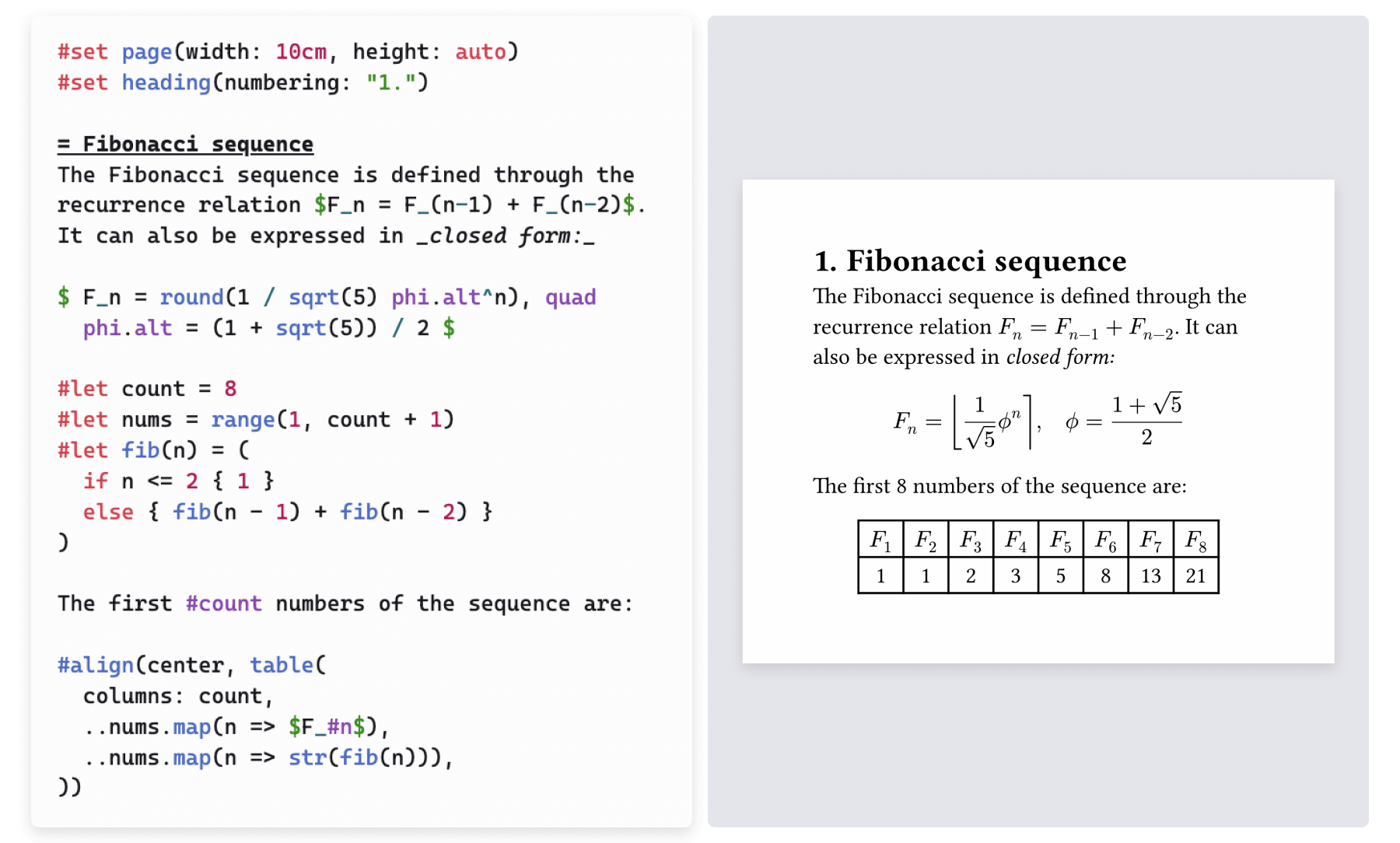
.typ source into a PDF in milliseconds.$sum_(i=1)^n x_i$) that is faster to type than LaTeX's backslash soup, with full support for matrices, alignment, and custom operators.\expandafter black magic required to generate tables programmatically..docx, and Markdown sources into Typst, which drastically shortens the migration path.#import line.
Developer sentiment on Hacker News and the Typst-heavy threads in r/LaTeX and r/typst is overwhelmingly positive, especially for anyone who has fought with LaTeX memory errors or opaque Overleaf build failures. Multiple top-voted HN comments describe the switch as "a massive win" and cite the sub-second preview and readable error messages as the features that close the deal.
The honest complaints are specific rather than general. Long-time LaTeX users on r/math have pushed back on Typst's math shorthand — for example writing limits as lim_(t -> oo) — arguing it feels like "reinventing the wheel" when their finger-memory for LaTeX commands is decades deep. Others note that using Typst as an embedded library inside Rust or other host languages is still rough, and that the template ecosystem, while growing, is younger than CTAN. None of these are dealbreakers for the core use case of writing documents.
The core compiler is free and open source under Apache-2.0 and always will be. The web app (typst.app) is freemium:
| Plan | Price | Key Limits |
|---|---|---|
| Free | $0/month | Unlimited projects, community templates, LaTeX/Word/Markdown import, 200 MB storage, up to 100 files per project |
| Pro | $7.99/month (~14% off annual) | Comments and review tools, private packages, GitHub/GitLab sync (experimental), Zotero/Mendeley integration, slide presentations, 2 GB storage, up to 1,000 files per project |
| On-Premises | Custom (min. 5 seats) | Self-hosted deployment, LDAP, org-wide packages and fonts, priority support |
Best for: researchers writing papers, PhD students working on theses, technical writers producing long-form reports, engineers generating invoices or regulatory documents from scripts, and anyone currently fighting Overleaf on a daily basis.
Not ideal for: people who need bit-for-bit reproduction of a specific LaTeX class that a journal still requires (though the IEEE, ACM, and Springer templates are already solid), or teams that have invested heavily in custom LaTeX tooling they cannot afford to migrate.
Pros:
Cons:
Overleaf / LaTeX: the incumbent — richer package ecosystem and journal support, but dramatically slower compiles and famously obscure errors. Quarto: great for data-science notebooks and reproducible reports, but less focused on pure typesetting. Pandoc + Markdown: fine for simple docs, but struggles with serious math, cross-references, and layout.
Yes — for most document-authoring jobs, Typst is the first LaTeX alternative in the last decade that actually delivers on the promise. The free tier and open-source compiler mean there is no risk to trying it on your next paper or report. We are comfortable rating it 85/100: it is not quite a 95 only because the package ecosystem and edge-case journal support still trail CTAN, and the math shorthand genuinely is an acquired taste. Anyone writing more than a few pages of structured documents per month should spend an afternoon with it.
ServiceNow and Accenture Launch Forward Deployed Engineering Program to Scale Agentic AI in the Enterprise (May 6, 2026)
At Knowledge 2026, ServiceNow and Accenture announced a joint forward deployed engineering program that drops co-located engineer pods into customer environments to ship agentic AI workflows natively on the ServiceNow AI Platform — with access to 300+ pre-built agent skills and the AI Control Tower as the governance backbone.
May 7, 2026
ReFiBuy Raises $13.6M Seed to Help Brands Get Recommended by AI Shopping Agents (May 5, 2026)
ReFiBuy, the Raleigh-based agentic commerce platform from ChannelAdvisor founder Scot Wingo, closed an oversubscribed $13.6M seed led by NewRoad Capital Partners on May 5, 2026 — betting that the next billion-dollar e-commerce moat is being chosen by ChatGPT, Claude and Perplexity.
May 7, 2026
OpenAI Replaces ChatGPT's Default Model With GPT-5.5 Instant — 52.5% Fewer Hallucinations, 30% Shorter Answers (May 5, 2026)
OpenAI on May 5 swapped GPT-5.3 Instant for the new GPT-5.5 Instant as ChatGPT's default model, claiming 52.5% fewer hallucinated claims on high-stakes prompts and 30% more concise answers. The model also rolls into the API as chat-latest and adds personalization from Gmail and past chats for Plus and Pro web users.
May 7, 2026