
 Developer Tools
Templ
Type-safe HTML templating language for Go with compile-time safety
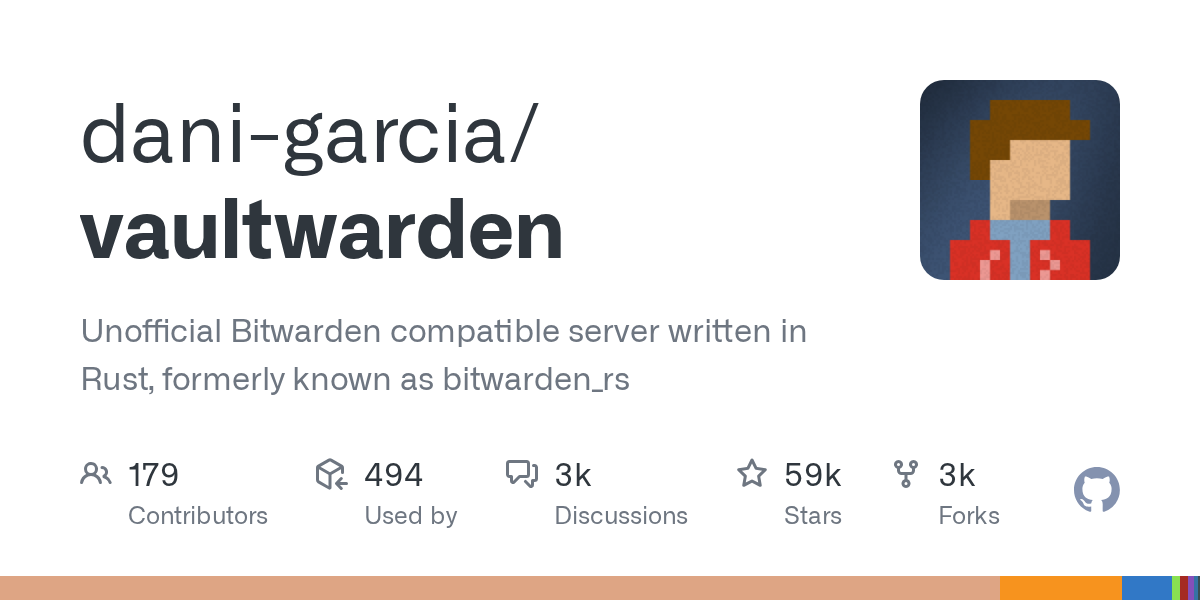
Vaultwarden is a Rust-based, drop-in Bitwarden-compatible server that runs in 50 MB of RAM and unlocks every Premium feature for free. The most popular self-hosted password manager in 2026.
Vaultwarden is an unofficial, drop-in compatible Bitwarden server written in Rust that lets you self-host every Bitwarden client — browser extensions, mobile apps, desktop apps, the CLI — on a fraction of the resources, and unlocks every paid Bitwarden Premium feature for free. We rate it 92/100 — the most efficient and most popular self-hosted password manager you can deploy in 2026, ideal for homelabbers, privacy-focused individuals, and small families or teams who want full control of their secrets without paying per seat.
Vaultwarden was created by Spanish developer Daniel García (dani-garcia), with the first commit landing on under the original name bitwarden_rs. It was renamed to Vaultwarden in at the request of Bitwarden Inc. to remove brand confusion. The project lives at github.com/dani-garcia/vaultwarden and is licensed under AGPL-3.0. As of the repository sits at 59,368 stars and 2,737 forks, with the latest stable release v1.35.8 shipped on .
Vaultwarden replaces Bitwarden’s official .NET-based self-hosted server with a single Rust binary that speaks the same API. You point any Bitwarden client at your Vaultwarden URL and it just works — same vault encryption (AES-256, PBKDF2/Argon2id), same end-to-end model, same sync. The difference is operational: where the official Bitwarden self-host stack pulls eleven Docker containers and asks for 2 GB of RAM, Vaultwarden runs as one container with SQLite or Postgres, idles around 50 MB of RAM, and is comfortable on a Raspberry Pi.
bw CLI — no client forks required./admin: Argon2-token-protected dashboard for user management, invitations, diagnostics, SMTP settings, push-notification configuration, and database backups — no separate management container.
resources/ directory.Vaultwarden is the de-facto standard on r/selfhosted, where it has appeared in nearly every “what self-hosted services do you actually use?” thread for the past four years. Recurring praise centers on three things: how light it is on a Raspberry Pi or low-end VPS, how it unlocks Bitwarden Premium features without a subscription, and how clean the upgrade story is — docker compose pull && docker compose up -d is the entire patch flow. On Hacker News, threads about the project consistently call out Daniel García’s long-term, single-maintainer commitment as both a strength and a risk.
The honest complaints are also consistent. Vaultwarden has not had a third-party security audit on the scale of Bitwarden Inc.’s SOC 2 Type II reports, so security-conscious shops with compliance requirements still pay for the official server. Push notifications, while now supported via the Bitwarden relay, are still trickier to set up than on Bitwarden’s hosted offering. And users on G2 mention occasional friction with autofill on mobile browsers and a steeper bar to entry for non-technical family members compared to the hosted Bitwarden plan.
Vaultwarden itself is free, open source, and donation-funded. You only pay for the infrastructure you run it on. A typical small deployment fits comfortably inside the free tier of any major homelab option.
| Deployment Option | Typical Monthly Cost | Notes |
|---|---|---|
| Raspberry Pi 4 / 5 at home | $0 (electricity only) | Idles at ~50 MB RAM — runs alongside other services |
| Hetzner CX11 / Oracle Free Tier VPS | $0–$5 | Most popular VPS choice on r/selfhosted |
| DigitalOcean / Linode 1 GB droplet | $4–$6 | Add an automated backup snapshot for ~$1/month |
| Donations to the project | Optional | Via GitHub Sponsors and Liberapay |
Best for: homelabbers, privacy-conscious individuals, families wanting unlimited users without a $40/year Family plan, and small teams or freelancers comfortable maintaining a Docker container. Anyone who already runs services like Jellyfin, Immich, or Pi-hole and wants a similarly lightweight password manager will feel at home.
Not ideal for: enterprises with SOC 2 / ISO 27001 obligations, organizations that want vendor-backed support and a managed SLA, or non-technical users who don’t want to babysit a server. For those, Bitwarden’s hosted Teams or Enterprise plans (or 1Password Business) remain the right answer.
Pros:
Cons:
The closest direct comparison is the official Bitwarden self-hosted server, which is heavier (multi-container, ~2 GB RAM) but vendor-supported and audited. Bitwarden’s hosted Free / Family / Premium plans are the no-effort path for most non-technical users. 1Password is the polished commercial alternative if you don’t care about self-hosting. For teams that need fine-grained secrets management with rotation, HashiCorp Vault or Infisical serve a different but adjacent niche. For a more recent open-source web-vault alternative, look at Passbolt — team-first, GPG-based, and audited.
If you can run a Docker container, Vaultwarden is almost a no-brainer. It has been the most popular self-hosted password manager on Reddit, GitHub, and Hacker News for years for a reason: it gives you 95% of Bitwarden Premium for $0/month and idles in less RAM than a single browser tab. The only real reasons to choose something else are formal compliance requirements, or simply not wanting the operational responsibility of running a server. For everyone else — families, homelabbers, indie developers, privacy-first power users — Vaultwarden in 2026 earns its 92/100.
bw CLI all work without modification. You only change the server URL.ServiceNow and Accenture Launch Forward Deployed Engineering Program to Scale Agentic AI in the Enterprise (May 6, 2026)
At Knowledge 2026, ServiceNow and Accenture announced a joint forward deployed engineering program that drops co-located engineer pods into customer environments to ship agentic AI workflows natively on the ServiceNow AI Platform — with access to 300+ pre-built agent skills and the AI Control Tower as the governance backbone.
May 7, 2026
ReFiBuy Raises $13.6M Seed to Help Brands Get Recommended by AI Shopping Agents (May 5, 2026)
ReFiBuy, the Raleigh-based agentic commerce platform from ChannelAdvisor founder Scot Wingo, closed an oversubscribed $13.6M seed led by NewRoad Capital Partners on May 5, 2026 — betting that the next billion-dollar e-commerce moat is being chosen by ChatGPT, Claude and Perplexity.
May 7, 2026
OpenAI Replaces ChatGPT's Default Model With GPT-5.5 Instant — 52.5% Fewer Hallucinations, 30% Shorter Answers (May 5, 2026)
OpenAI on May 5 swapped GPT-5.3 Instant for the new GPT-5.5 Instant as ChatGPT's default model, claiming 52.5% fewer hallucinated claims on high-stakes prompts and 30% more concise answers. The model also rolls into the API as chat-latest and adds personalization from Gmail and past chats for Plus and Pro web users.
May 7, 2026
Is this product worth it?
Built With
Compare with other tools
Open Comparison Tool →