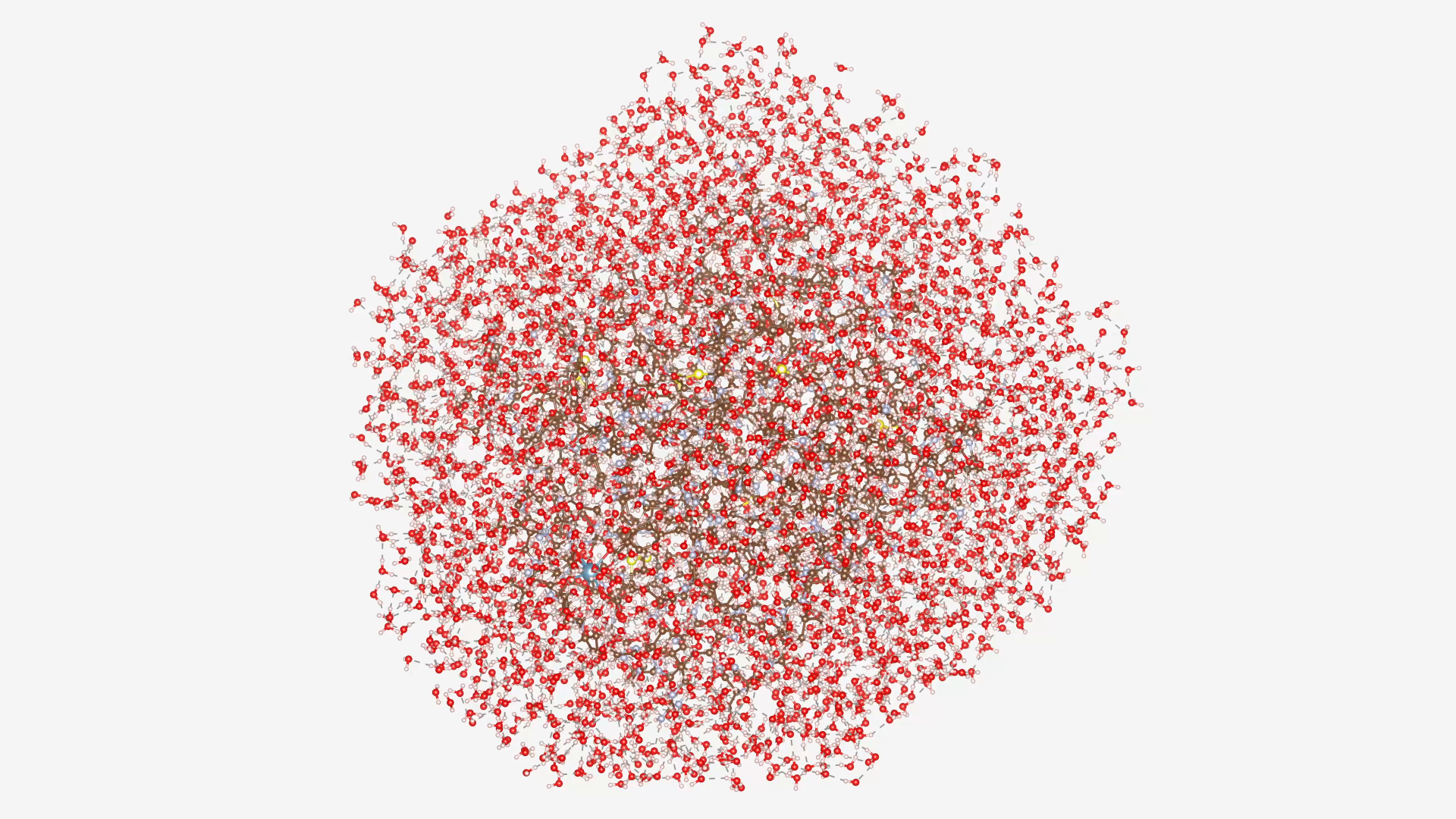
Cleveland Clinic, RIKEN and IBM Simulate 12,635-Atom Trypsin — Largest Protein Ever on Quantum Hardware (May 5, 2026)
On May 5, 2026, scientists at Cleveland Clinic, RIKEN and IBM modelled a 12,635-atom trypsin–ligand complex on IBM Heron quantum processors paired with Fugaku and Miyabi-G — 40× larger than what the same workflow could handle six months ago, and the largest biologically meaningful molecule ever simulated on quantum hardware.
On , researchers at Cleveland Clinic, Japan's RIKEN and IBM announced they had simulated protein–ligand complexes spanning up to 12,635 atoms — the largest biologically meaningful molecules ever modelled on quantum hardware. The work was carried out on IBM's 156-qubit Heron processors installed at Cleveland Clinic and RIKEN, running in tandem with two of the world's most powerful classical supercomputers, Fugaku and Miyabi-G.
What Happened
The team modelled two biochemically relevant proteins — T4-Lysozyme and Trypsin, each shown in solution with binding agents — using a quantum-classical hybrid algorithm called EWF-TrimSQD. Classical computers deconstructed each protein–ligand complex into computable fragments, IBM's Heron quantum processors calculated the quantum-mechanical behaviour of those fragments, and the results were reassembled on Fugaku at RIKEN and Miyabi-G (operated by the University of Tokyo and the University of Tsukuba) into a complete representation of each molecule. The simulation used up to 94 qubits running nearly 6,000 quantum operations in certain steps, and improved accuracy in the workflow's bottleneck step by up to 210× compared to six months ago. The pre-print is on arXiv and a full IBM Quantum write-up is here.

Key Details
- 12,635 atoms — Trypsin protein–ligand complex, 40× larger than what this workflow could simulate just six months ago.
- 156-qubit IBM Heron processors at Cleveland Clinic (Ohio) and RIKEN (Japan), with up to 94 qubits and ~6,000 quantum operations used per simulation.
- Classical partners: Fugaku at RIKEN and Miyabi-G operated by the University of Tokyo and the University of Tsukuba.
- Algorithm: EWF-TrimSQD, a new quantum-classical hybrid that reduced computational overhead and pushed accuracy in a key step up to 210× higher than the prior approach.
- Funding: Supported by Japan's NEDO under METI's Post-5G quantum-supercomputer hybrid platform project (JPNP20017), led by RIKEN's Mitsuhisa Sato.
What Researchers Are Saying
Lead author Kenneth Merz, Ph.D., staff scientist in Cleveland Clinic's Computational Life Sciences Department, framed the result as a scale milestone: by crossing the 12,000-atom barrier the team has "significantly expanded the scale of biologically meaningful molecular simulations possible with quantum computing." Jay Gambetta, Director of IBM Research and IBM Fellow, was more pointed: "For years, quantum computing has been a promise. Now, quantum computers are producing results that matter to science." Independent quantum coverage from The Quantum Insider and Quantum Computing Report echoed both points without claiming a quantum advantage — the team explicitly does not argue that classical-only methods could not reach the same answer, only that this is the first time a workflow of this size has been carried out with a quantum component in the loop.
What This Means for Developers and Drug Discovery
Predicting how a drug candidate binds to a target protein is one of the most expensive bottlenecks in pharma R&D — getting the energy calculations exactly right has historically only been possible for tiny molecules, and the rest of the discovery pipeline has had to lean on approximations that fail as molecules scale. A workflow that can model 12,000+ atom protein–ligand complexes with high-accuracy energetics would, in principle, shorten the multi-decade and multi-billion-dollar timeline for drug development. Practically, the EWF-TrimSQD algorithm is still pre-print research running on shared lab hardware, not a packaged tool — but it lowers the bar for what counts as "useful quantum" from toy systems to molecules biologists actually care about, which is exactly the threshold IBM has been pointing to in its 2026 quantum-centric supercomputing roadmap.
What's Next
The team has framed the 12,635-atom result as a starting point, not a finish line, and explicitly says there is a clear path to further increase both the size and accuracy of these calculations. IBM's near-term roadmap focuses on its quantum-centric supercomputing stack — pairing Heron-class processors with classical exascale machines via algorithms like EWF-TrimSQD — with the explicit goal of simulating enzyme catalysts and full drug-binding mechanisms that today rely on physical experimentation.
Sources
- IBM Newsroom — Official press release (primary source, May 5, 2026)
- IBM Quantum Blog — Quantum-centric supercomputing simulates 12,635-atom protein (technical write-up)
- Cleveland Clinic Newsroom announcement
- The Quantum Insider — Independent coverage
- Quantum Computing Report — Cleveland Clinic, RIKEN and IBM Simulate 12,635-Atom Protein Complex
- Yahoo Tech — Largest ever protein model hits 12,635 atoms with 210× accuracy boost
Stay up to date with Doolpa
Subscribe to Newsletter →