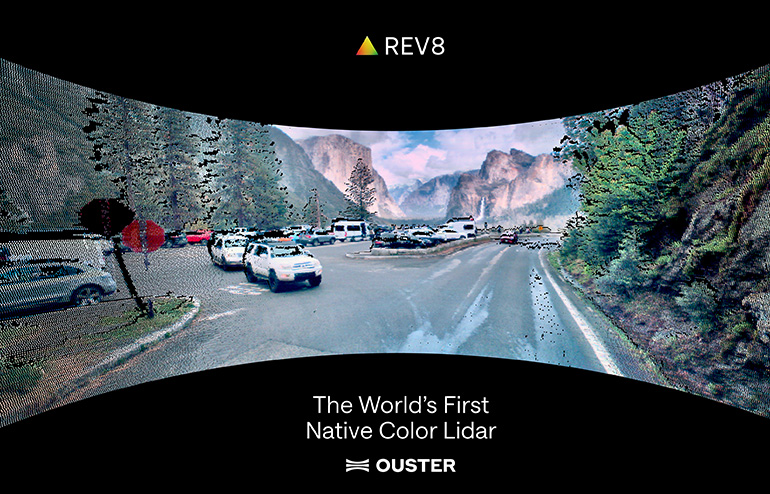
Ouster Launches REV8 — World's First Native Color Lidar That Could Replace Cameras (May 4, 2026)
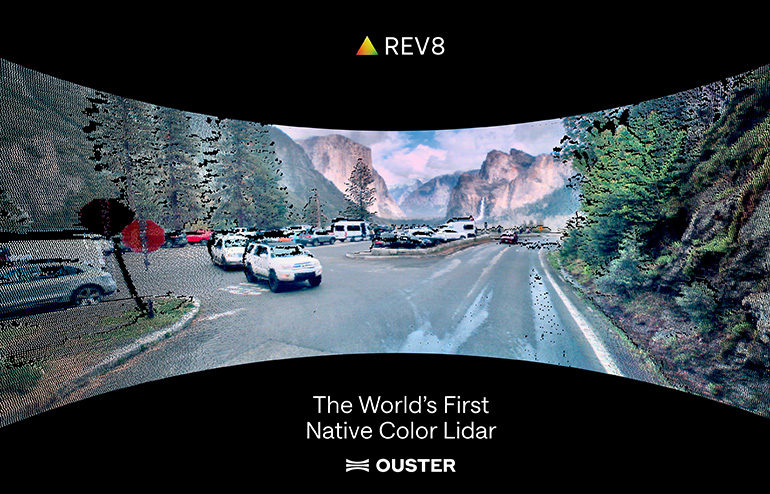
On May 4, 2026, San Francisco-based Ouster unveiled REV8, a new family of digital lidar sensors that capture full-color imagery and 3D depth on a single chip. CEO Angus Pacala calls native color lidar a decade-in-the-making 'holy grail' that lets robots and autonomous vehicles ditch separate cameras altogether.
San Francisco-based Ouster Inc. on unveiled REV8, a new family of digital lidar sensors that the company says is the world’s first to fuse 3D depth measurement and full-color imagery on a single chip. CEO Angus Pacala told The Robot Report that REV8 represents a “paradigm shift in AI perception” and is the foundation for replacing the separate camera + lidar stacks that today dominate self-driving cars, humanoid robots, and industrial automation.
What Happened
Ouster (NYSE: OUST) announced the REV8 OS sensor family on Monday morning via a BusinessWire press release and a simultaneous TechCrunch exclusive. The launch is built around the company’s next-generation L4 Ouster Silicon, a custom chip that combines lidar single-photon avalanche diode (SPAD) detectors with embedded Fujifilm color-science circuitry. The result is a sensor that captures color and depth as one pre-fused 3D point cloud rather than two streams that have to be calibrated together in software.
“With the L4 Ouster Silicon, we are delivering on the promise of our digital architecture to deliver exponential improvements in performance, doubling our core specs, and simultaneously introducing the world’s first native-color lidar to give machines 3D human-like sight for the next era of physical AI,” Pacala said in the official statement. He told The Robot Report that the move from being a “pure-play lidar vendor” to a sensing-and-perception platform is the strategic rationale behind the company’s acquisition of vision-perception startup StereoLabs for roughly $35 million plus 1.8 million shares.
Key Details
- Native color lidar: 48-bit color depth, 116 dB of hardware-enabled HDR dynamic range, with usable performance from 1 lux to 2 million lux. Every point is “born” with color, eliminating the calibration step required in two-sensor camera + lidar stacks.
- Doubled range and resolution: Up to 2× the previous generation. The flagship OS1 Max (256 channels) sees up to 200 m at 10% reflectivity, with a maximum detection range of 500 m and a 45-degree vertical field of view.
- L4 silicon performance: 42.9 GMACs of on-chip compute, 40 kHz measurement rate with picosecond timing, 10.4 million points/second, and 22.4 Gbps of data off-chip. The chip also detects up to 20 trillion photons per second.
- Lineup: Four redesigned sensors — OS0 (short-range wide FOV), OS1, OSDome (hemispherical), and the new flagship OS1 Max — using either the 128-channel L4 or 256-channel L4 Max silicon. All variants are automotive-grade and designed for functional safety.
- Customer roster: Ouster named more than 20 announced partners, including Google, Volvo Autonomous Solutions, Liebherr, Epiroc, Skydio, PlusAI, Field AI, Seegrid, Gecko Robotics, Burro, Pratt Miller, Cyngn, and SwarmFarm.
- Availability: REV8 OS sensors are available to order today from Ouster, with shipments beginning this quarter. NVIDIA Jetson native support for REV8 was announced the following day, on .
What Developers and Robotics Teams Are Saying
On the Open Robotics Discourse thread, ROS contributors flagged that single-sensor color lidar removes a long-standing pain point in autonomy stacks: spatio-temporal calibration between camera and lidar feeds, which is fragile under vibration and lighting changes. Reaction on Hacker News and r/robotics was mixed but largely positive — commenters praised the hardware-fused architecture, but several noted that the OS1 Max’s 200 m at 10% reflectivity still trails Luminar’s automotive-grade Iris (300 m+ at 10%) for highway-speed AV use cases. Pacala addressed that concern directly to The Robot Report: “Some people have seen cameras and lidars as being at odds, but not for our customers. It’s a matter of using the right sensor for the job.”
MicroVision CEO Glen DeVos, quoted in TechCrunch’s February coverage of the StereoLabs deal, said the sensor industry is “ripe for consolidation” — framing REV8 as the productized output of that consolidation playing out in the market.
What This Means for Developers and Robotics Teams
For autonomy and robotics engineers, REV8 collapses two pipelines into one. Teams that previously fused a Sony IMX-class image sensor with a separate Ouster or Velodyne lidar will now get a single colorized point cloud out of the box, with hardware-aligned timestamps and pixel-to-point correspondence. Pacala framed it as “picks and shovels” for physical AI: the same sensor stack works on humanoids, delivery robots, traffic infrastructure, and passenger vehicles, fed into NVIDIA Jetson edge GPUs that already have native REV8 driver support as of .
The pricing implication matters too. Ouster is positioning REV8 as cheaper and smaller than its previous generation while delivering more capability — a cost curve that, if it holds up in shipped units, could pressure the still-fragmented automotive lidar market and accelerate the camera-or-lidar debate that has divided Tesla and the rest of the AV industry for years.
What’s Next
Ouster says REV8 OS sensors are shipping this quarter, with the first wave of named customers including Volvo Autonomous Solutions, Skydio, and Seegrid expected to integrate them in 2026 deployments. The company is also pushing developer tooling: a unified perception platform that bundles REV8 hardware with the StereoLabs AI stack and edge-compute integration on NVIDIA Jetson. Investors will likely look to Ouster’s next earnings report — the company has not yet provided a specific REV8 unit-economics or backlog figure beyond the partner list announced today.
Sources
- Ouster Investor Relations — Official REV8 OS Family Press Release — primary source, May 4, 2026.
- TechCrunch — Exclusive interview with CEO Angus Pacala — technology framing and market context.
- The Robot Report — REV8 launch with detailed specifications — secondary trade-press coverage.
- Open Robotics Discourse — ROS community discussion — developer reaction.
- StockTitan — NVIDIA Jetson native REV8 support announcement — ecosystem follow-up, May 5, 2026.
- TechCrunch — Ouster acquires StereoLabs ($35M) — February 2026 background on the strategic move that enabled REV8.
Stay up to date with Doolpa
Subscribe to Newsletter →