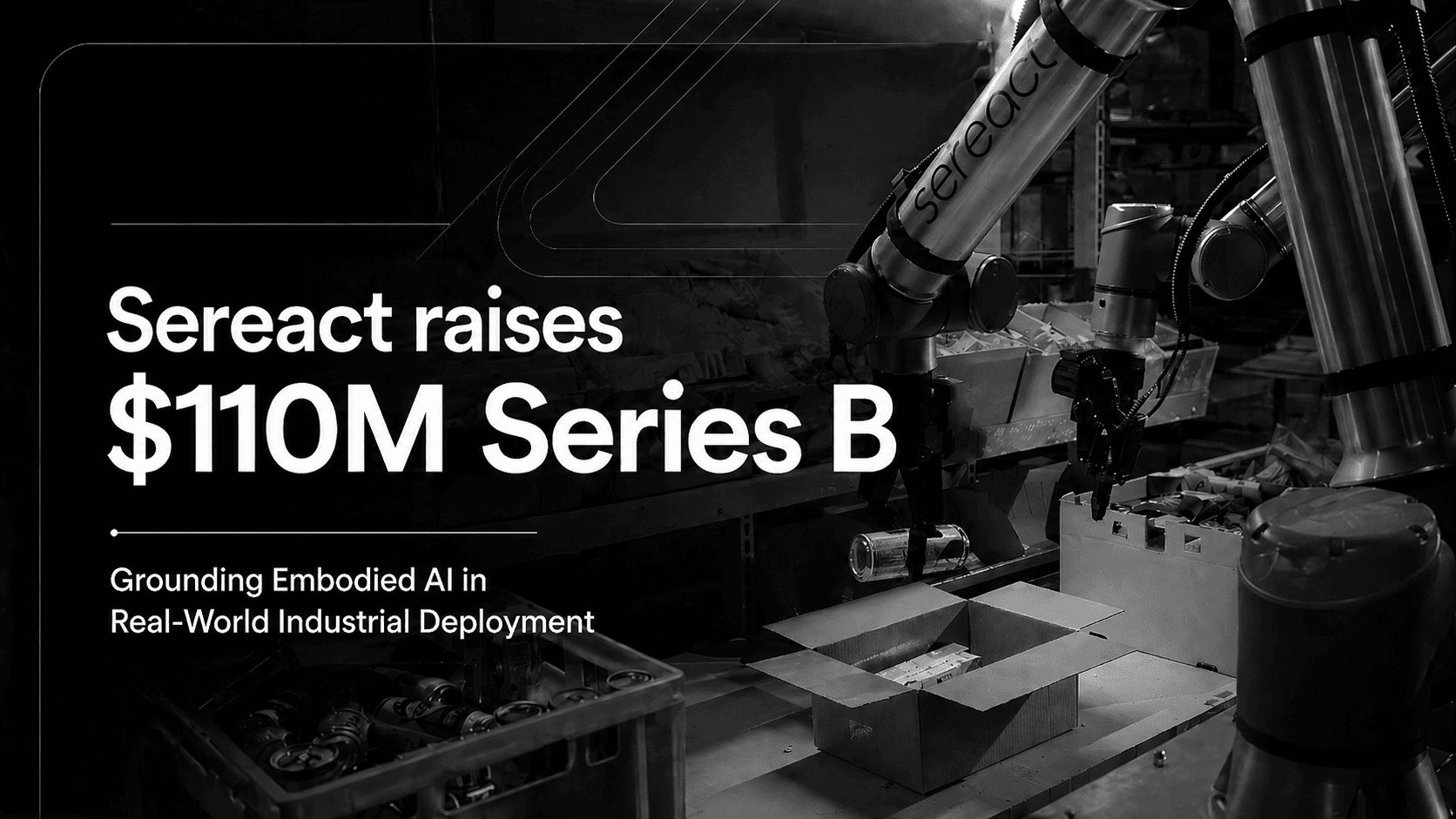
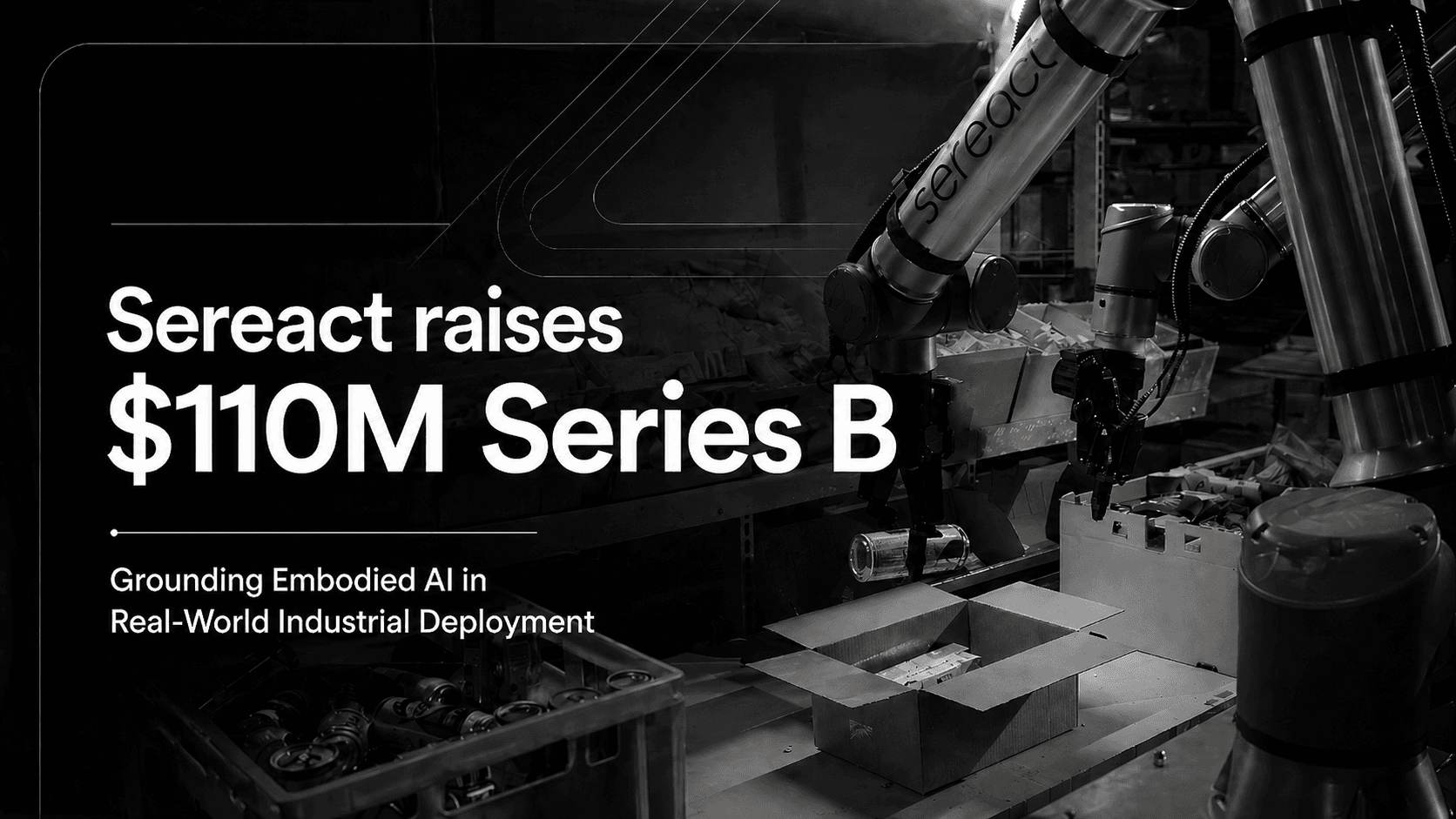
Sereact Raises $110M Series B to Scale Cortex 2.0 Robotic Brain
German physical-AI startup Sereact raised a $110M Series B led by Headline on April 26, 2026, to scale its Cortex 2.0 world-model robotic brain and open a first US office in Boston. The company has 200+ systems live across Europe at BMW, Daimler Truck, Mercedes-Benz, and PepsiCo, with over 1 billion real production picks completed.
German physical-AI startup Sereact on announced a $110 million Series B led by Headline, with the funding earmarked for two priorities: scaling its next-generation Cortex 2.0 "robotic brain" and opening a first US office in Boston this summer. The round — reported as €93 million in European media and confirmed at $110 million in Sereact's own post — brings the Stuttgart-based company's total funding to over $140 million.
What Happened
Sereact, headquartered in Stuttgart and founded in 2021 by CEO Dr. Ralf Gulde and CTO Marc Tuscher, raised a $110M Series B led by venture firm Headline (growth partner Trevor Neff), with participation from Bullhound Capital (founding partner Per Roman), Daphni, and Felix Capital (co-founder Antoine Nussenbaum). Existing investors Air Street Capital, Creandum (lead of the company's 2025 Series A), and Point Nine all returned for the round.
The round funds two priorities. The first is the launch of Cortex 2.0, the next generation of Sereact's "robotic brain" software. Where the current Cortex sees and picks reactively, Cortex 2.0 augments a vision-language-action (VLA) model with a learned world model — it generates candidate future trajectories, scores each one for stability, risk, and efficiency against a model of physics and object behavior, and commits only to the best-scored branch, updating the rollout in real time as the scene changes. The second priority is a US expansion: Sereact will open its first US office in Boston this summer and hire commercial, application, and engineering staff locally.
Key Details
- $110 million Series B — led by Headline; previous Series A in 2025 was led by Creandum. Total funding now exceeds $140 million.
- 200+ systems live across Europe — per Sereact, this makes the company the most deployed AI picking-robot operator in the world outside self-driving.
- 1 billion+ real production picks completed on the current Cortex software, with one human intervention per ~53,000 picks — a metric Sereact frames as a structural data-flywheel advantage over competitors training on simulation.
- Customer roster includes Active Ants, Austrian Post, BMW, bol., Daimler Truck, DeltiLog, Mercedes-Benz, Monta, MS Direct, PepsiCo, and Rohlik Group. BMW and Daimler Truck are production environments, not pilots.
- Hardware-agnostic by design — the Cortex brain runs across single-arm picking cells, dual-arm returns stations, humanoid robots, and fixed cells. Tuscher: "Hardware is becoming a commodity. The model isn't."
- First US office: Boston, opening summer 2026, with commercial, application, and engineering hires planned.
What Developers and Industry Are Saying
Coverage from Bloomberg, SiliconANGLE, The Next Web, and The Robot Report all converge on the same framing: a software-first European challenger to the humanoid-robotics arms race. Headline's Trevor Neff cast the bet bluntly: "The physical AI opportunity is one of the largest we've seen in a generation, and we believe it will rewire global supply chains and manufacturing."
Industry reaction also flagged a real differentiator: most VLA work in 2026 is happening in research labs on synthetic data, while Sereact's training corpus is over a billion picks of real production behavior. Per Roman of Bullhound Capital, who co-led with partner Alon Kuperman, said his team was "delighted to meet Ralf and Marc, the co-founders of Sereact, who have built an AI operating system that seamlessly retrofits into the world's vast fleet of industrial robots already in action." That last point — retrofitting existing industrial fleets rather than selling new humanoid hardware — is the part Hacker News commenters keep returning to: it's a more capital-efficient path to revenue than the hardware-and-vertical-integration approach being funded at humanoid-robotics startups raising billion-dollar rounds.
What This Means for the Industry
Sereact's pitch puts a number on a question that's gone unanswered in the physical-AI gold rush: how much real-world data does it take before a VLA model is reliable enough for production? The company's claim — one human intervention per ~53,000 picks across 200+ live deployments at BMW, Daimler Truck, Mercedes-Benz, and PepsiCo — is the kind of operational metric the rest of the field has not yet matched in production. If Cortex 2.0's planning-before-acting world model holds up at scale, the bar for what counts as a "deployable" robotics AI just moved.
For developers and integrators, the practical implication is that the same software stack will increasingly run across single-arm cells, dual-arm returns stations, humanoids, and fixed cells — meaning hardware choice becomes a procurement decision rather than a software lock-in. That's bullish for the long tail of European industrial robot OEMs (KUKA, ABB, Universal Robots) and bearish for any robotics startup whose only moat is bespoke hardware.
What's Next
Cortex 2.0 is ramping toward production deployment in 2026, with Sereact targeting use cases where contact matters — component assembly under tension, windshield-wiper placement without scratching, parts kitting that has to land in a specific orientation for the next station — rather than the simpler picking already covered by Cortex 1. The Boston office opens this summer, and Sereact says hiring is already underway. Watch for the first US customer announcement, follow-on raises in the same physical-AI category, and how humanoid-robotics players respond to a software-first competitor reaching production scale before they do.
Sources
- Sereact — "Sereact Raises $110M Series B" (primary source; founders' quotes, customer roster, Cortex 2.0 technical details)
- Bloomberg — "AI Startup Sereact Raises $110 Million for Robots That Predict Consequences"
- SiliconANGLE — "Sereact raises $110M to scale AI 'robotic brain' and expand into the US"
- The Next Web — "Sereact raises $110 million to scale its AI that makes any robot adaptable"
- The Robot Report — coverage and Cortex 2.0 deep dive
- Tech.eu — European-market angle on the round
- EU-Startups — €93M EUR equivalent and BMW/PepsiCo customer breakdown
Stay up to date with Doolpa
Subscribe to Newsletter →