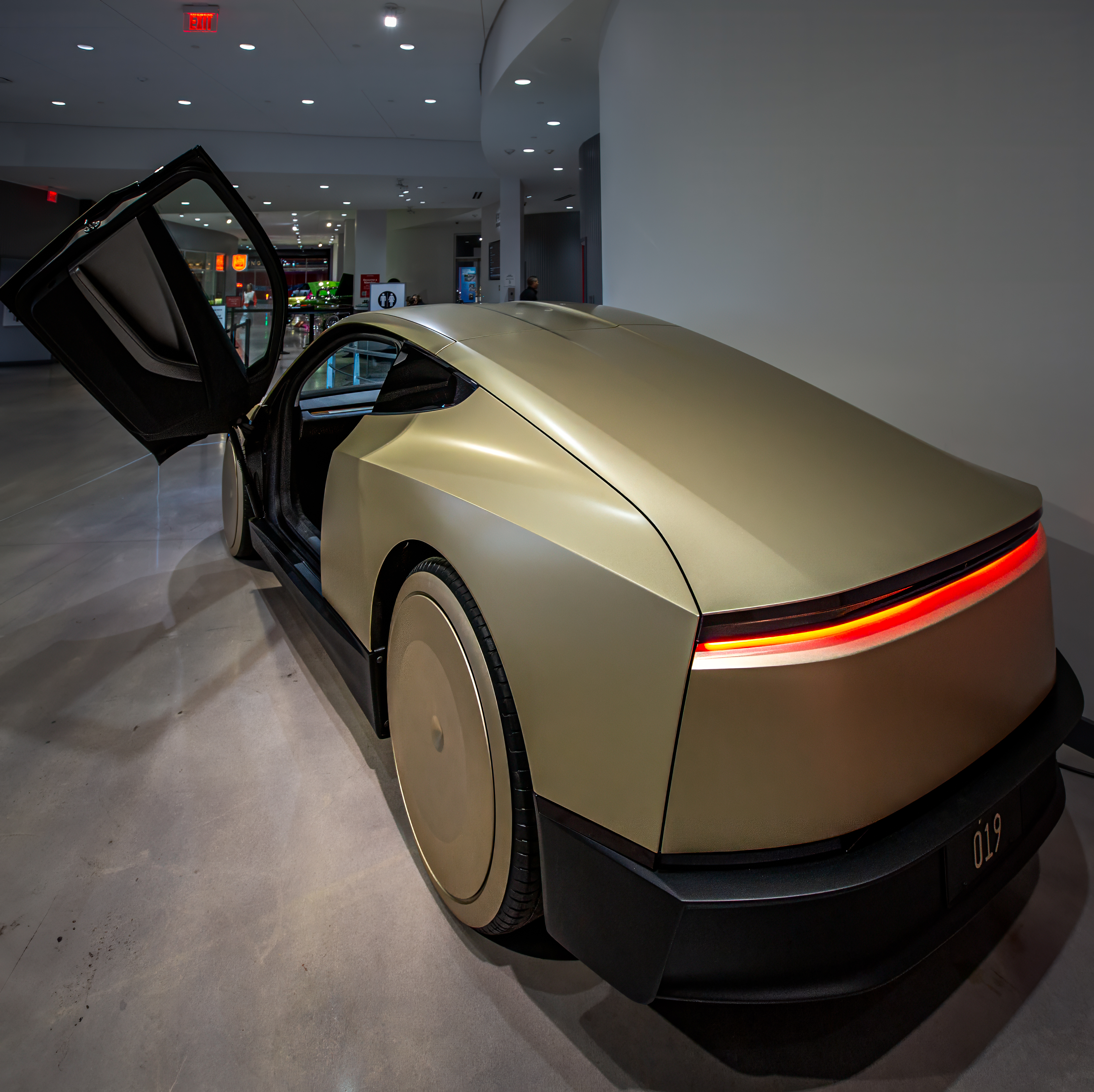
Tesla Starts Cybercab Production, Hikes Capex to $25B (April 2026)
Tesla confirmed at its April 22, 2026 Q1 earnings call that Cybercab volume production has officially begun at Giga Texas and raised its 2026 capex plan to over $25 billion — nearly triple last year — to fund AI, Optimus, the Cybercab ramp and a new Austin chip fab.
Tesla on confirmed that volume production of the Cybercab robotaxi has officially begun at Giga Texas and raised its 2026 capital-expenditure plan to more than $25 billion — nearly triple the $8.6 billion it spent in 2025 — to fund AI, Optimus, an in-house chip fab and the Cybercab ramp. CEO Elon Musk warned investors not to expect material Cybercab revenue before 2027.
What Happened
The announcement came during Tesla’s Q1 2026 earnings call, where the company reported $22.4 billion in revenue (up 16% YoY), $0.41 non-GAAP EPS, and 358,023 vehicle deliveries against 408,386 produced — building roughly 50,000 more vehicles than it sold.
The headline news was capex: Tesla raised its 2026 plan to “more than $25 billion,” up from the “over $20 billion” it guided in January. Musk told analysts the increase covers six new factories, the Optimus humanoid’s first volume production line, the Cybercab and Semi ramps, AI infrastructure including the Cortex training cluster, and a new dedicated chip fabrication facility in Austin.
VP of Vehicle Engineering Lars Moravy then confirmed that Cybercab production has begun at Giga Texas. Multiple drone observers including Teslarati have since spotted approximately 60 finished Cybercab units parked outside the Austin facility. Tesla’s first prototype Cybercab rolled off the line on ; the April announcement marks the official transition to volume production.

Key Details
- $25B+ 2026 capex — up from $8.6B in 2025 and $20B in January’s guidance, covering AI, Optimus, Cybercab, Semi, Megapack 3 and a new Austin chip fab.
- Cybercab now in volume production at Giga Texas, with ~60 units already spotted on-site by drone photographers.
- No NHTSA 2,500-vehicle annual cap — Lars Moravy confirmed Cybercab is FMVSS-compliant on its own, so it does not fall under the federal autonomous-vehicle production cap that applies to waiver-based AV programs.
- Optimus volume production targeted for the late-July to August 2026 window, with a public unveil tied to that ramp.
- Unsupervised FSD & Robotaxi targeted to be live in “a dozen or so states” by year-end 2026.
- S-curve warning: Musk explicitly told investors initial Cybercab and Semi output “will be very slow, but then ramping up and going kind of exponential towards the end of the year,” and that material Cybercab revenue is unlikely before 2027.
- Q1 2026 financials: $22.38B revenue (+16% YoY), $0.41 non-GAAP EPS (slight beat), 358,023 deliveries (~7,600 below consensus).
What Developers and Users Are Saying
Reaction was sharply mixed. Tesla shares popped roughly 4% in extended trading on the free-cash-flow beat, then gave back most of those gains once Musk laid out the capex jump on the call. Wedbush’s Dan Ives — one of Tesla’s loudest bulls — called the increase “a good (not a bad) thing” given the AI and robotaxi roadmap, while bears flagged the inventory build and the 7,600-unit delivery miss. Bloomberg’s live earnings blog highlighted that the $5B above-prior-guidance capex jump was the “single biggest surprise of the call.”
The Cybercab milestone landed best with retail and Tesla-focused communities. Threads on r/teslamotors and X picked up the drone shots of finished units at Giga Texas as the most concrete proof yet that the program is real, while skeptics on r/RealTesla pointed out that without Unsupervised FSD certified for public roads, the cars are inventory rather than revenue.
What This Means for Developers and Users
For developers building on Tesla’s stack — fleet APIs, charging integrations, FSD telemetry — the immediate impact is the timeline for Unsupervised FSD in a dozen-plus US states by year-end. That is the gating event for any third-party robotaxi or fleet product that depends on driverless Tesla operation. Optimus reaching volume production in late summer also opens a new robotics platform, though Tesla has not yet committed to a public SDK.
For consumers, the practical takeaway is that the Cybercab is now a manufactured car rather than a concept, but the rideshare experience tied to it is still pending regulatory approvals state-by-state. The dedicated robotaxi service Tesla teased in 2024 is unlikely to be broadly available before 2027, and pricing has not been disclosed.
What’s Next
Watch for three near-term milestones: (1) Optimus public unveil and volume ramp in late July–August 2026; (2) the first state-by-state activations of Unsupervised FSD, expected to roll out through the second half of the year; and (3) Tesla’s Q2 2026 earnings call, where investors will be looking for the first concrete Cybercab production numbers. The new Austin chip fab and Cortex AI training cluster will also be the venues where the bulk of the $25B capex is spent.
Sources
- CNBC — Tesla (TSLA) Q1 2026 earnings report — primary financial summary and capex guidance.
- Electrek — Tesla confirms Cybercab production has started despite delays in unsupervised driving — NHTSA 2,500-cap clarification and production status.
- Bloomberg — Tesla Starts Production of Cybercab Robotaxi, Musk Says — on-call quotes and S-curve warning.
- The Next Web — Tesla raises 2026 capex to $25 billion — capex breakdown and Austin chip fab details.
- Teslarati — Cybercab production ignites with 60 units spotted at Giga Texas — on-the-ground production evidence.
- Not a Tesla App — Everything Tesla Announced During Its Q1 2026 Earnings Call — full call recap and Optimus timeline.
- Yahoo Finance — Tesla Q1 analyst reaction — Dan Ives / Wedbush commentary and market reaction.
Stay up to date with Doolpa
Subscribe to Newsletter →