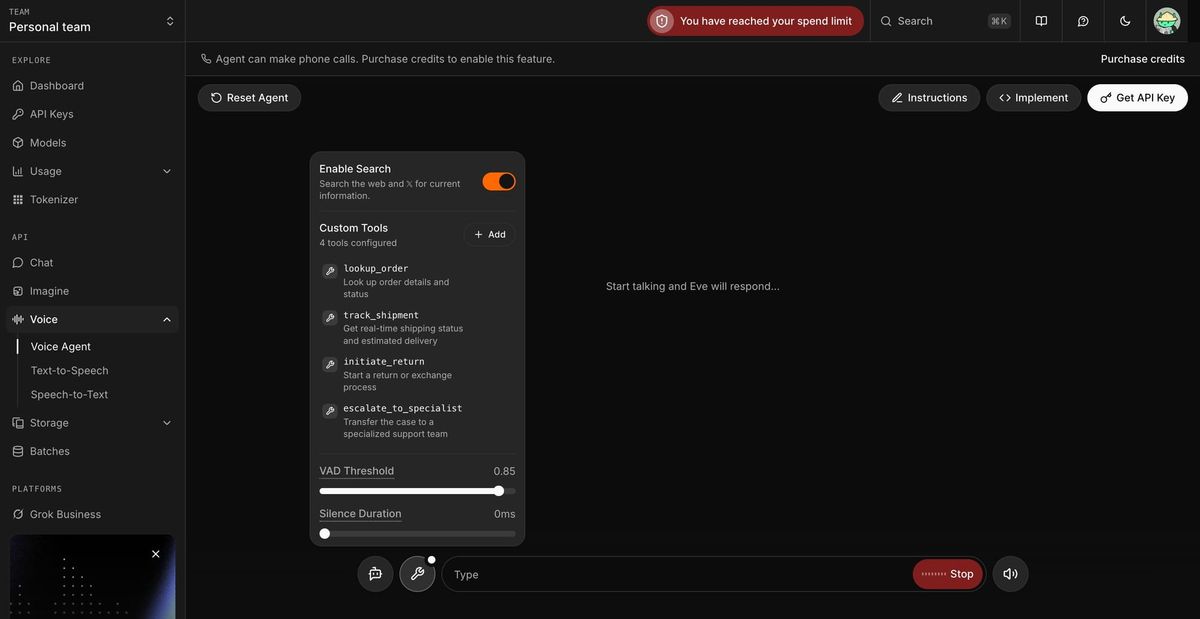
xAI Launches grok-voice-think-fast-1.0 — Tops τ-voice Bench at 67.3%, Powers Starlink Support (April 2026)
xAI on April 25, 2026 released grok-voice-think-fast-1.0, a flagship voice model that scored 67.3% on the τ-voice benchmark — beating Gemini 3.1 Flash Live, GPT Realtime 1.5 and its own predecessor by 24+ points. The model is already running Starlink's phone sales and support, autonomously resolving 70% of inquiries.
xAI on released grok-voice-think-fast-1.0, a new flagship voice model that scored 67.3% on the τ-voice benchmark — outperforming Google's Gemini 3.1 Flash Live (43.8%), OpenAI's GPT Realtime 1.5 (35.3%) and xAI's own previous Grok Voice Fast 1.0 (38.3%) by more than 24 points. The model is already in production powering Starlink's phone sales and customer support, where xAI says it autonomously resolves 70% of inquiries with no human in the loop.
What Happened
xAI announced the model in a blog post on , positioning it as the company's first voice model designed for "complex, ambiguous, multi-step workflows" rather than simple chatbots. The headline claim is a top-of-leaderboard result on τ-voice Bench, a benchmark that evaluates full-duplex voice agents under realistic conditions including background noise, regional accents, mid-sentence interruptions and natural turn-taking.
The release follows xAI's launch of standalone Grok speech-to-text and text-to-speech APIs, and rounds out a voice stack that the company is now pitching directly at OpenAI's Realtime API customers. Pricing remains the same as xAI's existing Grok Voice Agent API: $0.05 per minute of audio (about $3/hour), with tool invocations billed separately at $5 per 1,000 calls. The model is available immediately on the xAI Console for testing and via the Grok Voice Agent API for production traffic.

Key Details
- τ-voice Bench score: 67.3% — first place on the leaderboard, ahead of Gemini 3.1 Flash Live (43.8%), Grok Voice Fast 1.0 (38.3%) and GPT Realtime 1.5 (35.3%).
- Background reasoning — the model "thinks" while it talks, using inference time to plan multi-step actions without adding to perceived latency. xAI says response latency stays in the same envelope as its non-reasoning Grok Voice Fast model.
- Structured-data extraction — designed to capture email addresses, street addresses, phone numbers, account numbers and full names accurately even with strong accents, fast speech and disfluencies.
- Starlink in production — a single grok-voice-think-fast-1.0 agent calls 28 distinct tools across Starlink's phone-sales and support workflows, delivering a reported 20% sales conversion rate and 70% autonomous-resolution rate on inbound support calls.
- Pricing — flat $0.05 per minute of audio, plus $5 per 1,000 tool invocations. No separate per-token charge for the voice model itself.
- Availability — live on the xAI Console and Grok Voice Agent API as of April 25, 2026; same SDKs as the previous Grok Voice models, so existing integrations only require swapping the model name.
What Developers and Users Are Saying
Reaction across Hacker News, Reddit's r/MachineLearning and developer threads on X has been split between cautious enthusiasm and skepticism. Developers building on OpenAI's Realtime API and Google's Gemini Live have flagged the latency claims and the $0.05/minute price as the two numbers that, if they hold under load, make grok-voice-think-fast-1.0 immediately competitive — particularly for telephony and call-center deployments where token-based pricing has been hard to model. The Times of AI summarised the early developer mood as "if these numbers survive production, OpenAI Realtime customers will start looking elsewhere."
The main pushback is that the headline 67.3% τ-voice number comes from xAI's own evaluation harness, and there are no independent reproductions yet. Several Hacker News commenters noted that voice benchmarks are notoriously sensitive to audio preprocessing and turn-taking heuristics, and called for a third-party evaluation before treating the gap over Gemini and GPT Realtime as settled. The Starlink case study has also drawn questions: a 70% autonomous-resolution rate is striking, but xAI has not published the volume mix or how "resolution" is measured.
What This Means for Developers
For teams already shipping voice agents, this is a meaningful new option rather than an industry reset. The competitive picture now: grok-voice-think-fast-1.0 ($0.05/min, leads τ-voice), Gemini 3.1 Flash Live (cheap, multilingual, half the benchmark score), GPT Realtime 1.5 (deepest tooling ecosystem, lowest benchmark score on τ-voice), and Grok Voice Fast 1.0 (same xAI stack at lower cost for simpler workflows). The path of least resistance is to A/B the new model against your current provider on a real workflow rather than a synthetic benchmark — xAI has kept the API surface compatible with its earlier voice models, so the swap is essentially a model-name change.
Engineers building tool-heavy voice agents (booking, support triage, structured-data capture from phone calls) are the most obvious beneficiaries: the background-reasoning approach is specifically designed for workflows where the agent needs to plan multi-tool calls without long pauses. Teams that only need simple TTS or transcription should keep using xAI's separate STT/TTS APIs from the April 18 release — the new model is overkill for one-shot use cases.
What's Next
xAI says wider rollout, additional language coverage and on-prem deployment options are on the near-term roadmap, and that the model will continue to ship inside Starlink's phone systems as the public reference deployment. Independent τ-voice numbers from Artificial Analysis and academic groups are expected within a few weeks. Developers can read the full announcement and try the model on the xAI blog post or the xAI developer console.
Sources
- xAI — Grok Voice Think Fast 1.0 announcement — primary source, benchmark numbers and Starlink stats.
- MarkTechPost — independent coverage of the τ-voice leaderboard.
- TestingCatalog — developer-focused walkthrough including the xAI Console screenshot.
- Times of AI — community reaction and analysis.
- xAI Models & Pricing — current Grok API model list and per-minute voice pricing.
- MarkTechPost — Grok STT/TTS APIs (April 18) — context on the prior week's voice-stack release.
Stay up to date with Doolpa
Subscribe to Newsletter →