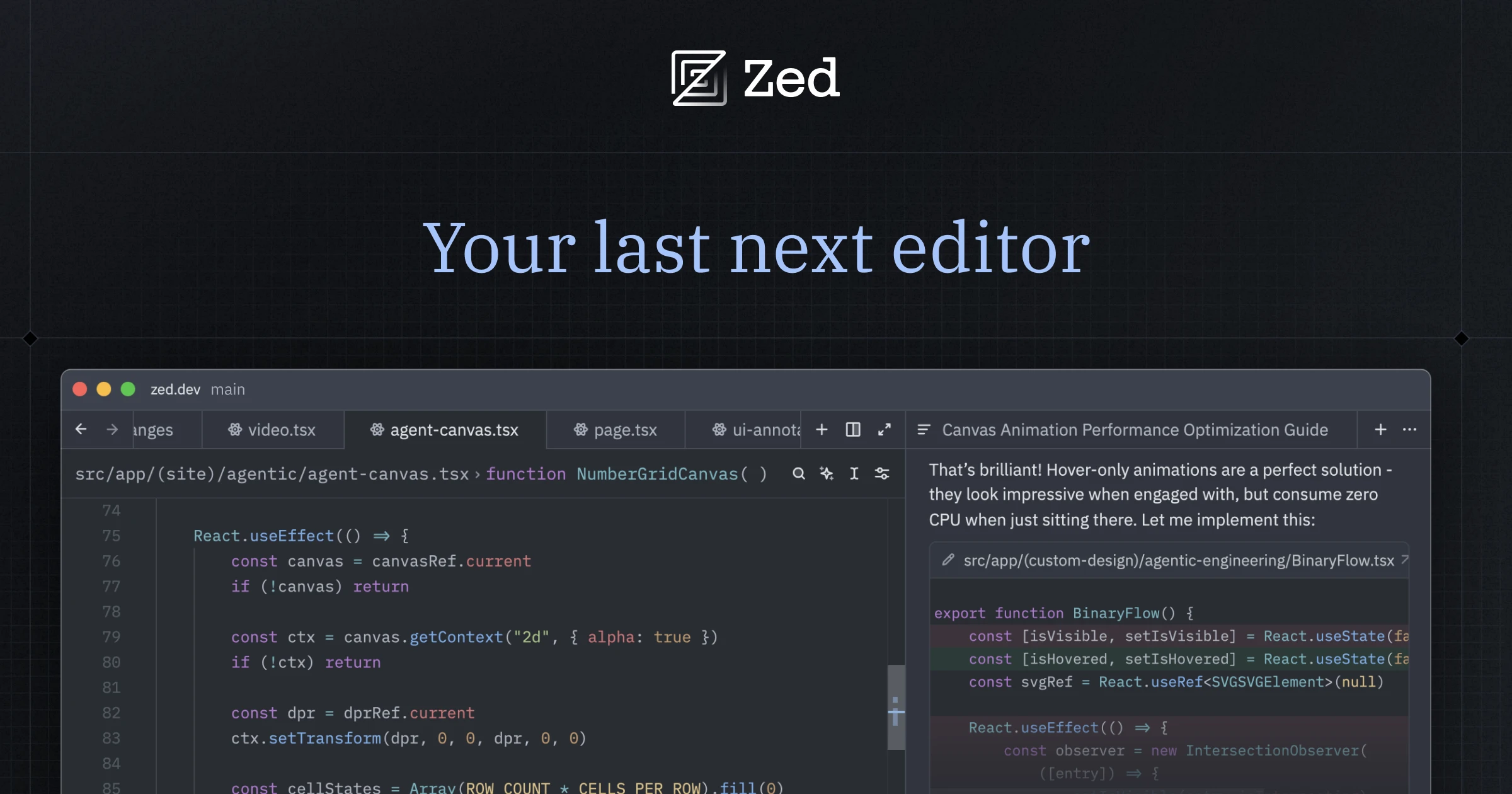
Zed 1.0 Released — GPU-Accelerated Rust Editor From the Atom Creators Hits Stable (April 29, 2026)
Zed Industries shipped Zed 1.0 on April 29, 2026 — the first stable release of its GPU-accelerated, Rust-built code editor from the team behind Atom and Tree-sitter. After 5 years and 1M+ lines of Rust, the editor trended #2 on Hacker News with 1,140+ points.
Zed Industries on released Zed 1.0, the first stable release of its GPU-accelerated, multiplayer code editor — capping more than five years of work, over a million lines of Rust, and a public preview that hundreds of thousands of developers have been running daily. CEO and co-founder Nathan Sobo — previously the lead architect of GitHub’s Atom and the co-creator of Tree-sitter — said the editor is “neither done nor perfect” but has “reached a tipping point where most developers can feel quickly at home.”
What Happened
Sobo posted the milestone on the Zed blog and tagged v1.0.0 on the zed-industries/zed repository at 14:31 UTC on April 29. The release marks Zed’s graduation from a preview project to a product the team is willing to recommend for daily use across macOS, Windows and Linux. The repository now sits at 81,000+ GitHub stars, putting it among the most starred developer tools released in the past five years.
Zed’s pitch is architectural: instead of building on Electron, the team wrote their own UI framework, GPUI, in Rust, and organized the entire application around feeding data to shaders running on the GPU — closer to how a video game renders frames than how a typical desktop editor draws text. Sobo argued in the launch post that the editor’s performance characteristics — 0.12 s startup vs. roughly 1.2 s for VS Code, ~2 ms input latency vs. ~25 ms, and 222 MB resident memory vs. ~3.5 GB on the same project — are downstream of that decision and not achievable inside an Electron shell.
Key Details
- Tagged release:
v1.0.0on April 29, 2026, the company’s standard weekly cadence; bug fixes plus new bookmarks support, agit: view commitcommand palette action, GIF animation in Markdown preview, and DeepSeek-V4-Pro / V4-Flash model integrations. - Platforms: Stable builds for macOS (Apple silicon and Intel), Linux (x86_64 and aarch64), and Windows — the latter promoted out of preview at 1.0.
- Pricing: Personal plan free forever with 2,000 accepted edit predictions per month and unlimited use with your own LLM API keys; Pro at $10/month (unlimited predictions, $5 of token credits, +10% over API list price for hosted usage); Enterprise on contract with SSO and shared billing.
- Differentiators: First-class collaborative editing (multi-cursor pair programming over the network), built-in AI agent panel with bring-your-own-keys for Anthropic, OpenAI, GitHub Copilot, DeepSeek, Mistral, Google AI, Ollama, OpenRouter, Vercel and others, and an extension API written in Rust + WebAssembly rather than JavaScript.
What Developers and Users Are Saying
Zed 1.0 trended at #2 on Hacker News with more than 1,140 upvotes within hours of the announcement. The dominant top-comment sentiment is that Zed is “everything I wanted Sublime to be” — fast, native, batteries-included, and shipping with high-quality language support out of the box rather than requiring extensive plugin configuration. Frustration with VS Code’s memory consumption is a recurring trigger for migration, with multiple commenters reporting that Zed feels physically faster to type into.
The criticism is also consistent. Several long threads on Hacker News and r/rust focus on the immaturity of the extension ecosystem versus VS Code’s, missing remote-development workflows for some setups, and a now-discussed concern that Zed downloads and runs Node.js automatically for certain language servers without explicit user consent. The Phoronix and Linuxiac coverage flagged the same trade-off: blazing performance, smaller surface area than VS Code today.
What This Means for Developers
1.0 is the first time Zed Industries is publicly recommending the editor for production use. Practically, that means stable APIs for extensions, semantic versioning going forward, and a commitment that the on-disk settings format is now durable across releases. For teams currently on VS Code, Cursor or Sublime, Zed is now a credible side-by-side trial: the Personal tier is genuinely free and the bring-your-own-keys mode means you can plug an existing Anthropic or OpenAI key in without paying Zed’s +10% margin. The biggest open question is extensions — if your daily VS Code workflow depends on niche extensions, expect gaps.
What’s Next
The official roadmap (linked from the blog post) calls out deeper agent / subagent workflows, more language-server polish on Linux and Windows, and continued investment in the Zed Cloud collaboration backend. Weekly stable releases continue; the project is also still accepting external contributions on GitHub under its existing license.
Sources
- Zed’s Blog — “Zed is 1.0” — primary announcement post by Nathan Sobo, April 29, 2026.
- GitHub release notes — v1.0.0 — the underlying tag with shipped features and credits.
- The Register — Zed team releases version 1.0 of Rust-built editor.
- Phoronix — Rust-Written Zed 1.0 Code Editor Released.
- Hacker News thread — 1,140+ points, primary developer reaction.
- Linuxiac — Zed Code Editor Hits 1.0 with GPU-Accelerated UI.
Stay up to date with Doolpa
Subscribe to Newsletter →