 Developer Tools
Templ
Type-safe HTML templating language for Go with compile-time safety
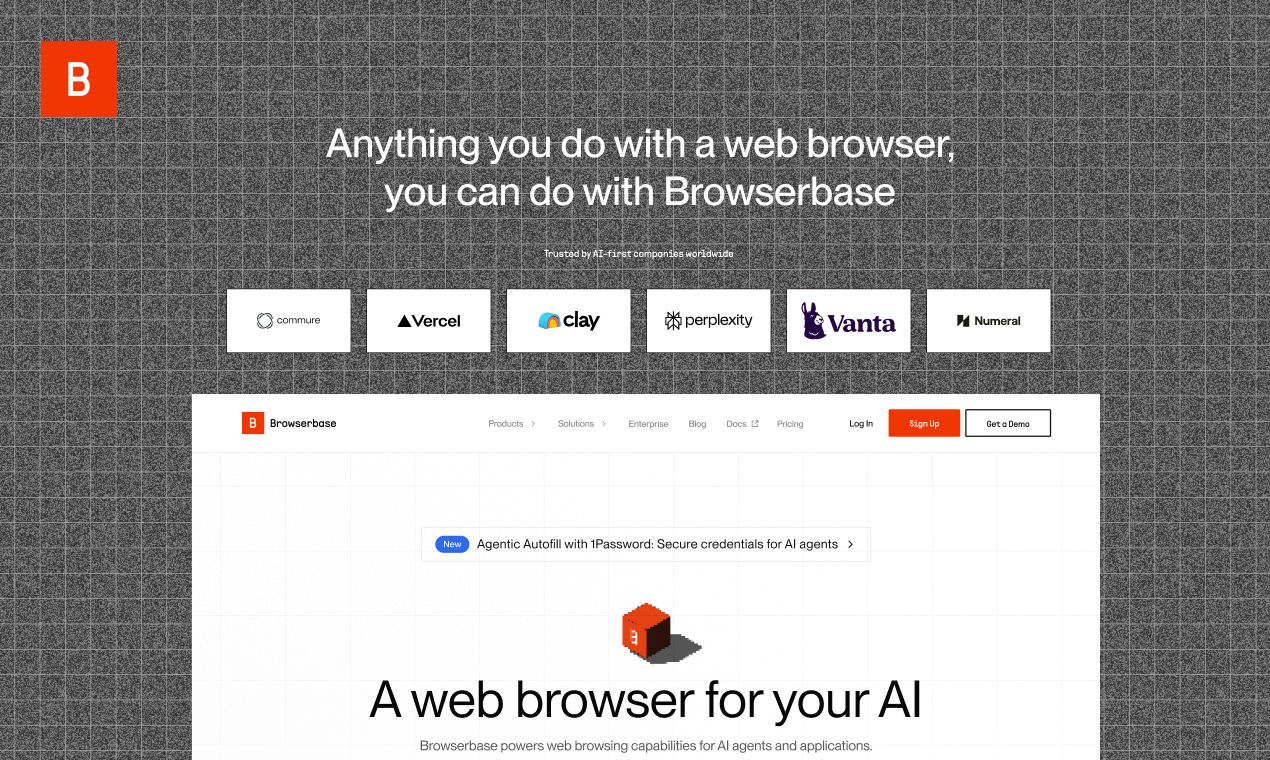
Browserbase runs fleets of managed Chromium browsers in the cloud and pairs them with Stagehand, an open-source SDK that drives agents via natural-language act/extract/observe calls. We rate it 78/100: best-in-class developer experience with real reliability caveats.
Browserbase is a managed browser-infrastructure platform that gives AI agents a reliable, fleet-scale Chromium runtime with session replay, captcha solving, proxy rotation, and identity handling baked in. We rate it 78/100 — the cleanest developer experience in browser automation for AI today, but a young platform with real reliability complaints that matter if you're running production workloads.
Browserbase was founded in 2024 by Paul Klein, a 3x founder whose previous company was acquired by Mux in 2023. The company raised a seed round in (Kleiner Perkins, with angels Jeff Lawson, Guillermo Rauch, and Patrick Collison), a $21M Series A from CRV in October 2024, and a $40M Series B led by Notable Capital in June 2025 at a $300M valuation. Revenue reportedly crossed $3M in the first 16 months.
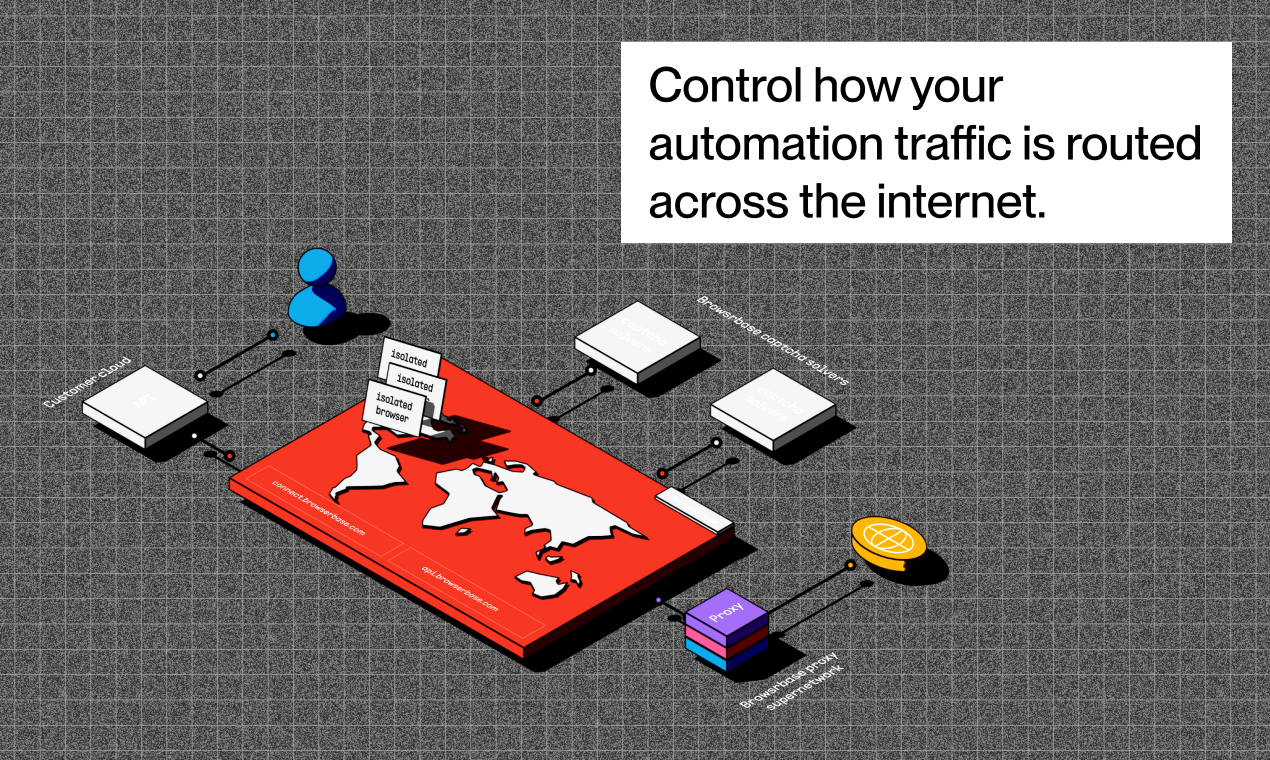
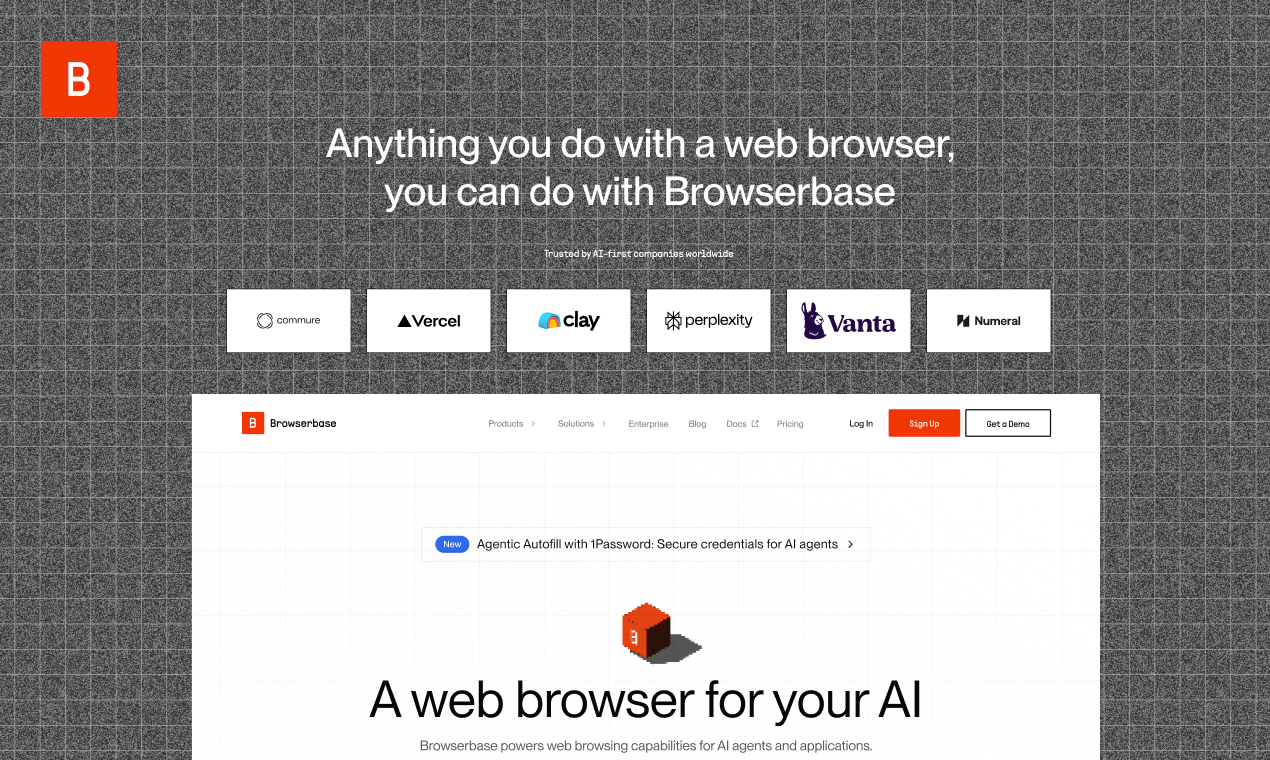
The pitch is simple: AI agents that browse the web break in exactly the ways human-driven automation breaks — CAPTCHAs, bot detection, session timeouts, flaky selectors, auth flows — but at 10x the volume. Browserbase runs fleets of managed Chromium browsers in its cloud, handles the undifferentiated infrastructure, and pairs the runtime with Stagehand, its open-source SDK (22.1k+ GitHub stars, MIT licensed) that lets you write automations as natural-language act(), extract(), observe(), and agent() calls instead of brittle CSS selectors. Over 10,000 companies — including Perplexity, Vercel, Ramp, Clay, 11x, and DeepMind — are referenced on the marketing site.
act, extract, observe, and agent — that wrap Playwright with an LLM layer. Works locally with any Chromium, opts into Browserbase cloud when you're ready for production.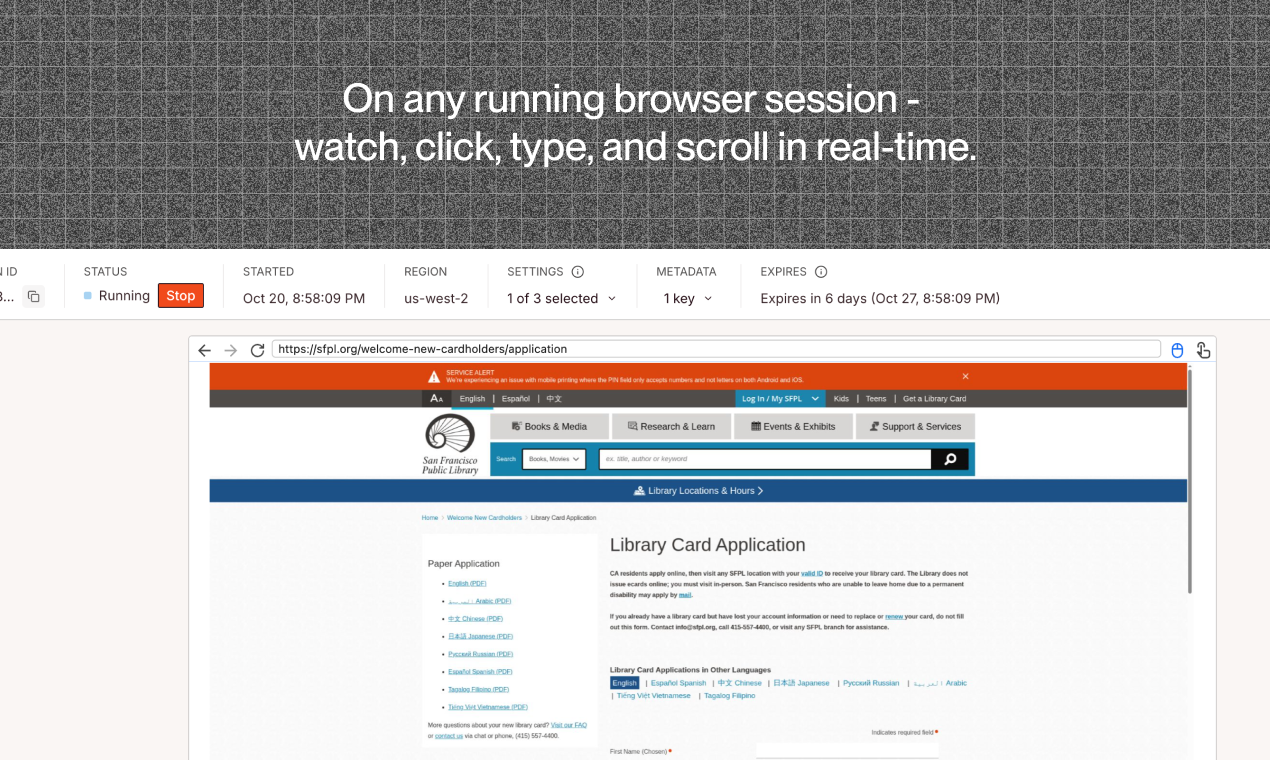
Developer sentiment is strongly split. On Product Hunt, Browserbase holds 5.0/5.0 across 12 reviews with founders of agent startups like Embra saying the API was "easy to integrate against, and provides a feature set that is critical for numerous business use cases." On Hacker News and the browser-automation subreddits, the recurring praise is that Session Inspector is unmatched and that Stagehand "finally brings a modern developer experience" to an area that had been stuck on raw Playwright scripts since 2018.
The criticism is also real. Growth marketer John Marbach publicly challenged Browserbase over a reported 29% failure rate on basic page loads, arguing that "developer tools need to work consistently in production." Independent reviews flag occasional slowdowns on heavy AI workloads, spotty communication from support, and a learning curve for beginners where the official tutorials thin out. The fair summary: excellent for teams prototyping agent workflows and shipping them at mid-scale; teams running thousands of concurrent mission-critical sessions report they still hedge with a secondary provider.
Browserbase uses a usage-priced freemium model — a permanent free tier, two fixed-fee plans, and custom pricing above that. All plans bill overage on browser-hours, fetch/search calls, and proxy bandwidth.
| Plan | Price | Key Limits |
|---|---|---|
| Free | $0/month | 3 concurrent browsers, 1 browser-hour, 1,000 fetch + 1,000 search calls, 15-min sessions, 7-day retention, $5 model tokens included |
| Developer | $20/month | 25 concurrent, 100 browser-hours ($0.12/hr overage), 1k fetch / 1k search calls, 1 GB proxies, auto CAPTCHA solving |
| Startup | $99/month | 100 concurrent, 500 browser-hours ($0.10/hr overage), 10k fetch / 1k search calls, 5 GB proxies, 30-day retention |
| Scale | Custom | 250+ concurrent, SSO, HIPAA BAA + DPA, verified agents, usage-based pricing across the board |
Overage pricing is transparent: $0.10–$0.12 per browser-hour, $7 per 1,000 search calls, $0.50–$1 per 1,000 fetch calls ($4 with proxies), and $10–$12 per GB of proxy traffic. Model tokens are billed pay-as-you-go at market rates.
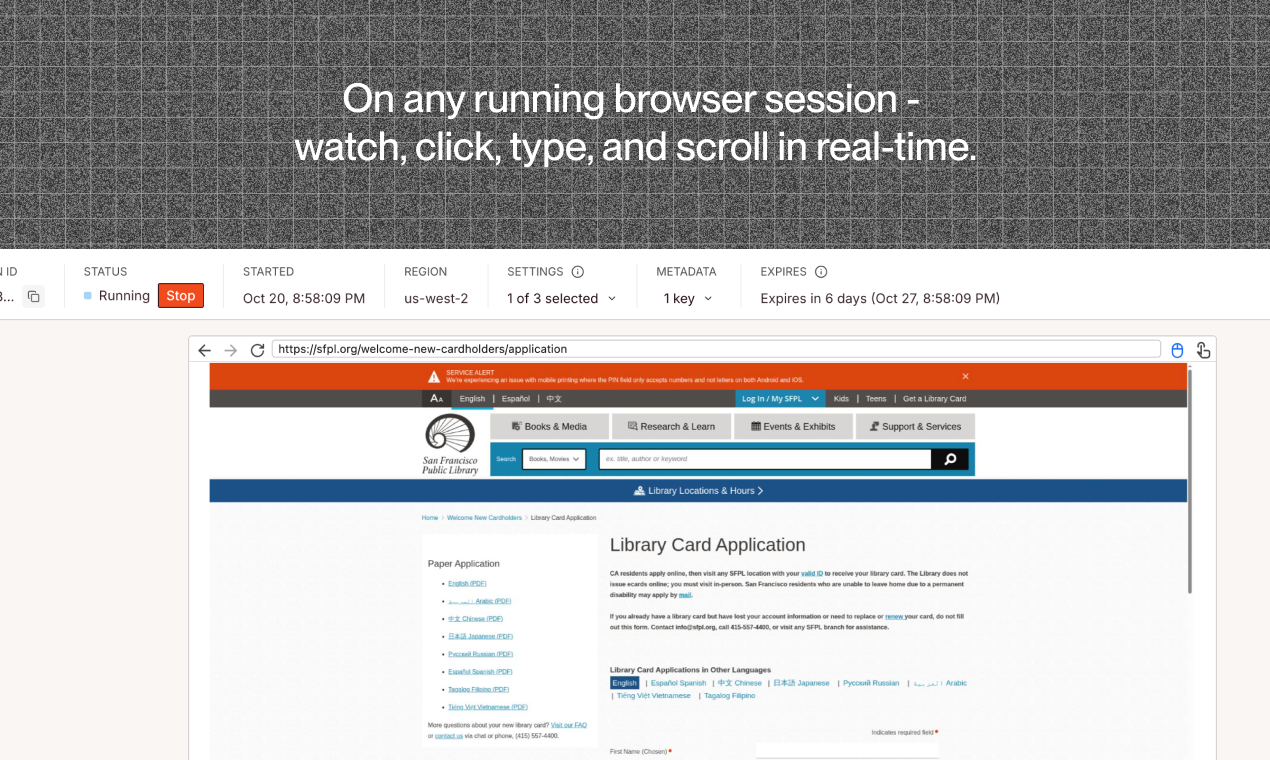
Best for: AI-agent startups, SDR and data-enrichment tools, RPA teams modernizing onto LLMs, and any engineering team that's tired of running Playwright on their own Kubernetes cluster. The Stagehand SDK pays for itself immediately if you're writing more than a handful of selectors by hand, and the Session Inspector turns "why did my agent fail at 3 a.m.?" into a 30-second answer instead of a 30-minute grep through logs.
Not ideal for: Teams that need air-gapped, on-premise browser automation (no self-hosted option), high-scale scraping workloads where raw throughput at rock-bottom cost matters more than agent ergonomics (Apify, Bright Data, or self-hosted Playwright on spot instances will be cheaper per-request), and anyone targeting sites with aggressive anti-bot where residential proxies alone still fall short.
Pros:
Cons:
Three named competitors worth benchmarking:
Teams also pair Browserbase with Hoppscotch for API testing and Firecrawl for pure-scrape extraction workloads.
If you're building an AI agent that touches the web and you don't want to run your own Playwright fleet, Browserbase is the path of least resistance in 2026. The Stagehand SDK is genuinely great, the debugging tools are a class above the category, and the free tier lets you prove out a use case before committing a dollar. The caveats — reliability wobbles, inconsistent support, no self-hosting — are real and worth testing against your workload before you lock in. Our 78/100 reflects a product that's best-in-class at developer experience but still maturing as production infrastructure. Try it free; upgrade when (and only when) your session volume justifies it.
act, extract, observe, and agent calls. It works locally with any Chromium and optionally connects to Browserbase's cloud for production workloads.ServiceNow and Accenture Launch Forward Deployed Engineering Program to Scale Agentic AI in the Enterprise (May 6, 2026)
At Knowledge 2026, ServiceNow and Accenture announced a joint forward deployed engineering program that drops co-located engineer pods into customer environments to ship agentic AI workflows natively on the ServiceNow AI Platform — with access to 300+ pre-built agent skills and the AI Control Tower as the governance backbone.
May 7, 2026
ReFiBuy Raises $13.6M Seed to Help Brands Get Recommended by AI Shopping Agents (May 5, 2026)
ReFiBuy, the Raleigh-based agentic commerce platform from ChannelAdvisor founder Scot Wingo, closed an oversubscribed $13.6M seed led by NewRoad Capital Partners on May 5, 2026 — betting that the next billion-dollar e-commerce moat is being chosen by ChatGPT, Claude and Perplexity.
May 7, 2026
OpenAI Replaces ChatGPT's Default Model With GPT-5.5 Instant — 52.5% Fewer Hallucinations, 30% Shorter Answers (May 5, 2026)
OpenAI on May 5 swapped GPT-5.3 Instant for the new GPT-5.5 Instant as ChatGPT's default model, claiming 52.5% fewer hallucinated claims on high-stakes prompts and 30% more concise answers. The model also rolls into the API as chat-latest and adds personalization from Gmail and past chats for Plus and Pro web users.
May 7, 2026
Is this product worth it?
Built With
Compare with other tools
Open Comparison Tool →