

 Developer Tools
Templ
Type-safe HTML templating language for Go with compile-time safety
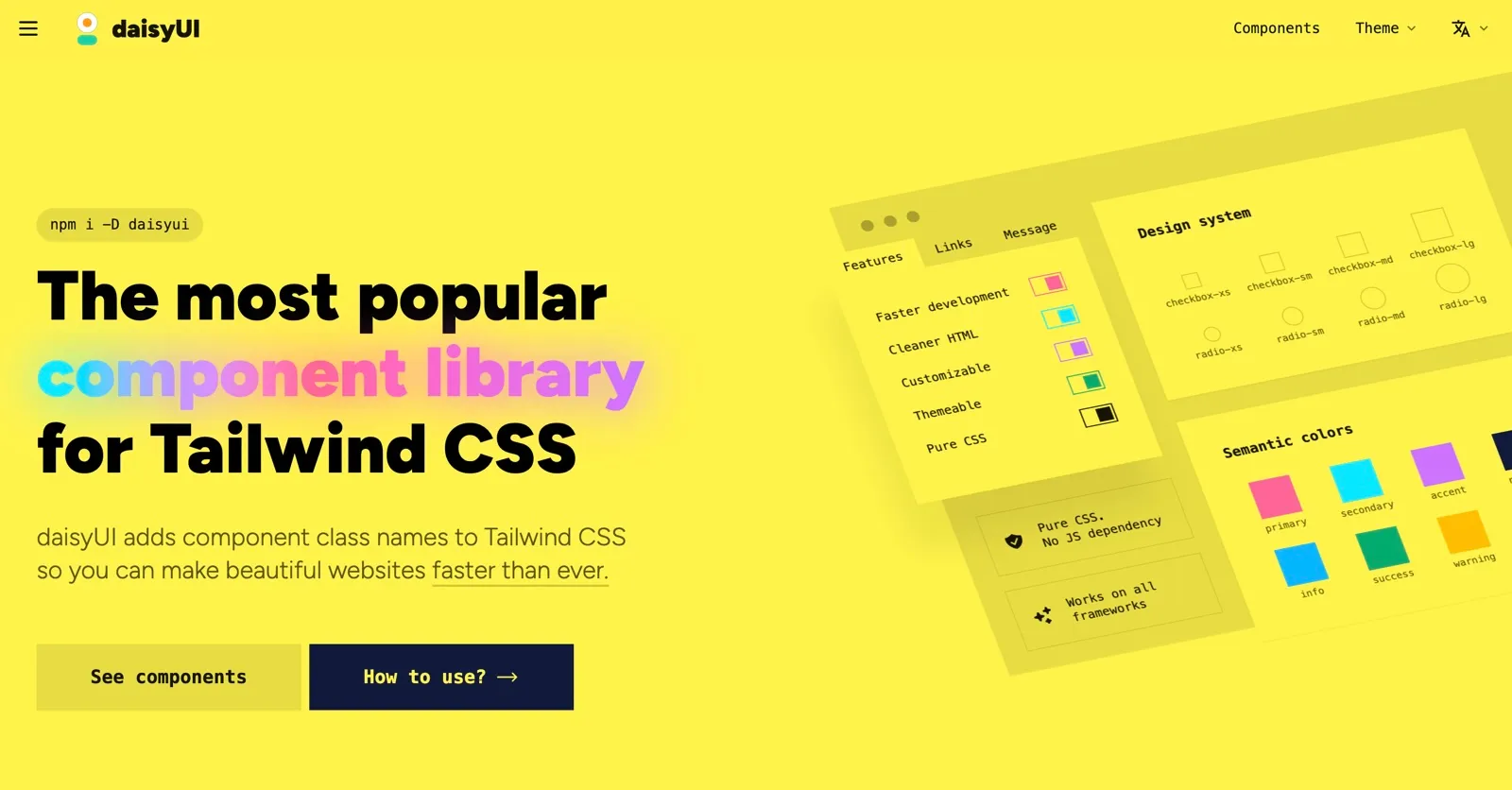
daisyUI is a CSS-only Tailwind component library with 63 components and 35 themes that ships zero JavaScript. We rate it 89/100 — the fastest way to ship a polished Tailwind UI without writing 20-class soup.
daisyUI is a free, open-source, CSS-only component library for Tailwind CSS. It gives you 63 prebuilt components, 35 themes and a 34 KB compressed CSS bundle — with zero JavaScript and no third-party dependencies. We rate it 89/100 — the right default for any Tailwind team that wants polished, accessible markup without the 20-class-name spaghetti.
daisyUI is a Tailwind CSS plugin authored by Iranian developer Pouya Saadeghi. Instead of giving you React or Vue components, daisyUI ships a single CSS file that adds high-level class names like btn, card, modal and navbar on top of Tailwind's atomic utilities. The library is licensed under MIT, sits at 40,600+ GitHub stars and is used by teams across React, Vue, Svelte, Astro, Laravel, Rails, Phoenix and plain HTML alike.
daisyUI 5 — the rewrite that landed alongside Tailwind CSS 4 — is a complete re-engineering of the library. It removed every third-party dependency, moved configuration into a @plugin "daisyui" directive in your CSS file, switched theme variables to native CSS color-mix(), and shrank the compressed CDN file to just 34 KB — the smallest in daisyUI's history. The current release as of is 5.5.19, with daisyUI 6 already on the public roadmap for later this year.
data-theme attribute on <html>.<dialog>, :checked and :target.bg-indigo-600 hover:bg-indigo-500 px-4 py-2 rounded-md text-white font-semibold ... as a single btn btn-primary — cutting HTML weight by roughly 79%.@plugin "daisyui" directly in your CSS file — no tailwind.config.js, no PostCSS gymnastics. Themes are also written in CSS using @plugin "daisyui/theme".dir="rtl" just works — useful for Arabic, Hebrew, Persian and Urdu locales without extra plugins.daisyui.com/theme-generator lets you build custom themes visually and copy the resulting CSS variables into your project.btn-primary, card-bordered, alert-warning — names that survive theme changes and don't break your markup when you redesign.
card component — a single class names compose into card-body, card-actions and image overlays without any utility soup.Sentiment is overwhelmingly positive on Reddit, Hacker News and Product Hunt. The recurring praise is that daisyUI is "a productivity hack with no going back" — developers consistently report shipping marketing pages and admin UIs in hours instead of days, and Laravel, Vue and Astro communities recommend it as their default Tailwind starter. The 35 themes get specific shout-outs because swapping them is one attribute change, not a refactor.
The honest complaints are real but narrow. The default themes (especially light and cupcake) are sometimes called "too playful" or "unprofessional" out of the box — teams building enterprise dashboards almost always switch to corporate, business or a custom theme. Because daisyUI is CSS-only, it gives you no accessibility primitives for things like focus traps or keyboard navigation in modals — you still need to wire those up yourself or pair it with a headless library. And if your design language is far from daisyUI's defaults, you'll spend time overriding tokens before you ship.
daisyUI itself is and always will be 100% free, open-source and MIT-licensed. There is no paid tier, no usage limit, no telemetry. The team monetizes through optional paid theme/template packs and donations.
| Plan | Price | Key Limits |
|---|---|---|
| daisyUI library | $0 forever | MIT licensed. All 63 components and 35 themes included. No usage caps. |
| daisyUI Store templates | $45–$199 one-time | Optional premium dashboards, marketing kits and Figma assets. Lifetime updates. |
| GitHub Sponsors | From $5/month | Optional. Supports the maintainer directly — doesn't unlock anything new. |
Best for: Solo developers, indie hackers and small product teams who use Tailwind CSS and want to ship a polished UI without writing utility-class novels. It is also the right default for back-end-heavy stacks like Laravel, Rails, Phoenix and Django, where you want a frontend system that doesn't require React.
Not ideal for: Teams with a custom design system that diverges sharply from daisyUI's tokens, or React/Next.js applications that need fully accessible, headless primitives — in those cases shadcn/ui on top of Radix is a stronger fit. It's also overkill for tiny landing pages where 20 lines of vanilla Tailwind would do.
Pros:
Cons:
The two strongest alternatives are shadcn/ui, the React-only copy-paste library built on Radix primitives that gives you full accessibility and code ownership, and Flowbite, which is the only Tailwind component library with first-party React, Vue and Svelte components plus built-in JavaScript interactivity. The 2026 consensus is to pair shadcn/ui with daisyUI — daisyUI for marketing pages and admin scaffolds, shadcn/ui for the React app shell. Tailwind Plus (formerly Tailwind UI) remains the polished commercial option but starts at $299 and is React/Vue/HTML only.
Yes — for almost any Tailwind project, daisyUI is a one-line install that pays for itself within the first afternoon. It is the most pragmatic Tailwind component library shipping today: free, framework-agnostic, JS-free, actively maintained and small enough that even adding it "just in case" costs you nothing. The 89/100 reflects the two real limits we've seen in production — default themes that need overriding for serious B2B work, and the absence of accessibility primitives for complex JS components. Neither is a dealbreaker; both are easy to mitigate. If you write Tailwind every day and aren't using daisyUI, you owe it a 30-minute trial.
@plugin directive in your CSS file instead of tailwind.config.js.<dialog>, the :checked pseudo-class and the :target pseudo-class.ServiceNow and Accenture Launch Forward Deployed Engineering Program to Scale Agentic AI in the Enterprise (May 6, 2026)
At Knowledge 2026, ServiceNow and Accenture announced a joint forward deployed engineering program that drops co-located engineer pods into customer environments to ship agentic AI workflows natively on the ServiceNow AI Platform — with access to 300+ pre-built agent skills and the AI Control Tower as the governance backbone.
May 7, 2026
ReFiBuy Raises $13.6M Seed to Help Brands Get Recommended by AI Shopping Agents (May 5, 2026)
ReFiBuy, the Raleigh-based agentic commerce platform from ChannelAdvisor founder Scot Wingo, closed an oversubscribed $13.6M seed led by NewRoad Capital Partners on May 5, 2026 — betting that the next billion-dollar e-commerce moat is being chosen by ChatGPT, Claude and Perplexity.
May 7, 2026
OpenAI Replaces ChatGPT's Default Model With GPT-5.5 Instant — 52.5% Fewer Hallucinations, 30% Shorter Answers (May 5, 2026)
OpenAI on May 5 swapped GPT-5.3 Instant for the new GPT-5.5 Instant as ChatGPT's default model, claiming 52.5% fewer hallucinated claims on high-stakes prompts and 30% more concise answers. The model also rolls into the API as chat-latest and adds personalization from Gmail and past chats for Plus and Pro web users.
May 7, 2026
Is this product worth it?
Built With
Compare with other tools