 Developer Tools
Templ
Type-safe HTML templating language for Go with compile-time safety
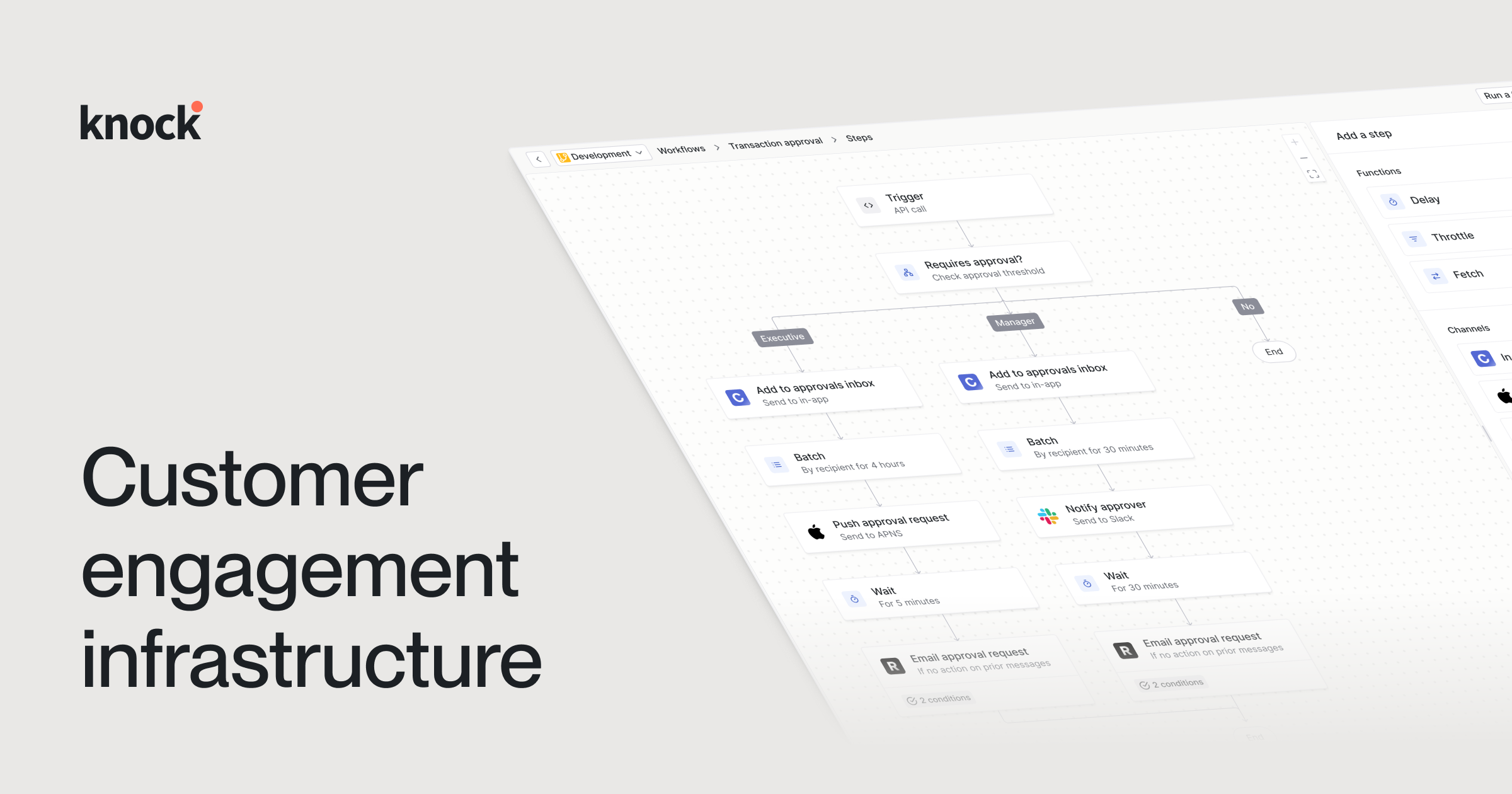
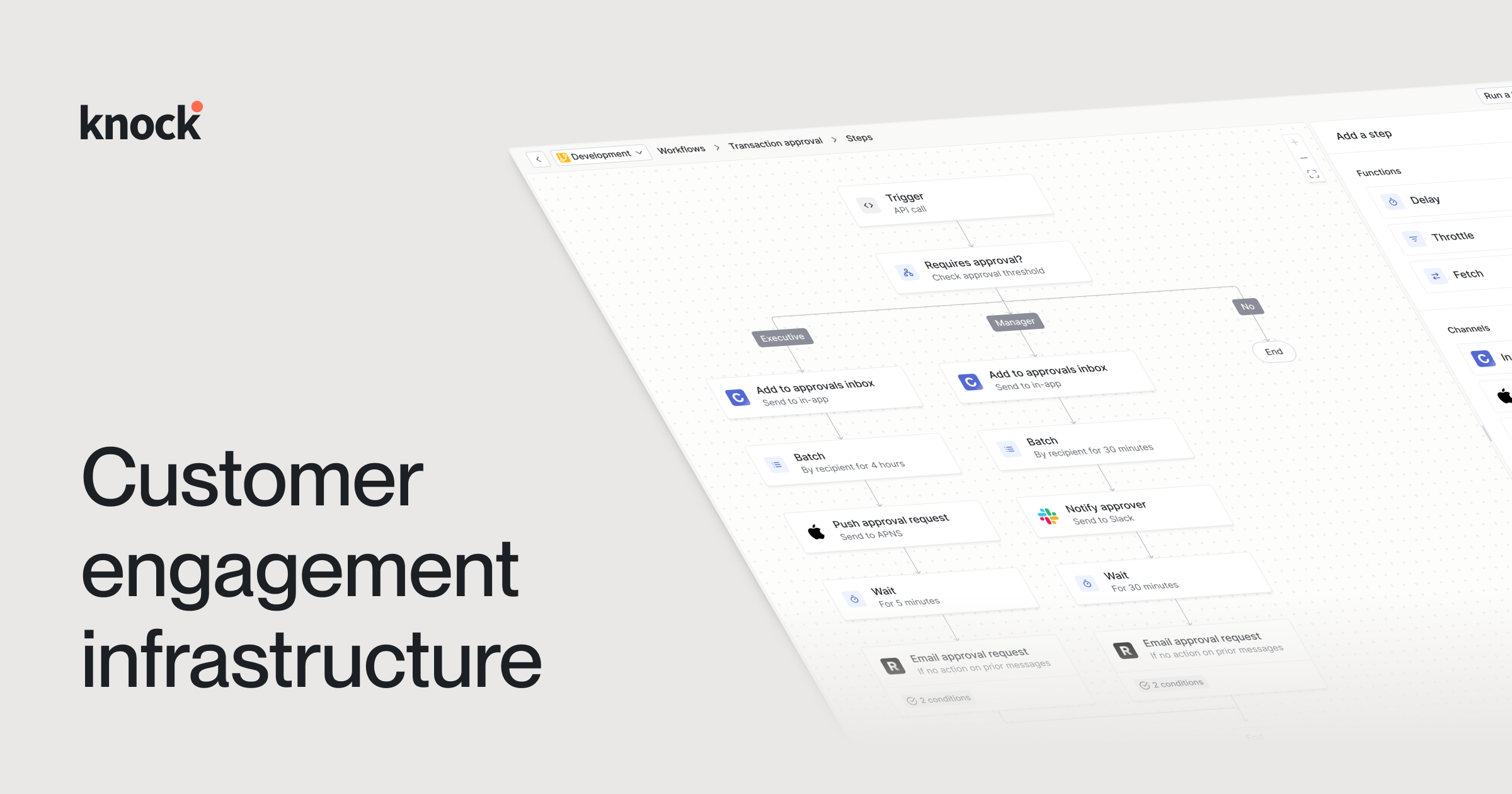
Knock is a developer-first notifications platform that bundles cross-channel orchestration, in-app inbox components, and a workflow engine into a single API. We rate it 88/100 — the most polished managed option for product teams who want to stop building notification infrastructure in-house.
Knock is customer engagement infrastructure for developers: a single API that ships cross-channel notifications, in-app inboxes, lifecycle workflows, and recipient preferences without you having to build any of that yourself. We rate it 88/100 — for product teams that want to retire their tangle of SendGrid scripts, Twilio webhooks, and bespoke in-app feed code, Knock is the most polished managed option you can adopt today.
Knock is a notifications platform founded in 2020 by Sam Seely (CEO) and Chris Bell (CTO) and headquartered in Brooklyn, New York. The company emerged from stealth with a public launch on and went on to raise an $18M total across two rounds — most recently a $12M Series A led by Craft Ventures in February 2024 (David Sacks took the board seat). Customers include Vercel, Mux, Linear, Modern Treasury, and hundreds of other product-led companies that have effectively outsourced their notifications stack.
The specific problem Knock solves is the one every growing SaaS hits around year two: notifications start as a single sendgrid.send() call and end up as a sprawling multi-channel system with email, SMS, push, in-app inbox, Slack, Teams, digesting, batching, throttling, internationalization, preference centers, and version control across staging and production environments. Knock collapses that into one API plus a dashboard the product team can actually edit.
Sentiment is unusually warm for a paid SaaS. On G2 Knock holds a near-perfect rating, with reviewers consistently calling out the SDK quality, documentation, and the time saved by not maintaining a homegrown notification service. The most-quoted line on Reddit's r/webdev is some variation of "we ripped out three weeks of email + push + inbox glue code and replaced it with one Knock workflow." On Hacker News the original Show HN drew technical praise for the workflow primitives and the decision to charge per message rather than per recipient.
The recurring complaints are real and worth knowing. First, pricing scales fast: at 50,000 notifications a month you are paying $250, and at the volumes any consumer product hits, Enterprise pricing becomes the only option. Second, several reviewers note that the workflow editor still favors developers — non-technical product managers can edit templates, but creating new workflows usually means a developer commits a change. Third, a few teams have wished for richer A/B testing built in rather than via the data export.
Knock charges only for messages successfully sent — bounces and workflow runs that route to no channels are free. Three published tiers plus contact-sales Enterprise:
| Plan | Price | Key Limits |
|---|---|---|
| Developer | $0 | 10,000 notifications/month, unlimited workflows, all channels, community support |
| Starter | $250/month | 50,000 notifications/month, environments, in-app feed, email support |
| Growth | Custom | Higher volume tiers, advanced workflow features, priority support |
| Enterprise | Contact sales | SLA, SSO/SAML, HIPAA, audit logs, dedicated infrastructure, volume discounts |
Knock Guides (in-app banners and product tours) is priced separately on a monthly active user model, with a 2,500 active-user limit on the Starter plan.
Best for: B2B and B2C SaaS teams between 10 and 500 engineers who already have notifications scattered across services and want to consolidate, plus startups that need an in-app inbox shipped this sprint without writing a websocket layer. The multi-tenant primitives make Knock especially strong for B2B products with org-level admin controls.
Not ideal for: Solo founders sending under 1,000 messages a month (Resend's API plus a homemade feed is cheaper); marketing-led teams who need rich campaign analytics and A/B testing as the headline feature (Customer.io or Braze fits better); and teams that have a hard requirement to self-host (look at the open source Novu instead).
Pros:
Cons:
The closest direct competitors are Courier, which leans more designer-friendly with a stronger template builder, and SuprSend, which competes on price and has a generous free tier. Novu is the open-source option — self-hostable and code-first via @novu/framework, but you carry the operational burden. For pure in-app feed-only needs, Liveblocks Notifications is worth a look. None of these match Knock's combination of SDK breadth and multi-tenant primitives, but each wins on a specific axis.
For any product team that has scaled past the "single email service plus a custom feed" stage, Knock is worth the price. The 88/100 reflects how complete and developer-friendly the platform is — the points it loses are for the steep first paid tier and the (deliberate) lack of a self-host option. If you are about to estimate "two engineers for a quarter to build proper notifications," buy Knock instead and ship it in a week.
ServiceNow and Accenture Launch Forward Deployed Engineering Program to Scale Agentic AI in the Enterprise (May 6, 2026)
At Knowledge 2026, ServiceNow and Accenture announced a joint forward deployed engineering program that drops co-located engineer pods into customer environments to ship agentic AI workflows natively on the ServiceNow AI Platform — with access to 300+ pre-built agent skills and the AI Control Tower as the governance backbone.
May 7, 2026
ReFiBuy Raises $13.6M Seed to Help Brands Get Recommended by AI Shopping Agents (May 5, 2026)
ReFiBuy, the Raleigh-based agentic commerce platform from ChannelAdvisor founder Scot Wingo, closed an oversubscribed $13.6M seed led by NewRoad Capital Partners on May 5, 2026 — betting that the next billion-dollar e-commerce moat is being chosen by ChatGPT, Claude and Perplexity.
May 7, 2026
OpenAI Replaces ChatGPT's Default Model With GPT-5.5 Instant — 52.5% Fewer Hallucinations, 30% Shorter Answers (May 5, 2026)
OpenAI on May 5 swapped GPT-5.3 Instant for the new GPT-5.5 Instant as ChatGPT's default model, claiming 52.5% fewer hallucinated claims on high-stakes prompts and 30% more concise answers. The model also rolls into the API as chat-latest and adds personalization from Gmail and past chats for Plus and Pro web users.
May 7, 2026
Is this product worth it?
Built With
Compare with other tools
Open Comparison Tool →