 Marketing
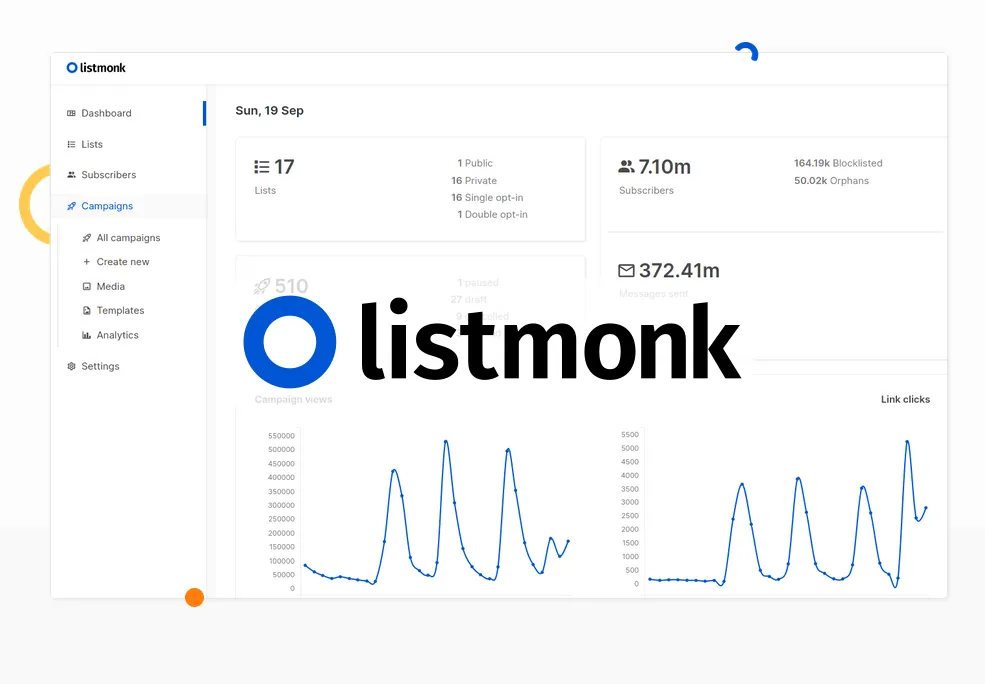
Listmonk
High-performance, self-hosted newsletter and mailing list manager packed into a single Go binary
Mautic is the open-source marketing automation platform behind 200,000+ self-hosted instances. We rate it 78/100 — a HubSpot-feature alternative for technical teams willing to manage their own server.
Mautic is the open-source marketing automation platform that quietly powers 200,000+ self-hosted instances worldwide — a HubSpot-style toolkit for email campaigns, lead scoring, landing pages, and multi-channel automation, except it costs nothing in license fees and your data never leaves your server. We rate it 78/100 — an excellent choice for technically capable teams who would rather pay for a $20 VPS than $800/month to HubSpot, but a poor fit if your team has no Linux administrator.
Mautic was created by David Hurley in 2014 as the world's first serious open-source marketing automation platform. The codebase is licensed under GPLv3 and lives at github.com/mautic/mautic, where it has accumulated roughly 9,500 GitHub stars and a full-time community of contributors. After Acquia's stewardship from 2019 to 2023, Mautic transitioned to an independent community foundation, and it now runs on a transparent six-month release cadence.
The pitch is unambiguous: HubSpot Marketing Hub Professional starts at roughly $800/month and climbs steeply with contact count, while a self-hosted Mautic instance running on a $20-50/month VPS plus Amazon SES for email delivery can serve 50,000 contacts for under $150/month all-in. Feature-for-feature, Mautic competes with the mid-tier of the commercial market — visual campaign builder, drip emails, lead scoring, dynamic content, web tracking, landing pages, multi-channel sequences (email + SMS + WhatsApp + push), and a built-in lightweight CRM. The catch, as every honest reviewer notes, is that you are responsible for the server, the upgrades, and the email deliverability tuning.


Sentiment across G2, TrustRadius, the Mautic forums, and the r/marketing and r/selfhosted subreddits is sharply bimodal. The recurring praise: technically inclined small businesses report cutting their marketing-automation bill by 80-95% versus HubSpot or ActiveCampaign while keeping feature parity, and several G2 reviewers specifically thank the platform for letting them keep customer data on their own servers under GDPR. The flip side is consistent: multiple Reddit threads warn that the in-app upgrade button is dangerous and updates should be run via SSH and the command line, the user interface has rough edges that confuse non-technical marketers, and email deliverability is entirely on you — Mautic does not own the IP reputation, so a misconfigured SMTP relay can land you in the spam folder fast. A 2026 review summarised the consensus well: "genuinely impressive for those comfortable managing a server, but commercial tools save hours of setup and troubleshooting."

The community edition is free forever under GPLv3 — every feature listed above is included, with no contact caps or send-volume limits beyond what your own infrastructure can handle. Real costs are infrastructure plus optional support.
| Plan | Price | Key Limits |
|---|---|---|
| Community (self-hosted) | $0 | All features, unlimited contacts and sends, GPLv3, community support only — you supply the server, MySQL, and SMTP relay |
| Typical real-world stack | ~$100-150/month at 50K contacts | $20-50/month VPS + $50-100/month Amazon SES + your DevOps time |
| Managed Mautic hosts | $30-300+/month | Acquia Campaign Studio, Webmecanik, mautic.com Cloud — pricing on request, varies by contact count |
| Extended LTS security | Paid (annual) | Optional commercial security support beyond the free community LTS window |
Best for: Technically capable small and mid-sized teams (2–200 employees) with at least one Linux-comfortable engineer or partner agency, especially European businesses with strict GDPR data-residency needs, agencies running marketing automation for many clients on shared infrastructure, and any team currently spending more than $500/month on a HubSpot or ActiveCampaign tier whose features they only partly use.
Not ideal for: Solo marketers with no engineering support — the upgrade and deliverability burden will eat your week. Also a poor fit if you need polished native iOS/Android apps for marketers on the move, or if your team requires the kind of vendor-managed deliverability and 24/7 phone support that a paid SaaS includes by default.
Pros:
Cons:
The closest commercial managed equivalent is ActiveCampaign, which mirrors Mautic's automation power but starts at $15/month (Lite, 1,000 contacts) and climbs to the Plus tier at $145/month for CRM features. HubSpot Marketing Hub is more polished but lands at $800+/month for the Professional tier; we cover it in our HubSpot review when applicable. Other open-source options worth considering: Listmonk (covered in our Listmonk review) for high-volume newsletter sending without automation overhead, and Postiz (see our Postiz review) for the social-publishing side specifically.
Mautic is genuinely the best free marketing automation platform on the planet — but "free" hides a real labour cost. If you have a Linux-fluent engineer or a Mautic-specialist agency on retainer, you can replicate 80% of HubSpot's day-to-day functionality for under 10% of HubSpot's cost, and your customer data never leaves your control. If you do not, every dollar saved in licensing will be paid back in lost weekends debugging cron jobs, SMTP throttling, and Symfony upgrades. We rate it 78/100 — outstanding open-source value, dragged down by operational overhead that the documentation cannot fully smooth over.
ServiceNow and Accenture Launch Forward Deployed Engineering Program to Scale Agentic AI in the Enterprise (May 6, 2026)
At Knowledge 2026, ServiceNow and Accenture announced a joint forward deployed engineering program that drops co-located engineer pods into customer environments to ship agentic AI workflows natively on the ServiceNow AI Platform — with access to 300+ pre-built agent skills and the AI Control Tower as the governance backbone.
May 7, 2026
ReFiBuy Raises $13.6M Seed to Help Brands Get Recommended by AI Shopping Agents (May 5, 2026)
ReFiBuy, the Raleigh-based agentic commerce platform from ChannelAdvisor founder Scot Wingo, closed an oversubscribed $13.6M seed led by NewRoad Capital Partners on May 5, 2026 — betting that the next billion-dollar e-commerce moat is being chosen by ChatGPT, Claude and Perplexity.
May 7, 2026
OpenAI Replaces ChatGPT's Default Model With GPT-5.5 Instant — 52.5% Fewer Hallucinations, 30% Shorter Answers (May 5, 2026)
OpenAI on May 5 swapped GPT-5.3 Instant for the new GPT-5.5 Instant as ChatGPT's default model, claiming 52.5% fewer hallucinated claims on high-stakes prompts and 30% more concise answers. The model also rolls into the API as chat-latest and adds personalization from Gmail and past chats for Plus and Pro web users.
May 7, 2026
Is this product worth it?
Built With
Compare with other tools
Open Comparison Tool →