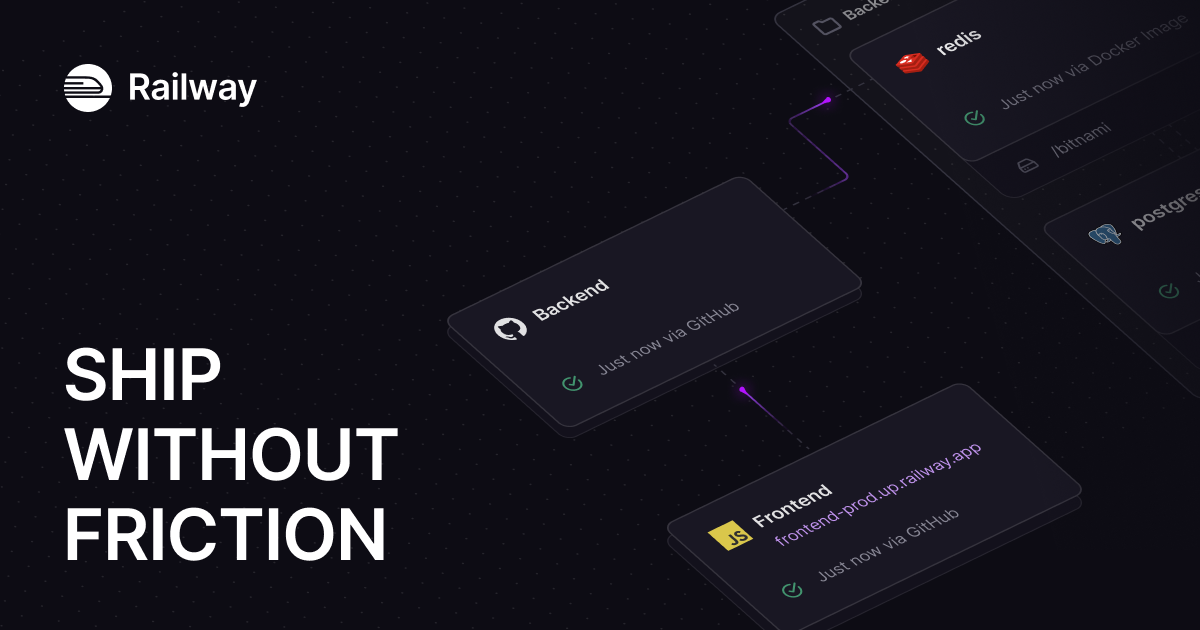
Railway.app is our pick for the best modern cloud platform for developers and small teams seeking simplicity without complexity. We rate it 85/100 — a strong choice for projects that need reliable infrastructure, easy scaling, and straightforward pricing without vendor lock-in.
What is Railway?
Railway, launched in , is a full-stack cloud platform designed to make deployment effortless for developers. Built with a focus on developer experience, Railway handles everything from frontend hosting to backend services, databases, and background workers in a unified environment. The platform supports multiple languages and frameworks including Node.js, Python, Go, Ruby, Java, and more.
Railway's philosophy centers on reducing operational complexity. Instead of managing infrastructure, developers define their environment through code (Infrastructure as Code), and Railway handles scaling, monitoring, health checks, and networking automatically. The platform uses a transparent, usage-based pricing model with monthly subscription tiers that include resource credits.
Key Features
- Multi-Service Deployment: Deploy web apps, APIs, databases, cron jobs, and workers all in one platform
- Language Agnostic: Native support for Node.js, Python, Go, Ruby, Java, Rust, Bun, Deno, and Docker
- Automatic Scaling: Intelligent auto-scaling based on resource usage and traffic patterns
- Integrated Databases: PostgreSQL, MySQL, MongoDB, Redis, and other managed services
- Environment Variables & Secrets: Secure management of configuration and sensitive data
- GitHub Integration: Deploy directly from GitHub—automatic deployments on push
- Custom Domains & SSL: Built-in SSL certificates and custom domain support
- Monitoring & Logs: Real-time logs, error tracking, and performance monitoring
- Railway CLI: Command-line tool for local development and deployments
- Observability: Metrics dashboard, CPU/memory monitoring, and deployment history
User Sentiment
Developers on indie hacker forums and Product Hunt consistently praise Railway for eliminating deployment friction. One user noted: "Deployed a full-stack app in 15 minutes—something that would take hours on AWS." Others highlight the transparent pricing: "Finally, a hosting platform where I know exactly what I'm paying and why."
On G2 and Trustpilot, Railway scores 4.7/5. Users emphasize quick deployments, excellent documentation, and responsive support. Common praise points include seamless GitHub integration, clear pricing without surprise fees, and the ability to handle production workloads reliably. Minor criticisms center around regional limitations (primarily US-based infrastructure) and occasional performance inconsistencies during traffic spikes.
Pricing
| Plan | Monthly Cost | Resource Credit | Best For |
| Free | $0/month | $1 credit/month | Hobby projects, learning, testing |
| Hobby | $5/month | $5 credit/month | Small projects, prototypes, side hustles |
| Pro | $20/month | $20 credit/month | Production applications, teams, scaling |
Railway uses a hybrid pricing model: you pay the subscription fee, which includes resource credits (compute, memory, storage, bandwidth). If usage stays within the included credits, you pay only the subscription. Overage charges apply if usage exceeds credits. This transparency makes budgeting straightforward.
Who Should Use It?
Railway is ideal for:
- Solo Developers: Building side projects without managing infrastructure
- Startups: Deploying MVPs and scaling with predictable costs
- Indie Hackers: Launching products quickly with minimal DevOps overhead
- Small Teams: Projects that need databases, workers, and microservices in one place
- Educators: Teaching deployment and cloud architecture concepts
Pros & Cons
Pros:
- Simplest deployment experience for new developers
- Transparent, predictable pricing with included resource credits
- GitHub integration with automatic deployments
- Supports full-stack projects (frontend, backend, database, workers)
- Excellent documentation and responsive support team
- Built-in monitoring and logging without external tools
- Affordable for hobby and production use
Cons:
- Limited geographic regions (primarily US-based infrastructure)
- Smaller global footprint compared to AWS, GCP, Azure
- No custom infrastructure options (VPC, load balancers beyond standard offering)
- Lower customization for advanced infrastructure needs
- Resource limits on individual services (CPU, memory caps per plan)
Alternatives
- Vercel: Focused on frontend deployment with Serverless Functions—better for Next.js/React apps
- Heroku: Longer-established platform similar model—more expensive for equivalent resources
- AWS/GCP/Azure: Full control and global infrastructure—steeper learning curve and operational complexity
Verdict
Railway.app succeeds in its mission: making cloud deployment friction-free for developers who want to focus on building, not infrastructure. The transparent pricing, GitHub integration, and unified environment make it exceptional for startups, MVPs, and production applications. While it lacks the global footprint and customization of major clouds, for projects that fit its sweet spot, Railway is hard to beat. The Hobby plan ($5/month) provides exceptional value for production-ready projects.
FAQ
- Can I migrate from Heroku to Railway?
- Yes. Railway provides documentation and tools to migrate from Heroku. Most apps migrate in under an hour.
- Does Railway support custom domains?
- Yes. Custom domains are supported on all plans with automatic HTTPS certificates via Let's Encrypt.
- Can I use Railway for production?
- Yes. Railway handles production workloads at scale. The Pro plan is recommended for production traffic.
- What databases does Railway support?
- Railway offers PostgreSQL, MySQL, MongoDB, Redis, and Docker-based databases. You can add any database service via Docker.