 Developer Tools
Templ
Type-safe HTML templating language for Go with compile-time safety
Vitest is the Vite-native testing framework that has become the default unit-test runner for modern JavaScript and TypeScript. As of May 2026 it ships at v4.1.5, is MIT-licensed, and averages over 56 million weekly npm downloads.
Vitest is the Vite-native testing framework that has, in roughly four years, become the default unit-test runner for modern JavaScript and TypeScript codebases. We rate it 92/100 — for any project already on Vite, and for most new JS/TS projects regardless of bundler, Vitest is the right answer in 2026.
Vitest is a Vite-powered test runner started by Anthony Fu and the Vite team and first released on . It runs your unit, component, and integration tests using the same Vite config, plugins, and module graph that already power your dev server — so transforms, aliases, and environment variables behave identically in tests and in production. The latest stable version, v4.1.5, shipped on , and the first v5.0.0-beta was tagged on .
Vitest is now maintained under VoidZero, the company founded by Vite creator Evan You, which raised a $12.5M Series A led by Accel in October 2025. The framework is MIT-licensed, has 16,400+ stars on GitHub, and on npm it pulls roughly 56 million downloads a week — about 214 million a month.
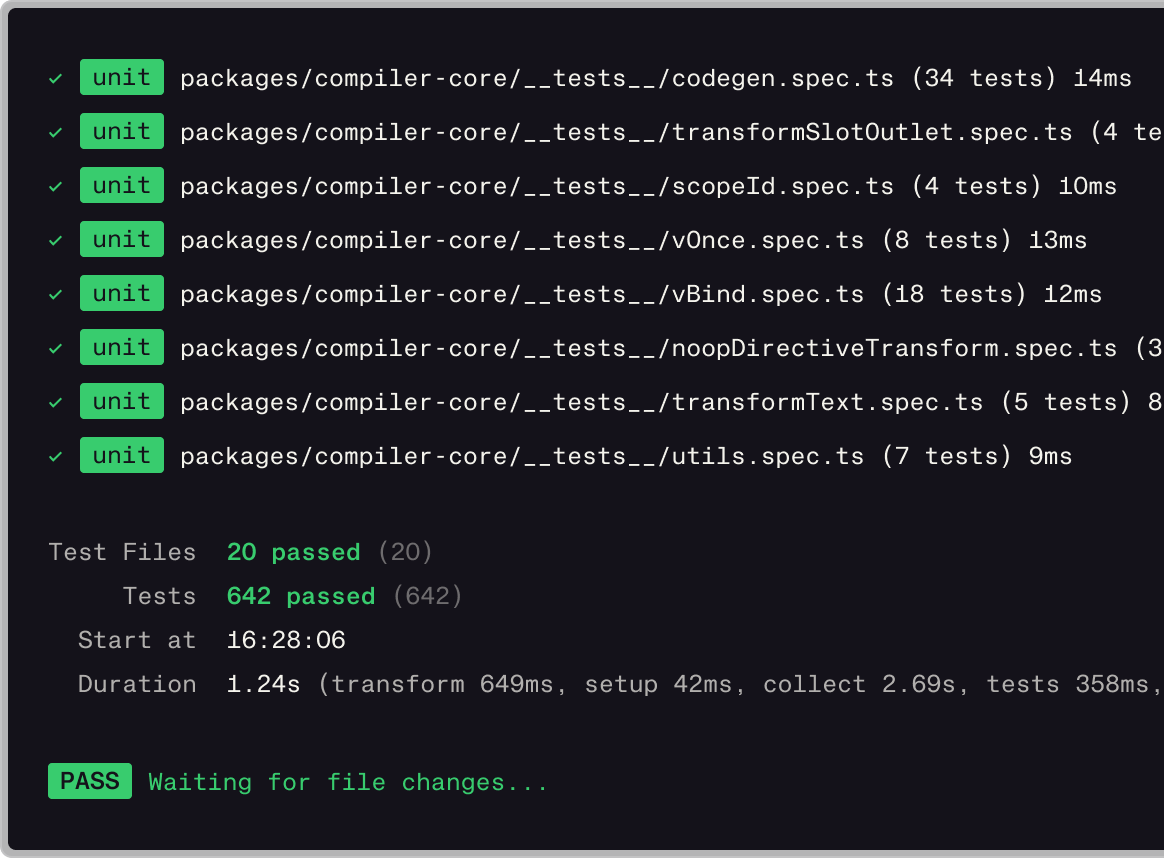
vite.config.ts drives both your app and your tests. Aliases, plugins, JSX, and environment variables Just Work — no parallel Babel/Jest config to maintain.describe, it, expect, vi.mock, snapshot testing — most Jest test files run on Vitest after a single import swap.v8 and istanbul coverage with HTML, JSON, and LCOV reporters. No nyc wiring required.vitest --ui opens a local dashboard that visualises your suites, mocks, dependency graph, and failure diffs — a clear improvement over a wall of terminal output.Sentiment is overwhelmingly positive. The State of JS 2024 survey shows Vitest passing Jest in developer satisfaction; on Reddit's r/javascript and r/reactjs the most upvoted threads describe migrations as "a one-afternoon job" with watch-mode reruns dropping from "a coffee break" to "a blink." Several Hacker News threads quantify the win at 5–28× faster on representative suites — driven mostly by Vite's transform pipeline, ESM-native execution, and Tinypool's worker model.
The honest complaints are real. vi.mock hoisting is similar to Jest's jest.mock but not identical, and complex factory closures sometimes need rewriting. Browser mode is excellent but still labelled experimental for some scenarios. Teams with Jest suites that lean heavily on the --shard flag at 100,000+ tests sometimes find sharding ergonomics in Vitest less mature.
Vitest is free and open source under the MIT license. There are no paid tiers, seat limits, or usage caps. The project is supported by GitHub Sponsors, OpenCollective, and corporate sponsorship of VoidZero by companies including Vercel, Bolt, and Chromatic.
| Plan | Price | Includes |
|---|---|---|
| Open Source | $0 | Full CLI, browser mode, UI mode, coverage, workspaces, AI Agent reporter, all reporters |
| Sponsor (individual) | From $5/month | Same software, supports development |
| Sponsor (corporate) | Custom | Logo placement and direct contact with maintainers |
Best for: Any team building or maintaining a JavaScript or TypeScript project with Vite, SvelteKit, Nuxt, Astro, Remix, Solid, or modern Angular. Library authors who ship ESM. Greenfield React or Vue applications. Monorepos that want one test runner across packages.
Not ideal for: Mature Jest suites at 100,000+ tests with deep --shard CI pipelines and complex jest.mock factory patterns — migration is doable but no longer a quick win. Pure non-JS projects (Vitest is JS/TS only).
Pros:
Cons:
Jest 30 remains the incumbent and is fine for Jest-shaped codebases that don't use Vite. Bun's built-in test runner is dramatically fast but tied to Bun runtime and has fewer plugins. Node.js node:test is zero-dependency and ships with Node, but lacks Vitest's UI, browser mode, and ecosystem. Playwright and Cypress are end-to-end runners and complement rather than replace Vitest.
Yes — for almost everyone writing modern JavaScript or TypeScript today. Vitest is free, MIT-licensed, ships in one npm install -D vitest, and replaces a stack of Jest-era plumbing with a single configuration. We score it 92/100. The remaining points are reserved for the small but real migration friction at very large Jest scale and a still-maturing browser mode. For everyone else, vitest is the test runner to reach for in 2026.
ServiceNow and Accenture Launch Forward Deployed Engineering Program to Scale Agentic AI in the Enterprise (May 6, 2026)
At Knowledge 2026, ServiceNow and Accenture announced a joint forward deployed engineering program that drops co-located engineer pods into customer environments to ship agentic AI workflows natively on the ServiceNow AI Platform — with access to 300+ pre-built agent skills and the AI Control Tower as the governance backbone.
May 7, 2026
ReFiBuy Raises $13.6M Seed to Help Brands Get Recommended by AI Shopping Agents (May 5, 2026)
ReFiBuy, the Raleigh-based agentic commerce platform from ChannelAdvisor founder Scot Wingo, closed an oversubscribed $13.6M seed led by NewRoad Capital Partners on May 5, 2026 — betting that the next billion-dollar e-commerce moat is being chosen by ChatGPT, Claude and Perplexity.
May 7, 2026
OpenAI Replaces ChatGPT's Default Model With GPT-5.5 Instant — 52.5% Fewer Hallucinations, 30% Shorter Answers (May 5, 2026)
OpenAI on May 5 swapped GPT-5.3 Instant for the new GPT-5.5 Instant as ChatGPT's default model, claiming 52.5% fewer hallucinated claims on high-stakes prompts and 30% more concise answers. The model also rolls into the API as chat-latest and adds personalization from Gmail and past chats for Plus and Pro web users.
May 7, 2026
Is this product worth it?
Built With
Compare with other tools
Open Comparison Tool →