 Developer Tools
Templ
Type-safe HTML templating language for Go with compile-time safety
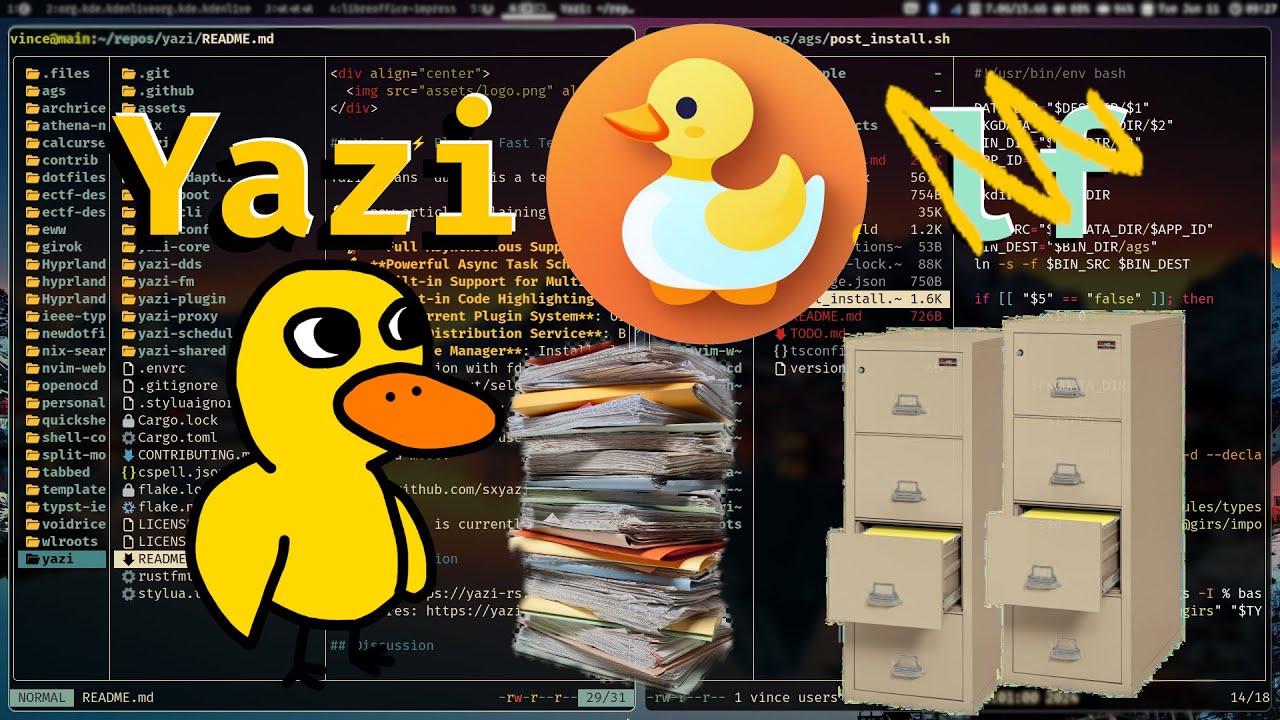
Yazi is a Rust-based terminal file manager built on async I/O — with native image previews, Lua plugins and tmux-killer features. We rate it 86/100.
Yazi is a free, MIT-licensed terminal file manager written in Rust by @sxyazi, built from the ground up on non-blocking async I/O. We rate it 86/100 — the fastest TUI file manager you can install today, and the only one in the ranger / nnn / lf / broot lineup that ships native Kitty, Sixel and iTerm2 image previews out of the box.
Yazi (the name means “duck” in Chinese) is a single Rust binary that gives you a vim-keybound, dual-pane file manager inside any terminal. The project was started by sxyazi with first public commits in , is licensed MIT, and lives at sxyazi/yazi on GitHub where it has crossed 33,000 stars and is mirrored on Homebrew, WinGet, Chocolatey, AUR, Nix, snap and cargo.
What makes Yazi different from the established TUI file managers (ranger, lf, nnn, broot) is the runtime: every I/O operation is asynchronous and CPU work is fanned out across threads, so navigating a directory with 100,000 entries or scrubbing through a folder of 4K JPEGs no longer blocks the UI. The official blog post “Why is Yazi fast?” walks through the architecture: a Tokio-driven event loop, pre-loading and caching layers, and a publish-subscribe Lua bus for plugins.

w3m-imgdisplay hack. Überzug++ is supported as a fallback for X11/Wayland and Chafa for ASCII art on plain TTYs.ya pkg command, with one-line install and version pinning.hjkl navigation, visual mode for batch selection, / search, r to bulk-rename through your $EDITOR, and an OSC 52 clipboard so yanked paths survive over SSH.z and Yazi jumps to your most-used directories without any plumbing.
On the recurring “Yazi is the best terminal file manager” Hacker News thread, the most-upvoted comments cite raw speed (“ranger feels like a slideshow after this”) and the responsiveness of the maintainer — non-trivial issues routinely close within 24 hours. r/commandline and r/unixporn rice-screenshot threads have made Yazi the default file manager featured next to Neovim and Zellij in 2025–2026 dotfile setups.
The most consistent complaint, and the main reason we capped the rating at 86, is platform parity on Windows: Microsoft’s ConPTY layer still blocks several image-preview protocols natively, so Windows users either run Yazi inside WSL or accept Chafa ASCII previews. Other recurring grumbles: the Flatpak edition ships in a sandbox that breaks file(1) mimetype detection unless you set YAZI_FILE_ONE, and Yazi is not yet packaged in Debian stable, so apt users have to use the upstream tarball or cargo.
Yazi is fully open source under the MIT License and free for personal and commercial use. There is no paid tier, no hosted product, no telemetry and no account. Pre-built binaries cover macOS (Intel and Apple Silicon), Linux (glibc and musl), Windows (native and WSL) and FreeBSD; package managers include Homebrew, WinGet, Chocolatey, AUR, Nix, snap and cargo install yazi-fm yazi-cli.
| Plan | Price | What you get |
|---|---|---|
| Yazi | $0 forever | Full feature set, all platforms, source code, no account, all plugins free via ya pkg |
Best for: Terminal-first developers who already live in Neovim/tmux/Zellij and want a file manager that matches that latency budget; sysadmins who need to scrub through huge directories on remote machines over SSH; anyone who has been waiting for ranger to feel snappy on a 4K monitor.
Not ideal for: Windows-only users who can’t use WSL (the native ConPTY image-preview story is still rough), or anyone who wants a stable-API tool — Yazi is in public beta, ships CalVer releases roughly every two weeks, and breaking changes to the Lua plugin API still happen.
Pros:
ya pkg add yazi-rs/plugins:git).Cons:
ranger is the venerable Python file manager — richer plugin ecosystem, but blocking I/O makes it feel slow on big directories in 2026. lf (Go) is closer to Yazi philosophically but has no image preview and a smaller feature set. nnn wins on resource footprint (sub-10 MB RAM) but is intentionally minimal. broot is the only competitor with comparable polish, and remains the best choice if your workflow is fuzzy-tree-search rather than two-pane navigation. We have full reviews of Lazygit and Atuin for adjacent terminal tooling.
Yes — if you spend most of your day in a terminal and you’ve ever felt ranger stutter, Yazi is a strict upgrade. The combination of async I/O, native image previews, a real Lua plugin system and a single-binary install is unmatched in the space. The 86/100 reflects two real costs: it’s still in public beta with a churning plugin API, and the Windows native experience trails macOS and Linux. For everyone else, it is now the default recommendation.
cargo install yazi-fm yazi-cli.ServiceNow and Accenture Launch Forward Deployed Engineering Program to Scale Agentic AI in the Enterprise (May 6, 2026)
At Knowledge 2026, ServiceNow and Accenture announced a joint forward deployed engineering program that drops co-located engineer pods into customer environments to ship agentic AI workflows natively on the ServiceNow AI Platform — with access to 300+ pre-built agent skills and the AI Control Tower as the governance backbone.
May 7, 2026
ReFiBuy Raises $13.6M Seed to Help Brands Get Recommended by AI Shopping Agents (May 5, 2026)
ReFiBuy, the Raleigh-based agentic commerce platform from ChannelAdvisor founder Scot Wingo, closed an oversubscribed $13.6M seed led by NewRoad Capital Partners on May 5, 2026 — betting that the next billion-dollar e-commerce moat is being chosen by ChatGPT, Claude and Perplexity.
May 7, 2026
OpenAI Replaces ChatGPT's Default Model With GPT-5.5 Instant — 52.5% Fewer Hallucinations, 30% Shorter Answers (May 5, 2026)
OpenAI on May 5 swapped GPT-5.3 Instant for the new GPT-5.5 Instant as ChatGPT's default model, claiming 52.5% fewer hallucinated claims on high-stakes prompts and 30% more concise answers. The model also rolls into the API as chat-latest and adds personalization from Gmail and past chats for Plus and Pro web users.
May 7, 2026
Is this product worth it?
Built With
Compare with other tools