 Developer Tools
Templ
Type-safe HTML templating language for Go with compile-time safety
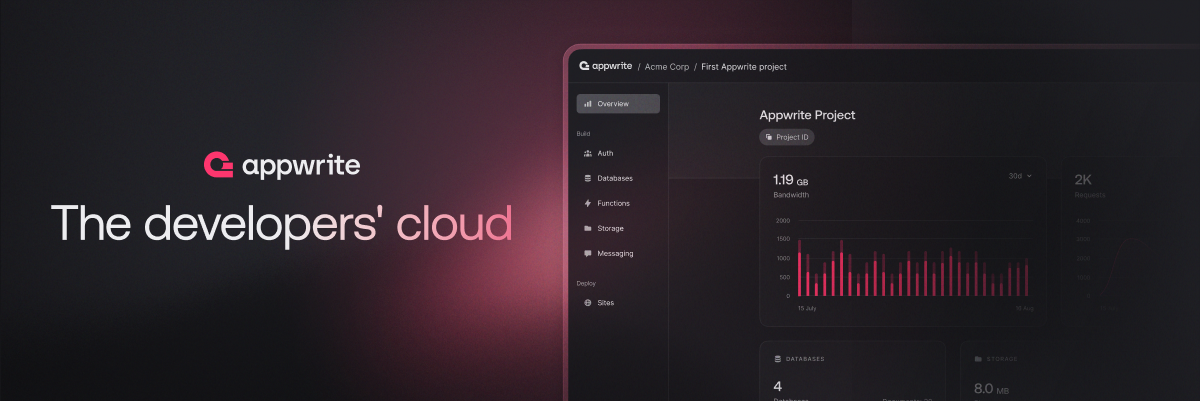
Appwrite is an open-source, all-in-one backend platform — auth, databases, storage, serverless functions, messaging and web hosting — that runs fully managed in the cloud or self-hosted on Docker. A credible Firebase/Supabase alternative, especially for teams who want a document database and a generous self-host path.
Appwrite is an open-source, all-in-one backend-as-a-service that bundles authentication, databases, object storage, serverless functions, messaging and web hosting behind a single console and a consistent SDK surface. We rate it 85/100 — one of the strongest Firebase and Supabase alternatives in 2026, especially for teams who want a flexible document database, broad language support, and the freedom to self-host the entire stack on their own servers.
Appwrite is a backend platform founded by Eldad Fux in Tel Aviv, Israel, and released as an open-source project on . What started as a single Docker container that gave developers a Firebase-style API on their own infrastructure has grown into a BSD-3-Clause-licensed project with 55,800+ GitHub stars, a public managed cloud, and enterprise tiers with SOC-2, HIPAA, and GDPR compliance.
The fundamental value proposition is the same across self-hosted and cloud editions: you get Auth, Databases, Storage, Functions (serverless in 15 runtimes and 13 languages), Messaging, Realtime and Sites (an "open-source Vercel alternative") behind one SDK — without being locked into a specific cloud. The release of Appwrite 1.9 made MongoDB the default database engine for new self-hosted instances and added a redesigned web installer, resource-scoped API keys, and an official Rust SDK.
varchar and text attribute types, realtime query subscriptions that filter by document, and indexed queries out of the box.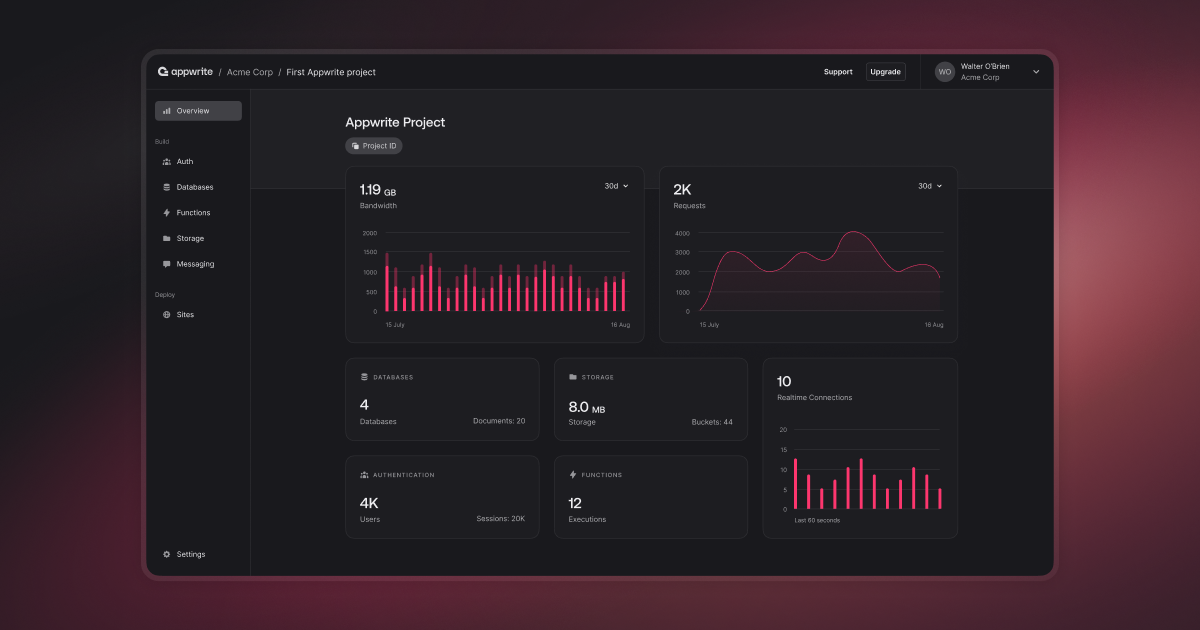
On Reddit and Hacker News, the most consistent praise is Appwrite's developer experience: "All the SDK calls and methods are extremely predictable," as one widely-cited comparison puts it. Self-hosters repeatedly note that a single Docker Compose file stands up the whole stack — one Better Stack guide reports Appwrite "comfortably handled up to 2,000 users per day" on a €5/month Hetzner box where Supabase struggled at the same load.
The criticisms are specific. First, Appwrite is more complex to operate than Firebase — you own the server, the upgrades, and the backups. Second, the ecosystem around it is smaller: fewer third-party integrations, fewer StackOverflow answers, and a smaller contributor pool than Firebase or Supabase. Third, the document-database model can be limiting if your app demands joins, complex relational constraints or PostgreSQL extensions — this is where Supabase tends to win on pure SQL horsepower.
Founder Eldad Fux is active and responsive in the community, and the project ships a feature-level release roughly every quarter — a pace that inspires confidence among self-hosters who have been burned by abandoned open-source backends in the past.
Appwrite Cloud is freemium; the self-hosted version is free under BSD-3-Clause.
| Plan | Price | Key Limits / What's Included |
|---|---|---|
| Free (Cloud) | $0/month | 2 projects, 75K monthly active users, 5 GB bandwidth, 2 GB storage, 750K function executions. Projects pause after 1 week of inactivity. Community support. |
| Pro (Cloud) | $25/month | 200K MAU, 2 TB bandwidth, 150 GB storage, 3.5M executions, daily 7-day backups, dedicated resources, email support, unlimited databases/buckets/functions, metered add-ons. |
| Enterprise | Custom | Everything in Pro + SOC-2/HIPAA/BAA, SSO, uptime SLA, 24/7 support, custom backup policies, volume discounts. |
| Self-hosted (OSS) | $0 | Full platform, every feature, unlimited scale, BSD-3-Clause license, Docker deploy. You pay only for your servers. |
Best for: Solo developers and small teams shipping web, mobile or cross-platform apps who want a Firebase-style API without Google's pricing model; startups with strict data-residency or GDPR/HIPAA requirements that can't leave their cloud; and open-source-oriented teams who want the option to self-host today without rewriting code tomorrow. It is an especially strong fit for Flutter, React Native, Next.js and Svelte builders.
Not ideal for: Teams whose product is built around complex relational schemas, PostgreSQL extensions (PostGIS, pgvector, full-text search) or SQL-heavy analytics — Supabase fits that shape better. Also skip Appwrite if you want a fully hands-off managed backend with zero ops awareness and don't need the ability to self-host — Firebase still wins on pure hands-off convenience.
Pros:
Cons:
Supabase — the most direct competitor; Postgres-based, stronger for relational and SQL-heavy apps, but only self-hostable in a partial form. Read our Supabase review for the side-by-side.
Firebase — the incumbent; fully managed, no self-hosting, and a famously unpredictable bill at scale.
PocketBase — a single-binary Go alternative for tiny projects; far smaller feature surface. See our PocketBase review.
Convex — reactive database with end-to-end TypeScript, stronger for live-sync apps but closed-source. Our Convex review covers it in depth.
Yes — for the right team. Appwrite is the easiest BaaS to recommend to a developer who wants Firebase's convenience and the right to walk away with the same codebase. The open-source story is real (not an "open-core" head-fake), the release cadence is honest, and the Cloud Pro plan at $25/month is one of the best dollar-per-feature deals among managed BaaS providers. If your app fits a document-oriented data model and you value portability, Appwrite belongs on the shortlist. If you need deep relational SQL power, start with Supabase instead. We rate it 85/100.
ServiceNow and Accenture Launch Forward Deployed Engineering Program to Scale Agentic AI in the Enterprise (May 6, 2026)
At Knowledge 2026, ServiceNow and Accenture announced a joint forward deployed engineering program that drops co-located engineer pods into customer environments to ship agentic AI workflows natively on the ServiceNow AI Platform — with access to 300+ pre-built agent skills and the AI Control Tower as the governance backbone.
May 7, 2026
ReFiBuy Raises $13.6M Seed to Help Brands Get Recommended by AI Shopping Agents (May 5, 2026)
ReFiBuy, the Raleigh-based agentic commerce platform from ChannelAdvisor founder Scot Wingo, closed an oversubscribed $13.6M seed led by NewRoad Capital Partners on May 5, 2026 — betting that the next billion-dollar e-commerce moat is being chosen by ChatGPT, Claude and Perplexity.
May 7, 2026
OpenAI Replaces ChatGPT's Default Model With GPT-5.5 Instant — 52.5% Fewer Hallucinations, 30% Shorter Answers (May 5, 2026)
OpenAI on May 5 swapped GPT-5.3 Instant for the new GPT-5.5 Instant as ChatGPT's default model, claiming 52.5% fewer hallucinated claims on high-stakes prompts and 30% more concise answers. The model also rolls into the API as chat-latest and adds personalization from Gmail and past chats for Plus and Pro web users.
May 7, 2026
Is this product worth it?
Built With
Compare with other tools
Open Comparison Tool →