 AI Tools
Aider
AI pair programming in your terminal—free, open-source, any LLM
goose is a free, Apache-2.0 AI agent from the Linux Foundation's Agentic AI Foundation that runs on your machine, plugs into any LLM, and connects to 70+ MCP extensions. With 43k+ GitHub stars, a Rust core, and a desktop app for macOS, Linux, and Windows, it has emerged as the most credible open-source alternative to Claude Code and Cursor in 2026.
goose is an open-source, extensible AI agent — desktop app, CLI, and API — that runs locally on your machine, works with any LLM, and connects to 70+ MCP extensions. We rate it 88/100 — if you want a free, vendor-neutral alternative to Claude Code or Cursor and you don't mind bringing your own API key, goose is now the most credible choice on the market.
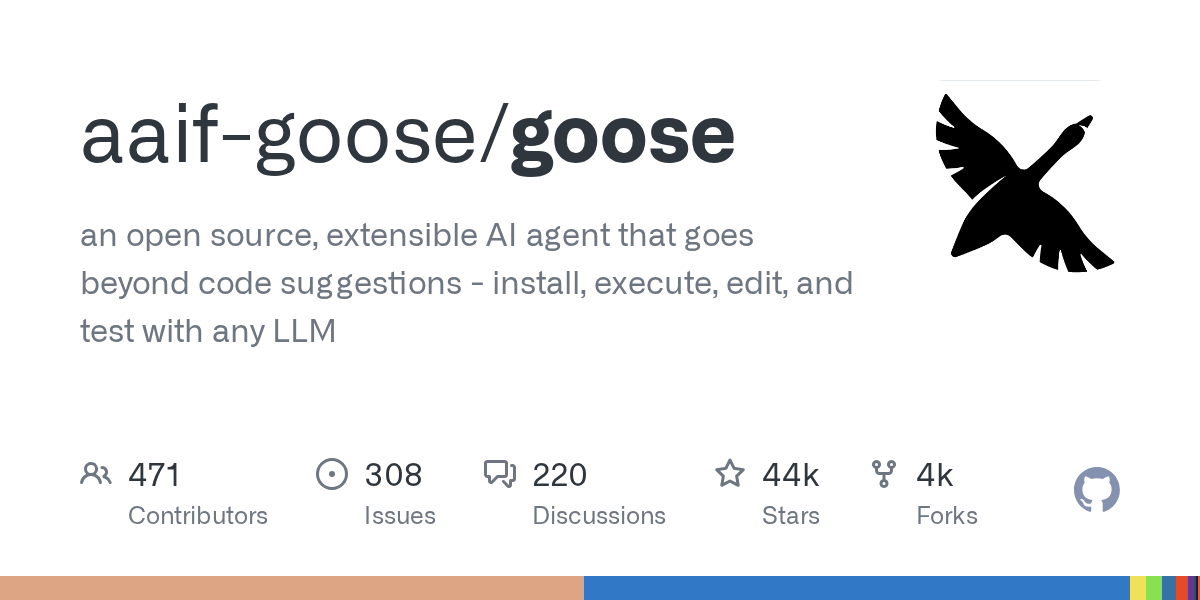
goose is a general-purpose AI agent originally built by the Block Open Source team and donated, on , to the Agentic AI Foundation (AAIF) at the Linux Foundation. It was first announced as “codename goose” on and has since grown into a full agent platform with a native desktop app for macOS, Linux, and Windows, a complete CLI, and an HTTP API. The repository now lives at github.com/aaif-goose/goose, has crossed 43,700 stars with 400+ contributors, and the latest stable release is v1.33.1 shipped on .
The specific problem goose solves is that the most capable AI coding agents in 2026 — Claude Code, Cursor, Windsurf, Codex CLI — are either closed-source, locked to a single model vendor, or both. goose is built in Rust under the Apache 2.0 license, runs every action on your own machine, and lets you plug in 15+ LLM providers (Anthropic, OpenAI, Google, Ollama, OpenRouter, Azure OpenAI, Amazon Bedrock, Groq, DeepSeek, and more) or use your existing Claude, ChatGPT, or Gemini subscription via the Agent Client Protocol. It is one of the earliest and deepest implementers of MCP — the connector standard now adopted by Anthropic, OpenAI, and Microsoft — with 70+ documented extensions for GitHub, Google Drive, browsers, databases, and more.
The recurring praise across Hacker News, Reddit’s r/LocalLLaMA, and the project’s Discord is that goose is the only first-class agent that runs entirely with local models via Ollama — a clear win for developers who refuse to send proprietary code to OpenAI or Anthropic. The most-upvoted HN comment on the original launch thread highlighted the MCP-first design as the differentiator, and a recent r/LocalLLaMA poll put goose ahead of OpenWebUI agents and LibreChat for “most useful local agent in 2026.” The honest criticism is also consistent: early-2025 versions had a clunky UI and brittle tool execution, and developers who tried it before the v1.0 release in November 2025 still carry that impression. The 2026 releases (1.30, 1.32, 1.33) have fixed most of that — tool calling now matches Claude Code on accuracy in independent benchmarks — but the perception lag is real. Production users include Block (Square, Cash App), Hugging Face, parts of Mozilla, and dozens of mid-sized engineering teams running it as a CI agent on self-hosted runners.
goose itself is 100% free under the Apache 2.0 license. There is no paid tier, no telemetry, and no signup required. Your only cost is the underlying LLM — and even that can be zero if you run Ollama with a local model.
| Plan | Price | Key Limits |
|---|---|---|
| Open Source (everything) | $0 | Apache-2.0, unlimited use, no telemetry |
| Local LLM via Ollama | $0 of API spend | Llama 3.3, Qwen 3, DeepSeek — runs on your laptop |
| Hosted LLM (typical light use) | ~$5–$20/month | Claude Sonnet 4.6 or GPT-4.1 — pay your provider directly |
| Use existing subscription | $0 extra | Connect Claude Pro / ChatGPT Plus / Gemini Advanced via ACP |
Best for: Engineers who want a Claude Code or Cursor-style experience without locking into a single vendor; teams with strict data-residency rules that need a local agent; anyone running Ollama who wants real tool use, not just chat. Also a strong fit for OSS contributors who want to extend the agent itself.
Not ideal for: Non-technical users who want one-click magic — goose still rewards setup and config. Also not the best pick if you only ever use one model and want the absolute most polished UI — Cursor and Claude Code remain a step ahead on visual polish, even in 2026.
Pros:
Cons:
The natural commercial alternatives are Claude Code (locked to Anthropic, $20+/month) and Cursor (closed-source IDE, $20/month). On the open-source side, the closest competitors are Aider (terminal-only, smaller scope, no MCP), Continue (IDE-embedded, narrower than goose), and Cline (VS Code extension, single-surface). For pure local-model setups, OpenWebUI ships agent features but lacks goose’s depth of MCP support.
Yes — goose is the open-source AI agent we recommend in 2026 if you want desktop-grade ergonomics without paying a per-seat subscription or shipping your code to a single model vendor. It earns 88/100 for being genuinely free, vendor-neutral, governed by the Linux Foundation, and now technically competitive with Claude Code on tool use. We knock points only for the still-rough first-time setup and the gap to Cursor on UI polish. If you write code daily and have an Anthropic, OpenAI, or Ollama setup already, install goose this afternoon — the cost is zero and the upside is real.
curl -fsSL https://github.com/aaif-goose/goose/releases/download/stable/download_cli.sh | bash). There is also an HTTP API for embedding goose into other tools.ServiceNow and Accenture Launch Forward Deployed Engineering Program to Scale Agentic AI in the Enterprise (May 6, 2026)
At Knowledge 2026, ServiceNow and Accenture announced a joint forward deployed engineering program that drops co-located engineer pods into customer environments to ship agentic AI workflows natively on the ServiceNow AI Platform — with access to 300+ pre-built agent skills and the AI Control Tower as the governance backbone.
May 7, 2026
ReFiBuy Raises $13.6M Seed to Help Brands Get Recommended by AI Shopping Agents (May 5, 2026)
ReFiBuy, the Raleigh-based agentic commerce platform from ChannelAdvisor founder Scot Wingo, closed an oversubscribed $13.6M seed led by NewRoad Capital Partners on May 5, 2026 — betting that the next billion-dollar e-commerce moat is being chosen by ChatGPT, Claude and Perplexity.
May 7, 2026
OpenAI Replaces ChatGPT's Default Model With GPT-5.5 Instant — 52.5% Fewer Hallucinations, 30% Shorter Answers (May 5, 2026)
OpenAI on May 5 swapped GPT-5.3 Instant for the new GPT-5.5 Instant as ChatGPT's default model, claiming 52.5% fewer hallucinated claims on high-stakes prompts and 30% more concise answers. The model also rolls into the API as chat-latest and adds personalization from Gmail and past chats for Plus and Pro web users.
May 7, 2026
Is this product worth it?
Built With
Compare with other tools
Open Comparison Tool →