
 AI Tools
Aider
AI pair programming in your terminal—free, open-source, any LLM
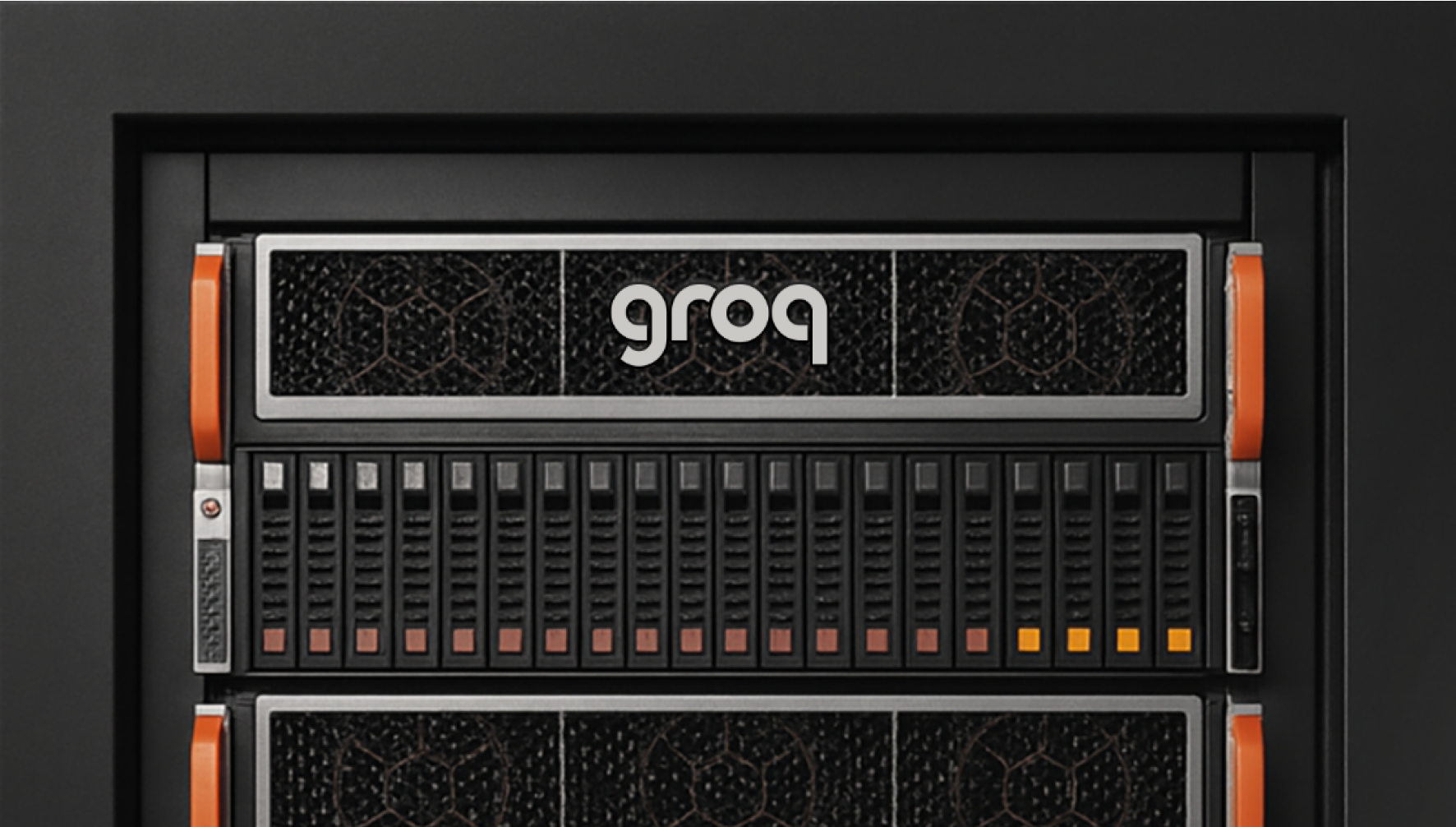
Groq runs open-weight LLMs on custom LPU hardware to deliver the fastest hosted token throughput on the market. We rate it 85/100 — best-in-class speed, with daily-cap caveats on the free tier.
Groq is a low-latency AI inference provider that runs open-weight models on its custom Language Processing Unit (LPU) hardware instead of the GPUs used by AWS Bedrock or together.ai. We rate it 85/100 — if you need the fastest token output you can get from a hosted API for chatbots, agents, and voice apps, Groq is the benchmark. If you need a reliable production surface beyond a few hundred requests a day on the free tier, the Developer plan is unavoidable.
Groq is a Mountain View, California chip and inference company founded in 2016 by Jonathan Ross, who designed and built the first generation of Google’s Tensor Processing Unit (TPU) as a 20% project before leaving to start the company. Groq’s thesis is that inference workloads, where every user is waiting for the next token, are fundamentally different from training workloads, and that a deterministic, single-core, software-scheduled architecture (the LPU) can serve them with far lower latency than a GPU stack designed for matrix-multiply throughput.
The consumer-facing product is GroqCloud, a hosted inference API that launched in early 2024. By late 2025 the company reported roughly 2 million developers on the platform and accounts inside 75% of Fortune 100 companies. In December 2025 Nvidia agreed to license Groq’s inference IP and absorb a portion of its team in a deal valued at approximately $20 billion — Nvidia’s largest transaction on record. Groq itself continues to operate as an independent company under new CEO Simon Edwards.

On Hacker News, Groq threads consistently surface the same two reactions: amazement at the raw speed (one customer cited an internal 7.4× chat-speed gain and an 89% cost reduction after switching from a GPU provider), and frustration with daily request caps that throttle anything past a single-developer side project. Reddit’s r/LocalLLaMA points to Groq as the go-to hosted option when local inference isn’t fast enough, but Reddit users echo the production complaint — the requests-per-day ceiling is the binding constraint, not RPM. The Groq community forum has long-running threads from teams asking how to escalate to enterprise rate limits, with developers describing slow turnaround on those requests.

Groq offers three tiers. The free tier covers prototyping; the Developer tier removes daily caps and is the realistic minimum for production use; Enterprise unlocks dedicated capacity and custom SLAs.
| Plan | Price | Key Limits |
|---|---|---|
| Free | $0 | 30 RPM / 6,000 TPM / 1,000 RPD on most models; every model available; no credit card required. |
| Developer | From $0.05 / M input tokens (per-model rates apply) | Up to 10× the free-tier rate limits; published 25% discount on selected models; pay-as-you-go billing. |
| Enterprise | Contact sales | Dedicated capacity, custom rate limits, SLAs, and procurement-friendly contracts. |
Per-model token prices vary — the cheapest open-weight models at $0.05/M input are dramatically below GPT-5.5 Mini economics, but flagship Llama 4 Maverick costs more.
Best for: AI engineers building voice agents, real-time chat, autonomous agent loops, and latency-sensitive RAG pipelines on open-weight models. Indie developers who want the fastest free hosted inference in the market for prototyping. Teams that have already chosen Llama or Mixtral and just need to run them faster.
Not ideal for: Teams that need GPT-5.5, Claude Opus 4.7, or Gemini 3 — Groq doesn’t host proprietary frontier models. High-volume batch workloads where throughput matters more than latency: a GPU provider is usually cheaper for offline jobs. Anyone who needs a fully managed enterprise stack on day one without a sales conversation.
Pros:
Cons:
The closest direct competitors are Together AI (broader model catalog on GPUs, slower), Fireworks AI (similar positioning, strong fine-tuning story), and Replicate (broader generative-media coverage, not latency-focused). For proprietary frontier models you need OpenAI, Anthropic, or Google directly — Groq doesn’t play in that lane.
Yes, with one caveat. If your application’s success depends on inference latency — voice, real-time agents, fast chat — Groq is the strongest hosted option in 2026, and the free tier is generous enough that there is no excuse not to benchmark it against your current provider this week. The caveat is that the moment you need to ship to real users, you will outgrow the free tier’s daily cap and need to commit to paid usage. At our 85/100 rating, Groq earns the “very good” label for delivering on its core promise (speed) better than anyone else, while losing points on the daily-cap experience and the strategic uncertainty introduced by the Nvidia deal.
ServiceNow and Accenture Launch Forward Deployed Engineering Program to Scale Agentic AI in the Enterprise (May 6, 2026)
At Knowledge 2026, ServiceNow and Accenture announced a joint forward deployed engineering program that drops co-located engineer pods into customer environments to ship agentic AI workflows natively on the ServiceNow AI Platform — with access to 300+ pre-built agent skills and the AI Control Tower as the governance backbone.
May 7, 2026
ReFiBuy Raises $13.6M Seed to Help Brands Get Recommended by AI Shopping Agents (May 5, 2026)
ReFiBuy, the Raleigh-based agentic commerce platform from ChannelAdvisor founder Scot Wingo, closed an oversubscribed $13.6M seed led by NewRoad Capital Partners on May 5, 2026 — betting that the next billion-dollar e-commerce moat is being chosen by ChatGPT, Claude and Perplexity.
May 7, 2026
OpenAI Replaces ChatGPT's Default Model With GPT-5.5 Instant — 52.5% Fewer Hallucinations, 30% Shorter Answers (May 5, 2026)
OpenAI on May 5 swapped GPT-5.3 Instant for the new GPT-5.5 Instant as ChatGPT's default model, claiming 52.5% fewer hallucinated claims on high-stakes prompts and 30% more concise answers. The model also rolls into the API as chat-latest and adds personalization from Gmail and past chats for Plus and Pro web users.
May 7, 2026
Is this product worth it?
Built With
Compare with other tools
Open Comparison Tool →