 Developer Tools
Templ
Type-safe HTML templating language for Go with compile-time safety
Kestra is an open-source, declarative orchestration platform that lets you build event-driven workflows in YAML and connect 1,300+ plugins across data, infrastructure, and AI. We rate it 88/100 — the strongest modern Airflow alternative for teams that want orchestration without the Python lock-in.
Kestra is an open-source, declarative orchestration platform that lets engineers describe workflows in YAML and connect them to 1,300+ plugins spanning data, infrastructure, APIs, and AI. We rate it 88/100 — the strongest modern Airflow alternative for teams that want orchestration without Python lock-in or a sprawling Helm chart.
Kestra was founded in 2019 by Ludovic Dehon and Loïc Mathieu in Paris after a decade of operating data pipelines on legacy schedulers. The team open-sourced the platform on under the Apache-2.0 license. The repository kestra-io/kestra now sits at 26,776 GitHub stars as of , used across 30,000+ organisations including Leroy Merlin, Bouygues Telecom, Rivian, Decathlon and Doctolib.
The pitch is simple. Apache Airflow is Python-only and was designed for cron-driven batch jobs. Kestra is language-agnostic, event-driven by default, and treats workflows as declarative YAML — the same format your DevOps team already uses for Kubernetes, Terraform and GitHub Actions. In March 2026, Kestra raised a $25M Series A led by RTP Global, bringing total funding to $36M and pushing the platform toward unified orchestration of data, infrastructure and AI agents.
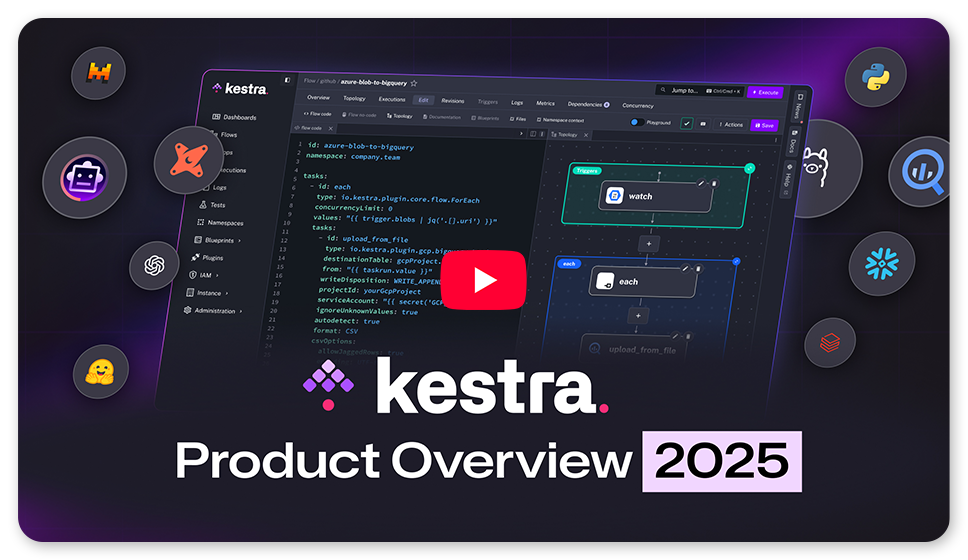
id, tasks, triggers — Git-versionable, code-reviewable, deployable through Terraform, no DAG factories or Python decorators required.localhost:8080 after one docker run.retry, timeout and SLA blocks declaratively and Kestra handles the state machine.AI Agent tasks that let you build autonomous workflows with memory, tools and any model provider.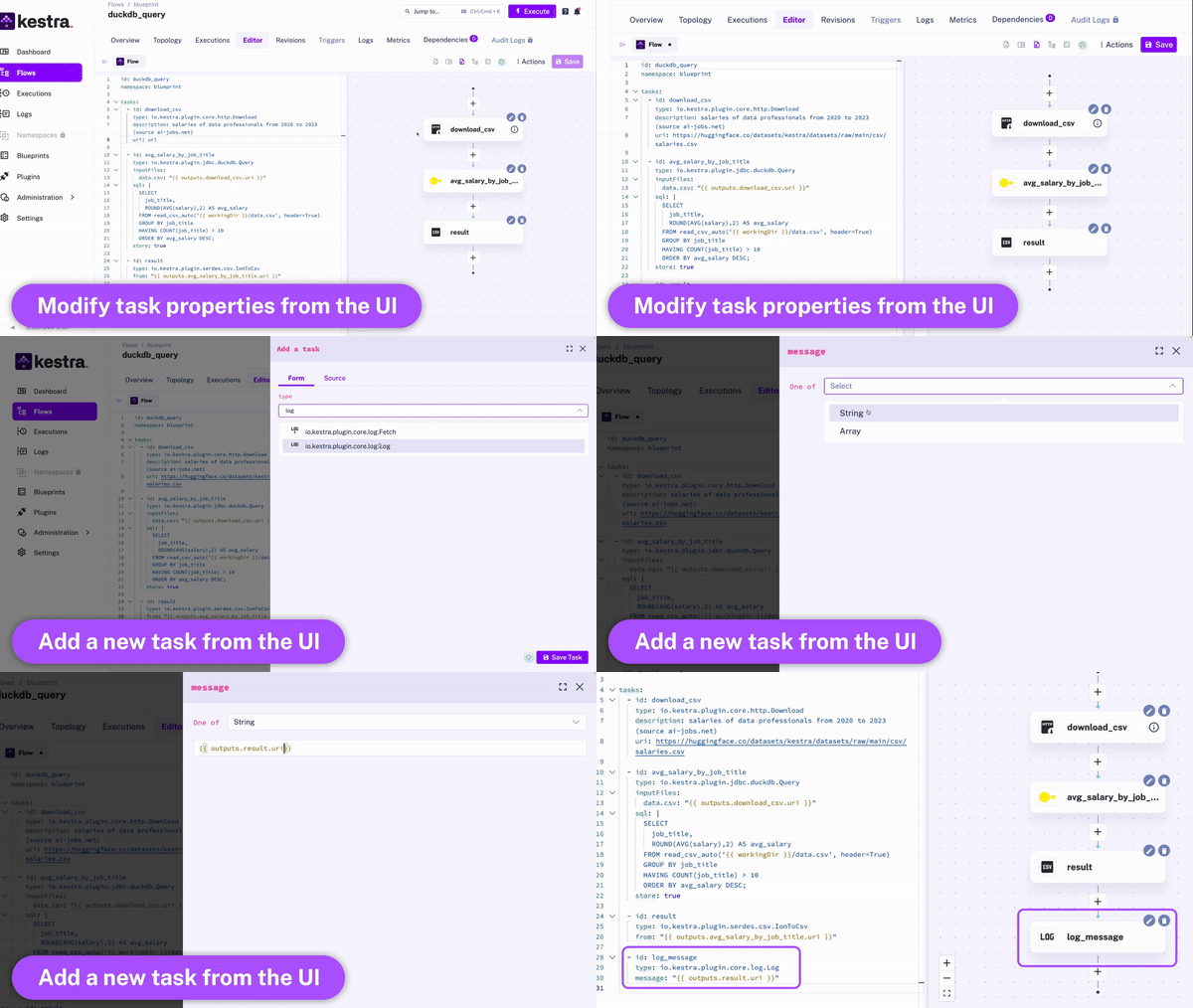
Reaction across Hacker News, Reddit's r/dataengineering, and G2 is overwhelmingly positive but pointed. The recurring praise: teams report cutting orchestration setup from "a sprint of Helm charts" to a single afternoon, and non-Python contributors (analysts, platform engineers, ML researchers) can finally read and edit flows without learning Airflow's DAG idiom. On G2, one platform team reports a 98% pipeline success rate after migrating off Airflow. The recurring criticism: large Python codebases still end up pasted into script blocks inside YAML, which can feel awkward, and engineers used to writing imperative DAGs sometimes miss the flexibility of pure code. A second thread of feedback notes that the Enterprise pricing is opaque — there is no public price list, and several Reddit threads complain that you have to talk to sales to get a number.
Kestra's open-source edition is free forever and includes every core orchestration feature. Cloud and Enterprise are the paid surfaces.
| Plan | Price | Key Limits |
|---|---|---|
| Open Source | $0 | Self-hosted, all 1,300+ plugins, unlimited flows and executions, community support |
| Cloud | Usage-based (request access) | Fully managed SaaS, automatic scaling, built-in security, Cloud SSO, multi-tenant |
| Enterprise Edition | Contact sales (annual subscription) | Adds RBAC, audit logs, LDAP, worker groups, plugin versioning, AI Copilot with custom models, Apps, SLA support |
Best for: Data, platform and DevOps teams (5–500 engineers) running multi-language pipelines who want a single orchestration layer over data, infra and AI — especially anyone migrating off Airflow because they are tired of the Python-only DAG model, the metadata-DB upgrade pain, or the scheduler/executor/webserver split.
Not ideal for: Solo developers running a handful of cron jobs (a single GitHub Actions workflow is simpler), or teams deeply standardised on Airflow with thousands of existing DAGs where the migration cost outweighs the benefit. Also a poor fit if your entire workflow is one Python notebook — Prefect or Dagster will feel more natural.
Pros:
Cons:
script blocks can feel awkward versus a pure-Python DAG.The closest direct competitor is Apache Airflow, which has a larger community but is Python-only and operationally heavier. Prefect and Dagster are Python-native challengers with strong type systems but neither matches Kestra's polyglot or YAML approach. Temporal is the right pick for application-level workflows in code (Go, Java, TypeScript) rather than data pipelines. For lightweight automation, n8n and Windmill overlap on the low-code side but lack Kestra's enterprise orchestration depth.
Yes — for any team running multi-language data, infrastructure or AI pipelines, Kestra is the strongest open-source orchestration platform on the market in 2026. The combination of a YAML-first declarative model, 1,300+ plugins, event-driven triggers and a single-binary deployment story makes it materially easier to operate than Airflow without giving up the production hardness Airflow is known for. We rate it 88/100 — the four points off reflect opaque Enterprise pricing and the fact that very Python-heavy teams may prefer Prefect or Dagster's pure-code model.
ServiceNow and Accenture Launch Forward Deployed Engineering Program to Scale Agentic AI in the Enterprise (May 6, 2026)
At Knowledge 2026, ServiceNow and Accenture announced a joint forward deployed engineering program that drops co-located engineer pods into customer environments to ship agentic AI workflows natively on the ServiceNow AI Platform — with access to 300+ pre-built agent skills and the AI Control Tower as the governance backbone.
May 7, 2026
ReFiBuy Raises $13.6M Seed to Help Brands Get Recommended by AI Shopping Agents (May 5, 2026)
ReFiBuy, the Raleigh-based agentic commerce platform from ChannelAdvisor founder Scot Wingo, closed an oversubscribed $13.6M seed led by NewRoad Capital Partners on May 5, 2026 — betting that the next billion-dollar e-commerce moat is being chosen by ChatGPT, Claude and Perplexity.
May 7, 2026
OpenAI Replaces ChatGPT's Default Model With GPT-5.5 Instant — 52.5% Fewer Hallucinations, 30% Shorter Answers (May 5, 2026)
OpenAI on May 5 swapped GPT-5.3 Instant for the new GPT-5.5 Instant as ChatGPT's default model, claiming 52.5% fewer hallucinated claims on high-stakes prompts and 30% more concise answers. The model also rolls into the API as chat-latest and adds personalization from Gmail and past chats for Plus and Pro web users.
May 7, 2026
Is this product worth it?
Built With
Compare with other tools
Open Comparison Tool →