
 Productivity
Raycast
Powerful macOS launcher and productivity platform — 7.3K GitHub stars for extensions
Obsidian is a free, local-first knowledge base that stores every note as a plain Markdown file on your own device. We rate it 91/100 for any individual who wants a note app that will outlive the company that built it.
Obsidian is a free, local-first knowledge base and note-taking app that stores every note as a plain Markdown file on your own device. We rate it 91/100 — it is the best personal knowledge management (PKM) tool in 2026 for anyone who wants full data ownership, a keyboard-first workflow, and a plugin ecosystem large enough to turn one app into a writing studio, a CRM, a Zettelkasten, or a project tracker. It is the wrong pick only if you need real-time multi-user collaboration out of the box.
Obsidian was built by Shida Li and Erica Xu, the same Waterloo duo behind the outliner Dynalist. The two began the project during the first weeks of the COVID-19 lockdown and shipped the first public beta on . Version 1.0 arrived on , and the current stable line — Obsidian 1.9 — shipped throughout 2025 and 2026, adding the Bases core plugin that turns any folder of notes into a filterable, formula-driven database. The company is still fully bootstrapped, has never taken venture funding, and founder Steph Ango has publicly said that even the founders don’t know the exact user count — community estimates put monthly active users at roughly 1.5 million as of late 2025, with over 110,000 members in the official Discord.
The specific problem Obsidian solves is vendor lock-in. Evernote, Notion, and Roam all keep your notes inside their own cloud and their own proprietary format. Obsidian flips that: every note is a .md file in a folder you control, so you can open the same vault in VS Code, iA Writer, or a plain text editor — and your notes keep working if Obsidian shuts down tomorrow. Links between notes are just wiki-style [[double brackets]] that the app resolves at read time, which is what powers the famous graph view.
[[link]] creates a bidirectional connection the graph view can traverse..md file on disk. No account, no cloud, no telemetry by default. RAM usage sits around 180–250 MB even on large vaults — roughly half of what Notion’s Electron app consumes.[[Note Name]] syntax creates two-way links that show up in the backlinks pane and in a force-directed graph of the whole vault..canvas JSON file..base file format — Obsidian’s answer to Notion databases, but the underlying data is still YAML frontmatter in your own files.
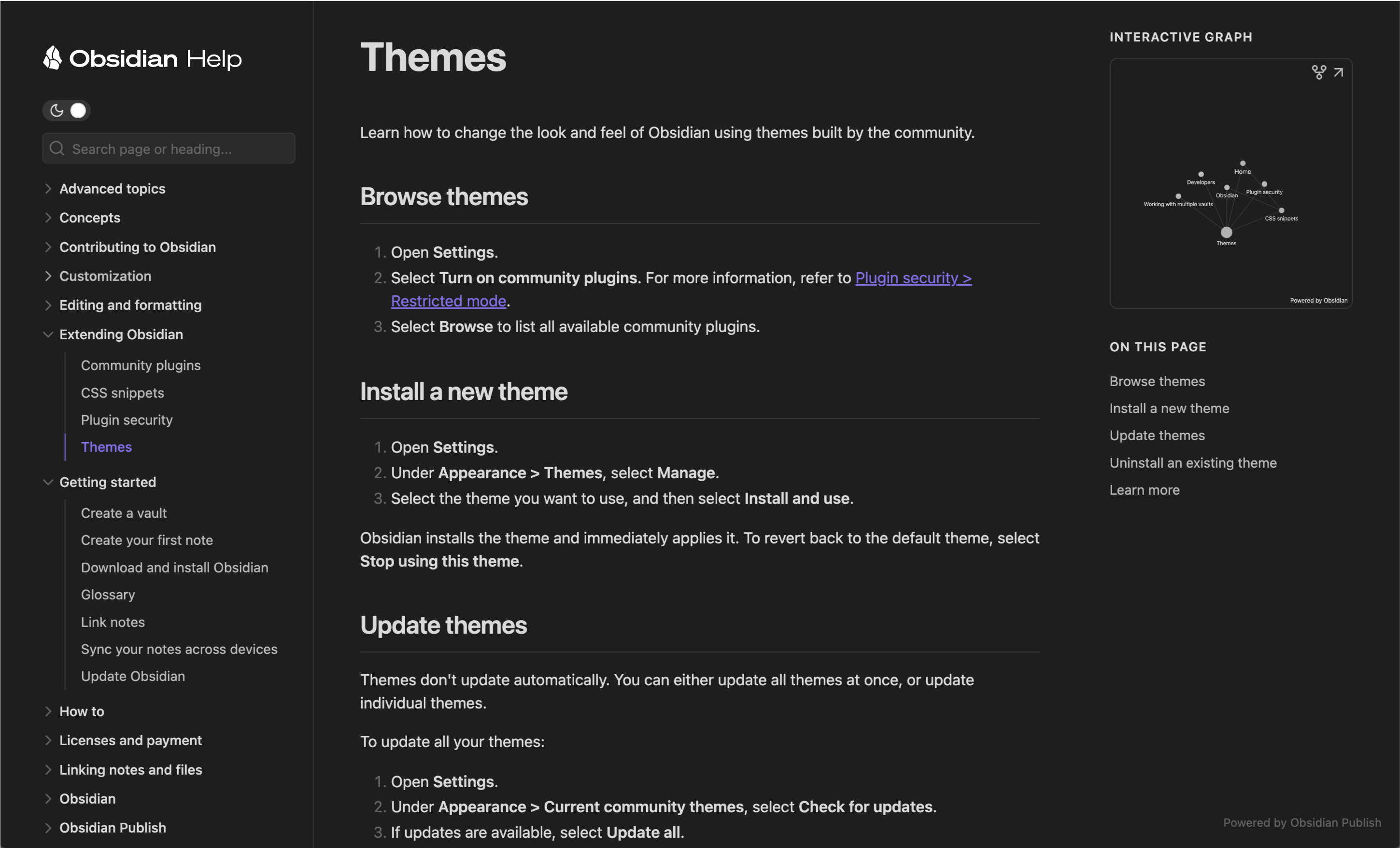
On r/ObsidianMD (260k+ members) the most upvoted threads praise the app’s longevity — five-year-old vaults still open instantly — and the depth of the plugin ecosystem. The most recurring complaint is the onboarding cliff: new users describe the default experience as “convoluted” until they install a theme, a few plugins, and learn the keyboard shortcuts. On Capterra, Obsidian averages roughly 4.7/5 across verified reviews with privacy and offline reliability cited as the strongest points and the lack of native team collaboration as the main weakness. Hacker News threads are blunter: developers love that it is “just Markdown in a folder”, but repeatedly note that Sync is a paid add-on rather than something you can point at your own S3 bucket for free.
Obsidian is free for personal use with no feature caps and no account required. Only the optional network services are paid, and a commercial license is required once you use Obsidian for work at a company with two or more employees.
| Plan | Price | What You Get |
|---|---|---|
| Personal | $0 | All core features, all community plugins, unlimited local vaults |
| Catalyst | $25 one-time | Insider builds, community badges, early feature access |
| Commercial | $50 / user / year | Required for business use at companies of 2+ employees |
| Sync | $4 / mo (annual) or $5 / mo | End-to-end encrypted sync across devices, version history, shared vaults |
| Publish | $8 / mo per site (annual) or $10 / mo | Publish any subset of a vault as a static website |
Students, teachers, and non-profit staff get 40% off Sync and Publish.
Best for: Researchers, writers, solo developers, students, and any knowledge worker who plans to use the same notes for a decade or longer. Especially strong for people already practicing Zettelkasten or building a “second brain”.
Not ideal for: Teams that need real-time multiplayer editing, non-technical users who want a hand-holding WYSIWYG, or anyone who refuses to touch Markdown.
Pros:
Cons:
Notion is the obvious cloud-first alternative — better for teams, worse for privacy and long-term durability. Logseq is fully open source and outliner-first, appealing if you think in bullets instead of pages. AppFlowy (see our review) is an open-source Notion clone with a more traditional database-first feel. Bear (our review) is the best pick if you want the Markdown philosophy without the plugin rabbit hole, though it is Apple-only.
Yes — and the free plan is genuinely free, so the only question is whether you care enough to pay $4–$5 per month for Sync or send $25 to support the team. For any individual building a long-lived knowledge base, Obsidian is the safest bet on the market: the files are yours, the app is fast, and the community ships features faster than most VC-backed competitors. We dock it points for the onboarding cliff and the closed-source core, but almost everything else lands. 91/100.
ServiceNow and Accenture Launch Forward Deployed Engineering Program to Scale Agentic AI in the Enterprise (May 6, 2026)
At Knowledge 2026, ServiceNow and Accenture announced a joint forward deployed engineering program that drops co-located engineer pods into customer environments to ship agentic AI workflows natively on the ServiceNow AI Platform — with access to 300+ pre-built agent skills and the AI Control Tower as the governance backbone.
May 7, 2026
ReFiBuy Raises $13.6M Seed to Help Brands Get Recommended by AI Shopping Agents (May 5, 2026)
ReFiBuy, the Raleigh-based agentic commerce platform from ChannelAdvisor founder Scot Wingo, closed an oversubscribed $13.6M seed led by NewRoad Capital Partners on May 5, 2026 — betting that the next billion-dollar e-commerce moat is being chosen by ChatGPT, Claude and Perplexity.
May 7, 2026
OpenAI Replaces ChatGPT's Default Model With GPT-5.5 Instant — 52.5% Fewer Hallucinations, 30% Shorter Answers (May 5, 2026)
OpenAI on May 5 swapped GPT-5.3 Instant for the new GPT-5.5 Instant as ChatGPT's default model, claiming 52.5% fewer hallucinated claims on high-stakes prompts and 30% more concise answers. The model also rolls into the API as chat-latest and adds personalization from Gmail and past chats for Plus and Pro web users.
May 7, 2026
Is this product worth it?
Built With
Compare with other tools
Open Comparison Tool →