 AI Tools
Aider
AI pair programming in your terminal—free, open-source, any LLM
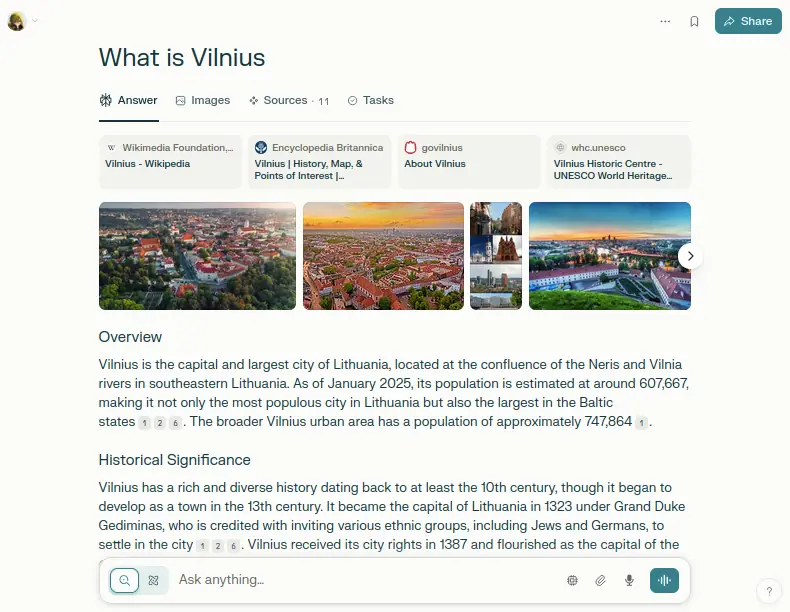
Perplexity is an AI answer engine that returns sourced, real-time answers instead of a wall of links. The free tier is unusually generous, the citations are class-leading, and the new Comet browser turns the entire web into a research surface.
Perplexity is an AI-powered answer engine that searches the live web, picks the trustworthy sources, and writes a cited answer in the time a Google search results page takes to load. We rate it 86/100 — it is the best place on the internet to ask a factual question right now, even if it still trails ChatGPT for raw creative writing and complex reasoning.
Perplexity was founded in by Aravind Srinivas (ex-OpenAI, DeepMind), Denis Yarats (ex-Meta AI), Johnny Ho and Andy Konwinski, and went public with its consumer product on . By April 2026 the company had crossed $450M in annual recurring revenue, 34 million monthly active users, and a $21.21 billion valuation after its Series E-6.
Unlike ChatGPT or Gemini, Perplexity is built around grounded retrieval first. Every answer is generated from a fresh web search, every claim has a numbered citation you can click, and the underlying model is swappable — you choose between GPT-5.5, Claude Opus 4.6, Sonar (Perplexity's own model), Gemini, Grok and others depending on tier. The current consumer flagship is the Comet AI browser, free since on iOS, Android, Windows and Mac.

$1/M input tokens and $5/1,000 grounded queries on the standard tier.
On Reddit's r/perplexity_ai and r/ChatGPT, the most upvoted thread of the last quarter is a head-to-head where Perplexity wins on "verify a fact in 10 seconds" and loses on "write me a marketing email." Across G2, Capterra and Hacker News, the recurring praise is the same three things: the citation UI, the speed (median answer in 3–5 seconds), and the quality of source selection — Perplexity now reliably preferences primary sources over SEO blog spam.
Complaints are also consistent. Multiple Reddit threads describe Deep Research occasionally inventing or misattributing citations, especially on niche academic topics. Coding and pure math are a known weak spot — users keep ChatGPT or Claude open for those. And every public test in 2025-2026 found that the agentic shopping flows in Comet still fail more often than they succeed once a checkout flow involves a captcha or a complex modal. Privacy-minded users on Hacker News also flag the data-retention defaults: Pro and Free both retrain on your queries unless you turn it off in settings.
Perplexity is freemium. The free tier is genuinely useful (about 5 Pro searches per day plus unlimited basic searches), and Pro at $20/month is competitive with ChatGPT Plus and Claude Pro while bundling $5/month of API credit. Comet, the AI browser, is free on every plan as of March 2026.
| Plan | Price | Key Limits |
|---|---|---|
| Free | $0/month | ~5 Pro searches/day, basic models, Comet browser, citations |
| Education Pro | $10/month | Verified students; same as Pro |
| Pro | $20/month ($200/yr) | Unlimited Pro searches, all models, unlimited Deep Research, $5/mo API credit |
| Max | $200/month ($2,000/yr) | Highest model limits, Computer agent, 10,000 credits/mo, dashboards & spreadsheets |
| Enterprise Pro | From $40/seat/mo | SSO, admin controls, no training on data, SOC 2 |
| Enterprise Max | $325/seat/mo ($3,250/yr) | Computer for teams, advanced governance, dedicated support |
Best for: researchers, journalists, analysts, lawyers, founders doing market research, students writing papers, and anyone whose job is to verify a claim and cite a source. If "prove it" is a question you ask a chatbot, Perplexity is the right tool.
Not ideal for: heavy code generation (Cursor or Claude Code is better), long-form creative writing (ChatGPT is still the leader), and offline or fully private workflows (try LM Studio with a local model).
Pros:
Cons:
ChatGPT Search closed most of the gap in 2025 and is the better creative writer. Claude wins for nuanced reasoning and code. Linkup and Exa are the closest API-only competitors to Sonar. Phind and You.com remain niche but capable for developer-flavoured search.
If you spend any meaningful time on Google for research, Perplexity Pro at $20/month pays for itself within a week. The free tier alone is enough to displace 70% of casual search behaviour, and the Sonar API gives developers a credible grounded-search backend without building their own retrieval pipeline. It is not a ChatGPT replacement — it is a Google replacement, and a much better one. Score: 86/100.
AI ToolsAI pair programming in your terminal—free, open-source, any LLM
 AI Tools
Open-source Python web crawler for LLMs, RAG and AI agents
 AI Tools
Open-source, extensible AI agent that goes beyond code suggestions — desktop app, CLI, and API for any LLM
 AI Tools
All-in-one open-source AI app to chat with your docs, run agents, and connect any LLM — local-first.
ServiceNow and Accenture Launch Forward Deployed Engineering Program to Scale Agentic AI in the Enterprise (May 6, 2026)
At Knowledge 2026, ServiceNow and Accenture announced a joint forward deployed engineering program that drops co-located engineer pods into customer environments to ship agentic AI workflows natively on the ServiceNow AI Platform — with access to 300+ pre-built agent skills and the AI Control Tower as the governance backbone.
May 7, 2026
ReFiBuy Raises $13.6M Seed to Help Brands Get Recommended by AI Shopping Agents (May 5, 2026)
ReFiBuy, the Raleigh-based agentic commerce platform from ChannelAdvisor founder Scot Wingo, closed an oversubscribed $13.6M seed led by NewRoad Capital Partners on May 5, 2026 — betting that the next billion-dollar e-commerce moat is being chosen by ChatGPT, Claude and Perplexity.
May 7, 2026
OpenAI Replaces ChatGPT's Default Model With GPT-5.5 Instant — 52.5% Fewer Hallucinations, 30% Shorter Answers (May 5, 2026)
OpenAI on May 5 swapped GPT-5.3 Instant for the new GPT-5.5 Instant as ChatGPT's default model, claiming 52.5% fewer hallucinated claims on high-stakes prompts and 30% more concise answers. The model also rolls into the API as chat-latest and adds personalization from Gmail and past chats for Plus and Pro web users.
May 7, 2026
Is this product worth it?
Built With
Compare with other tools
Open Comparison Tool →