 Productivity
Raycast
Powerful macOS launcher and productivity platform — 7.3K GitHub stars for extensions
Logseq is a free, open-source outliner-style knowledge base that stores everything as plain Markdown or Org-mode files on your disk. We rate it 84/100 — the best Roam-style tool for privacy-minded researchers, with notable mobile and sync rough edges.
Logseq is a free, open-source outliner-style knowledge base that stores everything as plain Markdown or Org-mode files on your own disk, then layers bidirectional links, a graph view, daily journals, PDF annotations and flashcards on top. We rate it 84/100 — the strongest free Roam Research alternative for privacy-conscious researchers and zettelkasten devotees, with notable rough edges around mobile and sync that you should know about before you migrate.
Logseq was founded by Tienson Qin and his small team in — the first commit on the main GitHub repository landed on — and the project has since grown to 42,400+ GitHub stars and 2,580+ forks under the AGPL-3.0 license. The latest beta release is 0.10.15 (), and a long-awaited rewrite known as the DB version — backed by SQLite instead of plain files — has been in active beta through 2025 and 2026, with a new iOS app already shipped and Android coming soon.
The core idea is the outliner: every line in Logseq is a block that can be referenced from anywhere else in your graph. Where Obsidian treats each Markdown file as a first-class document, Logseq treats each bullet as a first-class addressable unit, and that single design choice is what makes its daily journal, queries and bidirectional linking feel different from any flat-file note app.

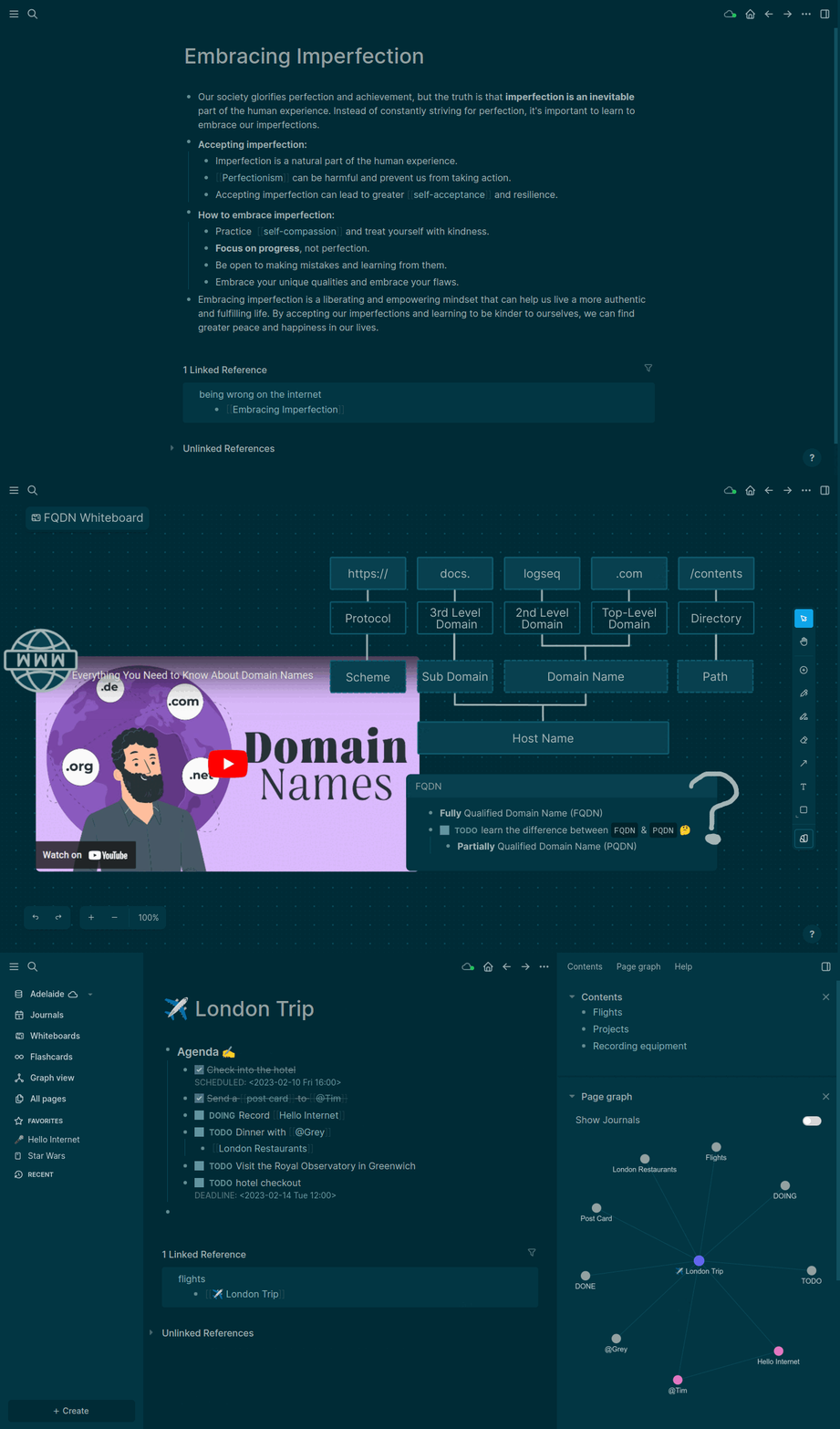
(( to embed any block from anywhere in your graph by reference, and edits propagate live to every embed — the closest free reproduction of Roam Research's transclusion model.[[double brackets]] and tags use #hashtag. Linked & unlinked references show up automatically at the bottom of every page, and the graph visualizer renders your entire knowledge web as an interactive force-directed network.#project/atlas on Tuesday, search the project page on Friday, and every Tuesday note shows up in chronological order — no manual filing needed.#card tag), a TODO/DOING/DONE task system with native query support, and PDF annotation that pins highlights back to a block in your notes — all shipped in the core app, no plugins required.{{query}} blocks let you build live dashboards ("all DOING tasks tagged #urgent"). Power users drop into raw Datalog for arbitrary structured queries across the entire graph..md or .org files plus an assets/ directory. Use Git, iCloud, Dropbox or Syncthing for free, or pay for the official end-to-end encrypted Logseq Sync.demo.logseq.com) lets you try the full app in a browser.
On Reddit's r/logseq and r/PKMS, the most upvoted threads frame Logseq as the de-facto free Roam Research alternative — users repeatedly praise the daily journal, block references, and the fact that the app keeps working forever even if the company disappears tomorrow. The Hacker News discussions when the DB version landed in 2025 highlighted Tienson's commitment to local-first storage as a real differentiator in a market drifting toward cloud lock-in.
The honest criticism is consistent. The mobile apps lag the desktop in polish — iOS has historically been slower and less stable than the Mac client, and Android still trails on the new DB version. The shift between the file-based 0.10.x branch and the DB-based 0.11.x rewrite has been bumpy, with users on the Logseq forum reporting plugin breakage and migration friction. And Logseq's outliner-everywhere design feels constraining if you want to write long-form prose — many power users on r/ObsidianMD say they keep both apps installed: Logseq for daily capture, Obsidian for finished writing.
The Logseq desktop and mobile apps are 100% free and open source under AGPL-3.0. The only paid product is the optional Logseq Sync service, which provides end-to-end encrypted multi-device sync.
| Plan | Price | Key Limits |
|---|---|---|
| Logseq (app) | $0 forever | All features, all platforms, no account, no telemetry |
| Logseq Sync (Open Collective tier) | $5/month | End-to-end encrypted sync across desktop and mobile |
| Sponsor tier | $15/month | Sync + experimental features and insider builds |
Best for: Researchers, PhD students, knowledge workers, and developers who want a Roam-style outliner without the $15/month subscription, who care about owning their data as plain files, and who like the daily journal as a primary capture surface.
Not ideal for: Long-form writers (look at Obsidian), team-collaboration use cases (use AFFiNE or Notion), or users who need first-class mobile parity today.
Pros:
Cons:
Obsidian — closed-source but more polished, better long-form writing, larger plugin ecosystem, $4/user/month for sync. AFFiNE — open-source Notion alternative with whiteboards and real-time collab, but heavier and database-backed. Roam Research — the original outliner with block references, but $15/month and cloud-only. AppFlowy — open-source Notion clone, more database-style than outliner-style.
For privacy-minded researchers, zettelkasten devotees and anyone who wants Roam Research's block-reference workflow without the subscription, Logseq is the best free choice on the market in 2026 — full stop. Skip it if you primarily write long-form prose, need polished mobile apps today, or work in a team that demands real-time collaboration. Our 84/100 reflects an outstanding desktop experience and an honest acknowledgement that the mobile and DB-rewrite stories are still works in progress.
ServiceNow and Accenture Launch Forward Deployed Engineering Program to Scale Agentic AI in the Enterprise (May 6, 2026)
At Knowledge 2026, ServiceNow and Accenture announced a joint forward deployed engineering program that drops co-located engineer pods into customer environments to ship agentic AI workflows natively on the ServiceNow AI Platform — with access to 300+ pre-built agent skills and the AI Control Tower as the governance backbone.
May 7, 2026
ReFiBuy Raises $13.6M Seed to Help Brands Get Recommended by AI Shopping Agents (May 5, 2026)
ReFiBuy, the Raleigh-based agentic commerce platform from ChannelAdvisor founder Scot Wingo, closed an oversubscribed $13.6M seed led by NewRoad Capital Partners on May 5, 2026 — betting that the next billion-dollar e-commerce moat is being chosen by ChatGPT, Claude and Perplexity.
May 7, 2026
OpenAI Replaces ChatGPT's Default Model With GPT-5.5 Instant — 52.5% Fewer Hallucinations, 30% Shorter Answers (May 5, 2026)
OpenAI on May 5 swapped GPT-5.3 Instant for the new GPT-5.5 Instant as ChatGPT's default model, claiming 52.5% fewer hallucinated claims on high-stakes prompts and 30% more concise answers. The model also rolls into the API as chat-latest and adds personalization from Gmail and past chats for Plus and Pro web users.
May 7, 2026
Is this product worth it?
Built With
Compare with other tools
Open Comparison Tool →