 Productivity
Raycast
Powerful macOS launcher and productivity platform — 7.3K GitHub stars for extensions
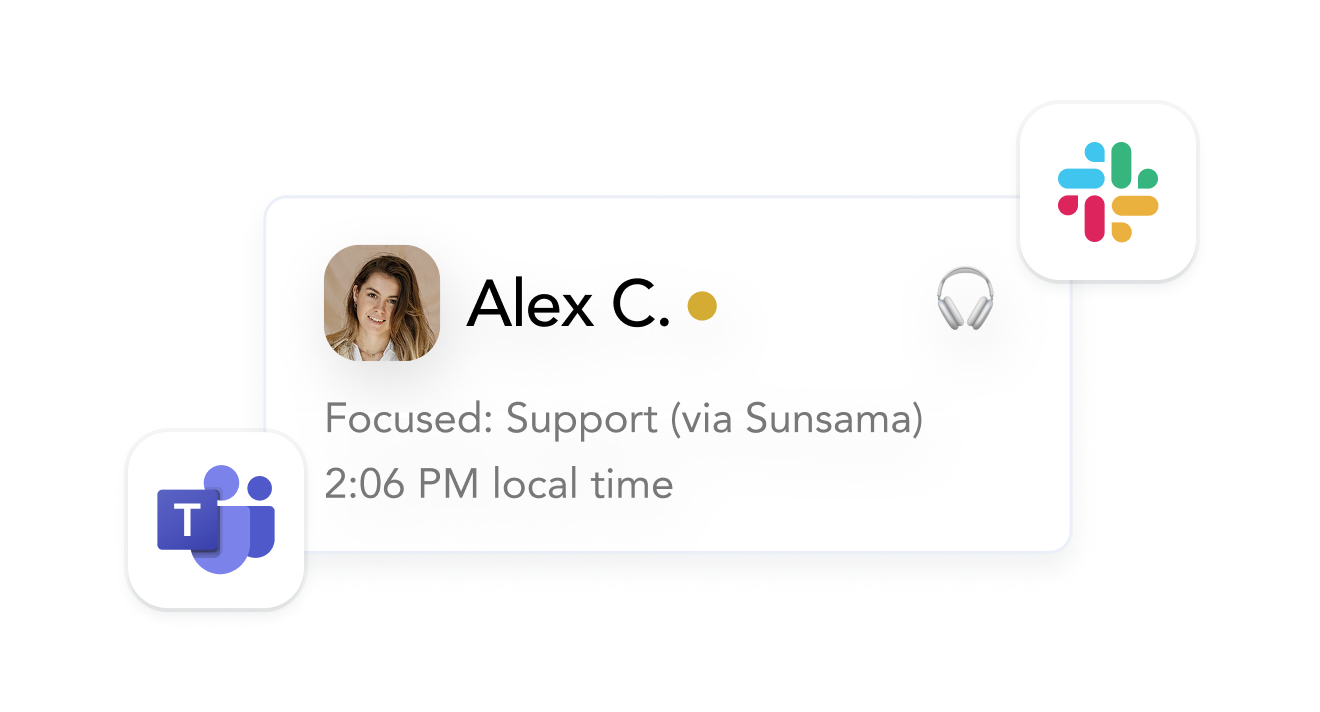
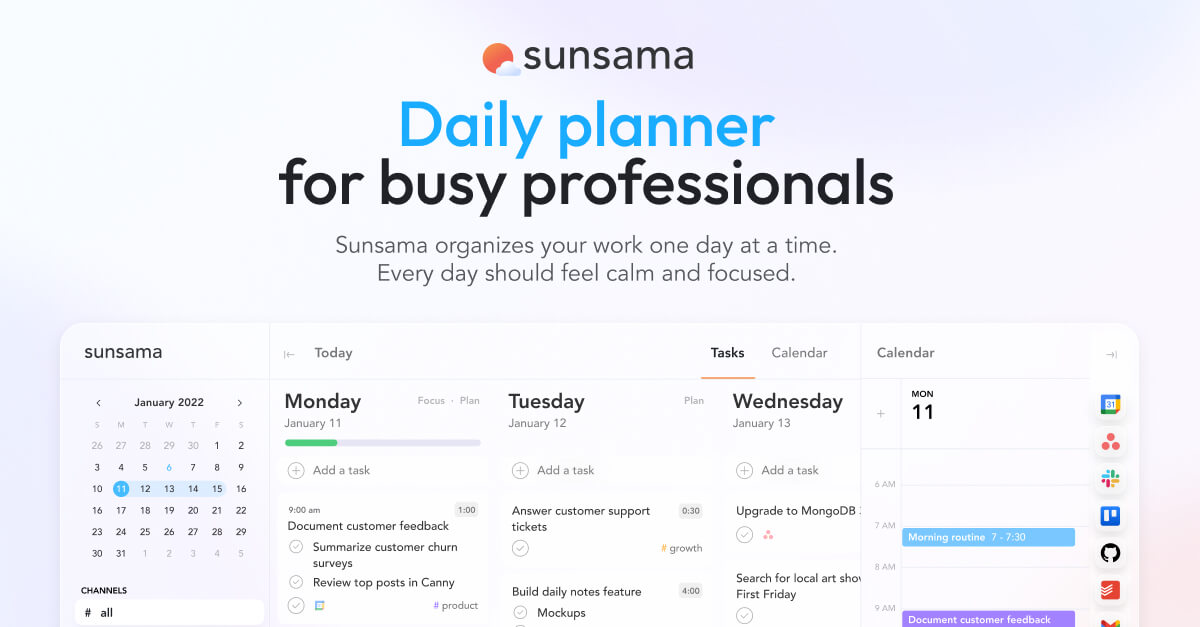
Sunsama is a mindful daily planner that merges your calendar, tasks, email and project tools into one guided ritual. At $20/month it is pricey, but for professionals who over-commit it is the most effective "stop and plan" app on the market.
Sunsama is a guided daily planner that merges your calendar, tasks, emails, and project tools into a single, intentional day — forcing you to plan, estimate, and shut down with ritualized check-ins. We rate it 82/100 — the best “stop-and-plan” app on the market for busy professionals, though the $20/month price tag and limited AI automation will turn off anyone hoping for Motion-style auto-scheduling.
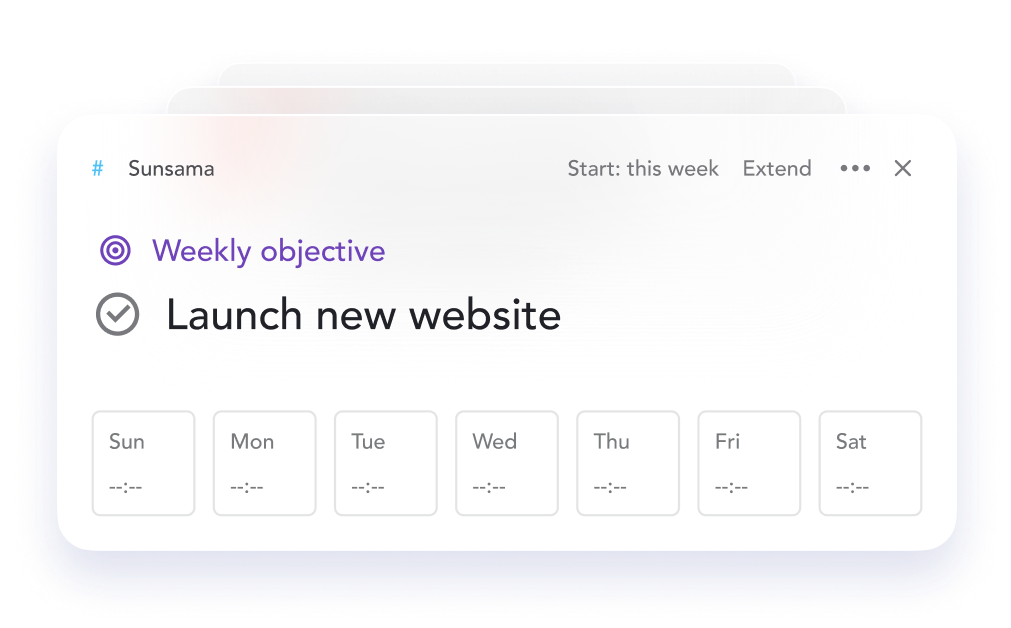
Sunsama is a digital daily planner for knowledge workers, built around one core philosophy: every day should start calm, stay focused, and end confident. Instead of being yet another to-do app, it is an opinionated ritual — each morning a guided planner walks you through picking a realistic list of tasks, time-boxing them onto your actual calendar, and defining what “done for today” looks like. Every evening a shutdown check-in asks you to reflect and roll over anything unfinished.
The company was founded in by Ashutosh Priyadarshy and Travis Meyer, went through Y Combinator W19, and relaunched as the modern Sunsama product in after a $2.4M seed round. Unusually for a venture-backed startup, the team has stayed small (around 9 people) and profitable — reporting about $1.5M ARR in 2024 without chasing further VC rounds. In The New York Times’ Wirecutter named Sunsama its pick for best scheduling app, which is the clearest signal yet that the category has moved from a cult favorite to a mainstream recommendation.


The reaction across Reddit, Product Hunt and Capterra is strikingly consistent: people who embrace the ritual become fierce evangelists, and people who want automation bounce off quickly. On r/productivity the single most upvoted Sunsama thread from the past year describes switching from Motion after dealing with “duplicated and vanishing tasks” and calling Sunsama “soooo much better.” Another long-time user summed it up as “the single best productivity app I’ve used.” On Capterra, reviewers repeatedly highlight the end-of-day shutdown as the feature that actually changed their working habits.
The honest criticism is equally consistent. The pricing is the loudest complaint — roughly $240 a year for what several Redditors describe as “a pretty to-do list.” The mobile apps are generally considered “fine for checking your plan, not for doing the plan,” with Android users noting they lag the iOS and desktop experiences. And, critically, Sunsama does not auto-reschedule your day when a meeting gets dropped in at the last minute — that is a deliberate design choice, but it means Motion fans will feel like they are doing extra manual work.
There is no free-forever tier. Sunsama’s pricing is explicit on this point — the company has publicly said it does not plan to add one. What you get instead is a generous 14-day trial of the full product with no credit card required.
| Plan | Price | Key Details |
|---|---|---|
| Free Trial | $0 for 14 days | Every feature unlocked, no card required |
| Pro (monthly) | $25/user/month | Unlimited usage, all integrations, AI + MCP + Zapier |
| Pro (annual) | $20/user/month ($240/year) | 20% saving vs monthly; same feature set |
| Enterprise | Contact sales | SSO, SAML, SCIM, audit logs, custom privacy requirements |
Best for: solopreneurs, founders, consultants, managers and knowledge workers who keep over-committing — people whose actual problem is not “I forget tasks” but “I have no idea whether this day is realistic.” If you live inside Google Calendar and ship work across Gmail, Slack, Asana and Notion, Sunsama is the forcing function that makes you stop, estimate, and commit.
Not ideal for: individual contributors who already have a working system in Todoist or Things, engineers who want the IDE/CLI experience, price-sensitive students, or anyone who explicitly wants AI to rearrange their day for them — Motion and Reclaim.ai do that job better.
Pros:
Cons:
The closest head-to-head is Motion, which uses AI to automatically schedule tasks around your meetings — better if you want automation, worse if you want calm ritual. Reclaim.ai is similar to Motion and free for individuals. Akiflow matches Sunsama’s unified-inbox approach and is a few dollars cheaper but without the same shutdown ritual. Amie is a beautiful calendar-first alternative popular among designers and creative professionals. For a free option, TickTick offers time-blocking without the guided planning layer.
For the narrow but large group of professionals who over-commit, feel reactive every day, and need a forcing function to actually plan and stop — yes, Sunsama is worth the $20/month. The ritual is the product, and the ritual genuinely changes how you work. For everyone else — developers who already live in an issue tracker, students, or anyone happy with Todoist — the price is hard to justify. Use the 14-day trial; you will know by day 4 whether the ritual clicks for you. We rate it 82/100: a very good, opinionated product that would be outstanding if it were half the price and had a real mobile app.
ServiceNow and Accenture Launch Forward Deployed Engineering Program to Scale Agentic AI in the Enterprise (May 6, 2026)
At Knowledge 2026, ServiceNow and Accenture announced a joint forward deployed engineering program that drops co-located engineer pods into customer environments to ship agentic AI workflows natively on the ServiceNow AI Platform — with access to 300+ pre-built agent skills and the AI Control Tower as the governance backbone.
May 7, 2026
ReFiBuy Raises $13.6M Seed to Help Brands Get Recommended by AI Shopping Agents (May 5, 2026)
ReFiBuy, the Raleigh-based agentic commerce platform from ChannelAdvisor founder Scot Wingo, closed an oversubscribed $13.6M seed led by NewRoad Capital Partners on May 5, 2026 — betting that the next billion-dollar e-commerce moat is being chosen by ChatGPT, Claude and Perplexity.
May 7, 2026
OpenAI Replaces ChatGPT's Default Model With GPT-5.5 Instant — 52.5% Fewer Hallucinations, 30% Shorter Answers (May 5, 2026)
OpenAI on May 5 swapped GPT-5.3 Instant for the new GPT-5.5 Instant as ChatGPT's default model, claiming 52.5% fewer hallucinated claims on high-stakes prompts and 30% more concise answers. The model also rolls into the API as chat-latest and adds personalization from Gmail and past chats for Plus and Pro web users.
May 7, 2026
Is this product worth it?
Built With
Compare with other tools
Open Comparison Tool →