


 AI Tools
Aider
AI pair programming in your terminal—free, open-source, any LLM
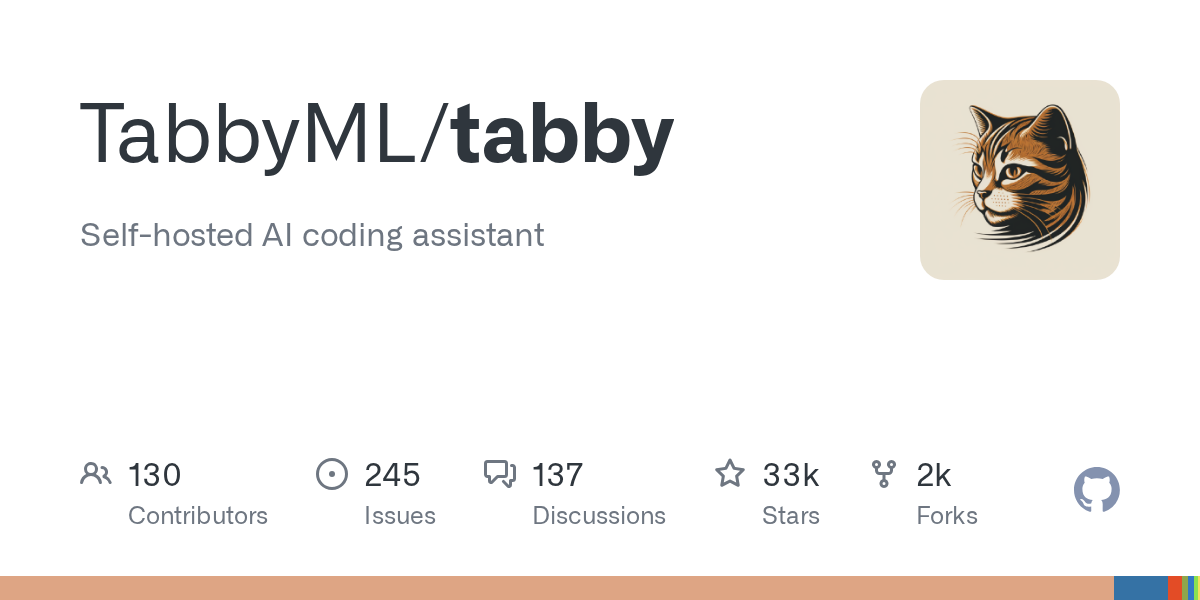
Tabby is 2026's most polished open-source, self-hosted AI coding assistant — a private Copilot replacement with completion, chat, and codebase RAG.
Tabby is an open-source, self-hosted AI coding assistant built by TabbyML — a private alternative to GitHub Copilot, Cursor, and Tabnine that runs entirely on hardware you control. We rate it 86/100: it is the most complete self-hosted Copilot replacement we have tested in 2026, and the right pick for security-conscious teams that cannot ship code to a third-party AI service.
Tabby is a self-contained AI coding platform that bundles three things into a single binary: a code-completion engine, an in-IDE chat ("Inline Chat"), and an Answer Engine that retrieves context from your own repos, docs, and issues. It is built by TabbyML, Inc., the YC-backed startup that raised a $3.2M seed in October 2023. The first commit landed on , and the project debuted on Hacker News in April 2023 with a 627-point Show HN. The repo at TabbyML/tabby currently sits at 33,477 stars and 1,743 forks, and the latest stable release is v0.32.0, shipped on .
What separates Tabby from generic inference servers like Ollama or vLLM is that it is purpose-built as a Copilot replacement. You get an admin dashboard, team management, IDE plugins for VS Code, JetBrains, and Vim, OAuth/SAML SSO, a code-context indexer that ingests your private GitHub or GitLab repos, and a built-in RAG pipeline — all in one Docker container. No external database, no cloud account, no telemetry leaving your network.

docker run -p 8080:8080 tabbyml/tabby and you have the full stack running.
Sentiment is mostly positive among self-hosters but realistic about trade-offs. The 627-point Show HN thread on Hacker News in April 2023 praised the project for being a "real" self-hosted Copilot rather than a research demo, and the follow-up 366-point thread in January 2025 noted a clear quality jump after Tabby added its Answer Engine. On r/selfhosted and r/LocalLLaMA, top-voted posts call Tabby "the only self-hosted Copilot that actually works on a real codebase," and admins point to the dashboard and SSO as why it survived a security review when generic Ollama setups didn't.
The recurring complaints are honest. Out-of-the-box completion quality with a 1B or 7B local model is noticeably below GitHub Copilot — reviewers at Sider and ML Journey both call this out. You need either a larger model (and the GPU to match) or to wire Tabby up to an OpenAI-compatible endpoint to close the gap. The project also moves fast: minor versions occasionally break Docker image tags, and the v0.32 release notes still list "v0.x" — there is no 1.0 yet, which is a fair concern for risk-averse buyers. Finally, the GitHub license is technically "Other" (a custom Apache-2-with-noncommercial-clauses for some hosted features), which trips up some compliance teams.
Tabby is dual-licensed: the source code is open and free to self-host, with paid plans for managed deployments and enterprise features.
| Plan | Price | Best For |
|---|---|---|
| Community | Free / Open Source | Up to 5 users, local deployment, code completion + chat + Answer Engine + Context Provider. |
| Team | $19 / user / month | Up to 50 users, flexible deployment, growing engineering teams. |
| Enterprise | Custom (contact sales) | Unlimited users, customized deployment, enhanced security, group management. |
Hardware cost is on you for self-hosting: budget roughly $1,500–$2,500 for an RTX 3090 or 4090 if you want a serious 7B–13B model serving 5–10 developers comfortably.
Best for: Engineering teams at security-conscious companies (finance, healthcare, defense, government) where shipping source code to a third-party AI is a non-starter. Also: small teams with existing GPU hardware who don't want per-seat Copilot bills, and tinkerers who actually enjoy running their own AI stack.
Not ideal for: Solo developers who just want the best completions out of the box — Cursor or Copilot will be faster, smarter, and cheaper than buying a GPU. Also a poor fit for teams without anyone willing to own GPU drivers, Docker, and model-management problems.
Pros:
Cons:
The closest alternatives are Continue, an open-source IDE extension that brings your own model (we reviewed Continue), and Cody by Sourcegraph, which has stronger codebase search but is not as cleanly self-hostable. GitHub Copilot ($10–$19/seat) wins on raw completion quality but ships your code to Microsoft. For the no-IDE crowd, Aider is the terminal-native option that pairs nicely with local models via Ollama.
If your company will not let you use Copilot or Cursor — or you are an OSS purist who refuses on principle — Tabby is the best self-hosted answer in 2026. Pair it with DeepSeek-Coder or Qwen 2.5 Coder on a single 24 GB GPU, point it at your private GitHub org, and a five-person team gets a Copilot-shaped experience for the price of one used 3090. We rate it 86/100: not the best AI coding assistant, but the best one you can run entirely on your own metal.
AI ToolsAI pair programming in your terminal—free, open-source, any LLM
 AI Tools
Open-source Python web crawler for LLMs, RAG and AI agents
 AI Tools
Open-source, extensible AI agent that goes beyond code suggestions — desktop app, CLI, and API for any LLM
 AI Tools
All-in-one open-source AI app to chat with your docs, run agents, and connect any LLM — local-first.
ServiceNow and Accenture Launch Forward Deployed Engineering Program to Scale Agentic AI in the Enterprise (May 6, 2026)
At Knowledge 2026, ServiceNow and Accenture announced a joint forward deployed engineering program that drops co-located engineer pods into customer environments to ship agentic AI workflows natively on the ServiceNow AI Platform — with access to 300+ pre-built agent skills and the AI Control Tower as the governance backbone.
May 7, 2026
ReFiBuy Raises $13.6M Seed to Help Brands Get Recommended by AI Shopping Agents (May 5, 2026)
ReFiBuy, the Raleigh-based agentic commerce platform from ChannelAdvisor founder Scot Wingo, closed an oversubscribed $13.6M seed led by NewRoad Capital Partners on May 5, 2026 — betting that the next billion-dollar e-commerce moat is being chosen by ChatGPT, Claude and Perplexity.
May 7, 2026
OpenAI Replaces ChatGPT's Default Model With GPT-5.5 Instant — 52.5% Fewer Hallucinations, 30% Shorter Answers (May 5, 2026)
OpenAI on May 5 swapped GPT-5.3 Instant for the new GPT-5.5 Instant as ChatGPT's default model, claiming 52.5% fewer hallucinated claims on high-stakes prompts and 30% more concise answers. The model also rolls into the API as chat-latest and adds personalization from Gmail and past chats for Plus and Pro web users.
May 7, 2026
Is this product worth it?
Built With
Compare with other tools
Open Comparison Tool →