 Productivity
Raycast
Powerful macOS launcher and productivity platform — 7.3K GitHub stars for extensions
Heptabase is a visual, card-based knowledge base that lets you organise and connect ideas on infinite whiteboards. Best-in-class for synthesising research and complex topics.
Heptabase is a visual, card-based knowledge base built for students, researchers, and lifelong learners who think on infinite whiteboards rather than nested folders. We rate it 84/100 — it is the best dedicated tool for synthesising messy research into a connected understanding, provided you are willing to pay a real subscription for it.
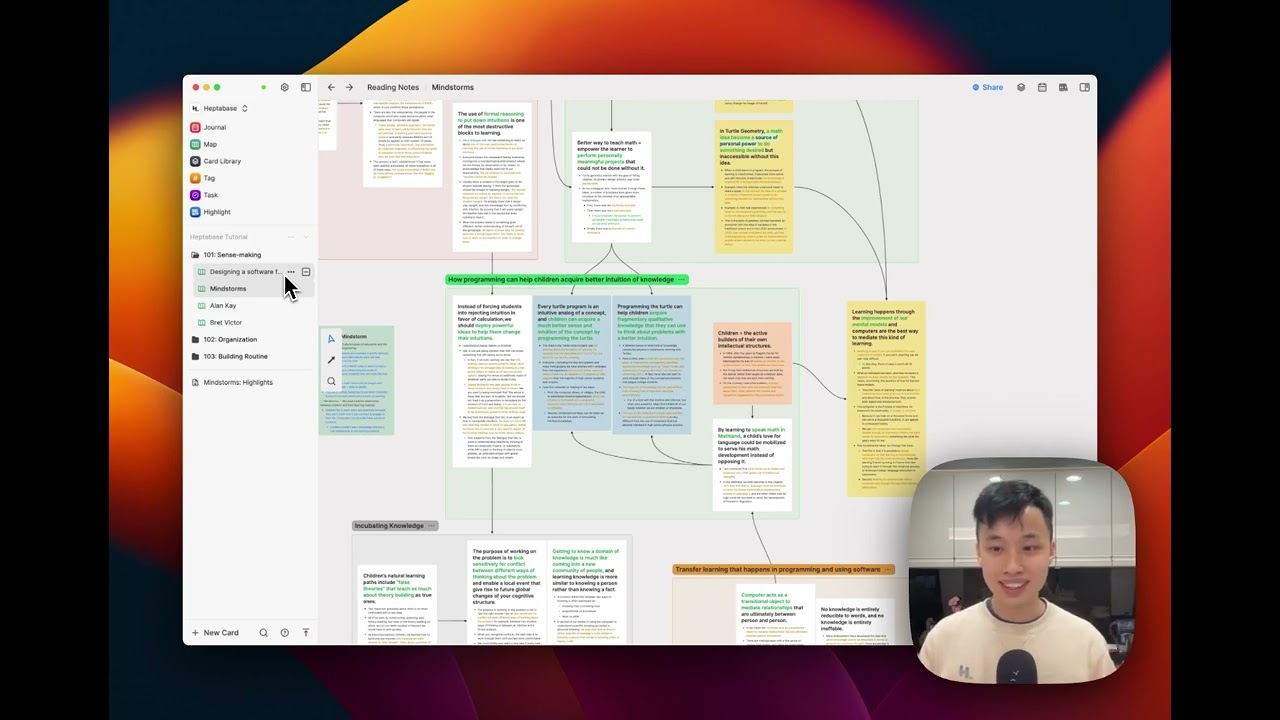
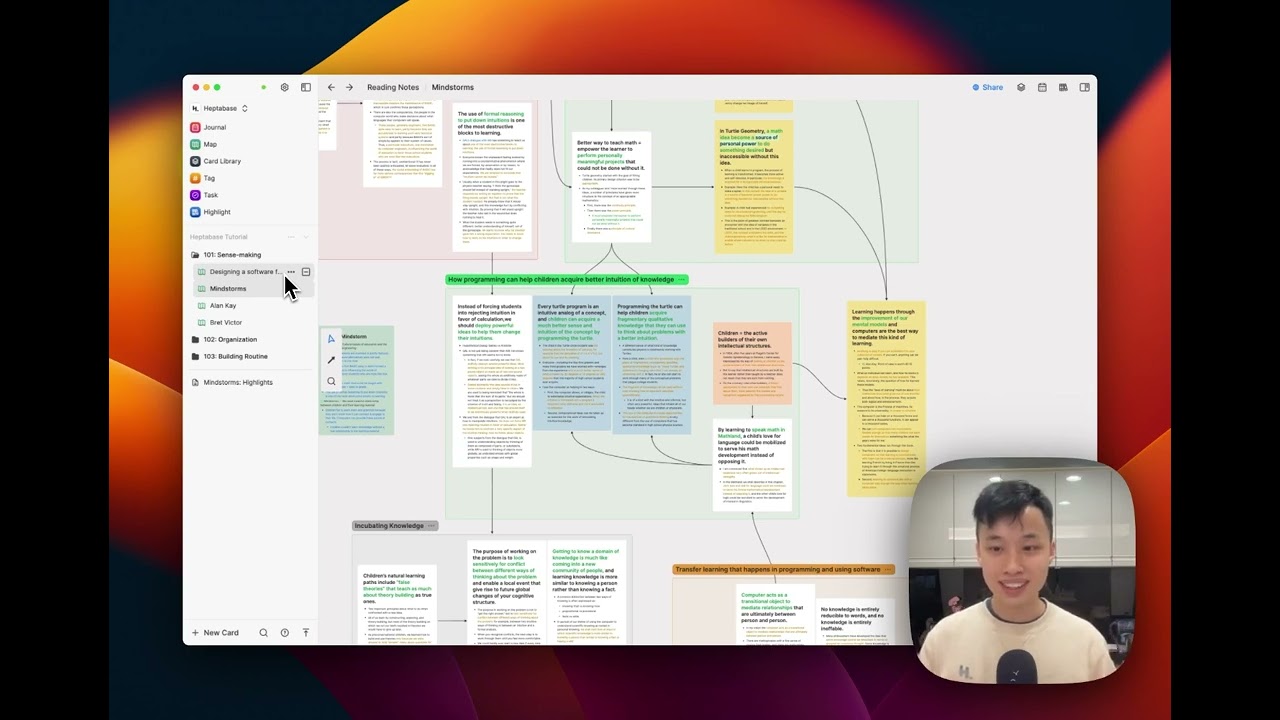
Heptabase was founded in May 2021 by Alan Chan, Yeefun Lin, and Ethan Wu, went through Y Combinator, and has remained bootstrapped while reportedly crossing $200K in monthly recurring revenue on the strength of a fiercely loyal user base. The product is a Markdown-compatible card editor sitting on top of an infinite spatial whiteboard, with bi-directional links, journal entries, tags, PDF and YouTube highlighting, and offline-first sync across desktop and mobile.
Where most note apps optimise for capture, Heptabase optimises for the second step — taking the cards you already wrote, dragging them onto a whiteboard, grouping them, drawing arrows between them, and watching the structure of an idea actually appear. That spatial layer is the entire pitch, and it is the reason people switch to it from Obsidian, Notion, or Roam.
Sentiment on Reddit's r/Heptabase and r/ObsidianMD is unusually positive for a paid PKM app. The most-upvoted comparison threads describe Heptabase as "a more stable, predictable experience" than Obsidian plugin stacks, and praise the developers for shipping hundreds of small improvements based on community feedback. Product Hunt reviewers single out the whiteboard model as "the missing layer above notes" that they did not realise they needed.
The complaints are real and recurring. Multiple users report lag on whiteboards with thousands of cards, especially when those cards contain large PDFs, and the to-do handling is widely regarded as the weakest part of the app. A common gripe in 2026 is that the in-app upgrade prompts and resubscription dialogs feel intrusive when you are simply revisiting old notes. None of this is a deal-breaker — it is the texture of using a young, opinionated product.
Heptabase has a 7-day free trial and three paid tiers. All tiers can be billed monthly or annually, with a 25% discount on annual billing.
| Plan | Price (monthly) | Key Limits |
|---|---|---|
| Pro | $8.99/month | Unlimited notes, whiteboards, tags, image uploads, collaborator invites; PDF highlights and YouTube transcripts; AI features trial with 100 AI credits/month |
| Premium | $17.99/month | Everything in Pro plus unlimited PDF uploads and OCR, unlimited basic AI chats, AI Tutor, 1,800 AI credits/month |
| Premium+ | $53.99/month | Everything in Premium plus 8,100 AI credits/month and a 33% discount on additional AI credits |
Best for: graduate students writing literature reviews, researchers synthesising findings across dozens of papers, non-fiction writers building up an argument from sources, and visual learners who think in maps rather than outlines.
Not ideal for: people who just want a fast capture inbox or a daily journal — a plain Markdown app or Apple Notes is faster. Teams that need granular permissions, comment threads, and admin controls should look at Notion or Coda instead. Anyone who needs a serious task manager will find the to-do system underbuilt.
Pros:
Cons:
For a free, local-first option with a giant plugin ecosystem, see Obsidian. For an outline-and-database hybrid, Notion remains the default. For block-based, open-source alternatives, look at AFFiNE, Anytype, and Logseq. None of them replicate the spatial whiteboard layer that defines Heptabase.
If you do serious thinking on paper or whiteboards and have ever wished your notes lived on a canvas instead of a sidebar, Heptabase is worth the $8.99/month Pro tier on its own. The Premium and Premium+ tiers are harder to justify unless you actively use AI Tutor or process large volumes of PDFs. We rate it 84/100 because the core idea is executed better than any competitor we have tested, and the developers ship constantly — but performance on very large knowledge bases and a thin task layer keep it out of the 90s. As of , this remains the visual PKM tool to beat.
ServiceNow and Accenture Launch Forward Deployed Engineering Program to Scale Agentic AI in the Enterprise (May 6, 2026)
At Knowledge 2026, ServiceNow and Accenture announced a joint forward deployed engineering program that drops co-located engineer pods into customer environments to ship agentic AI workflows natively on the ServiceNow AI Platform — with access to 300+ pre-built agent skills and the AI Control Tower as the governance backbone.
May 7, 2026
ReFiBuy Raises $13.6M Seed to Help Brands Get Recommended by AI Shopping Agents (May 5, 2026)
ReFiBuy, the Raleigh-based agentic commerce platform from ChannelAdvisor founder Scot Wingo, closed an oversubscribed $13.6M seed led by NewRoad Capital Partners on May 5, 2026 — betting that the next billion-dollar e-commerce moat is being chosen by ChatGPT, Claude and Perplexity.
May 7, 2026
OpenAI Replaces ChatGPT's Default Model With GPT-5.5 Instant — 52.5% Fewer Hallucinations, 30% Shorter Answers (May 5, 2026)
OpenAI on May 5 swapped GPT-5.3 Instant for the new GPT-5.5 Instant as ChatGPT's default model, claiming 52.5% fewer hallucinated claims on high-stakes prompts and 30% more concise answers. The model also rolls into the API as chat-latest and adds personalization from Gmail and past chats for Plus and Pro web users.
May 7, 2026
Is this product worth it?
Built With
Compare with other tools
Open Comparison Tool →